Frank Mulvaney
Fictional. Generated by AI — not a real person, and no likeness of one is intended.
55, retired in New York · rolled by @connor.waskiewicz · card — no film
History
who has worn him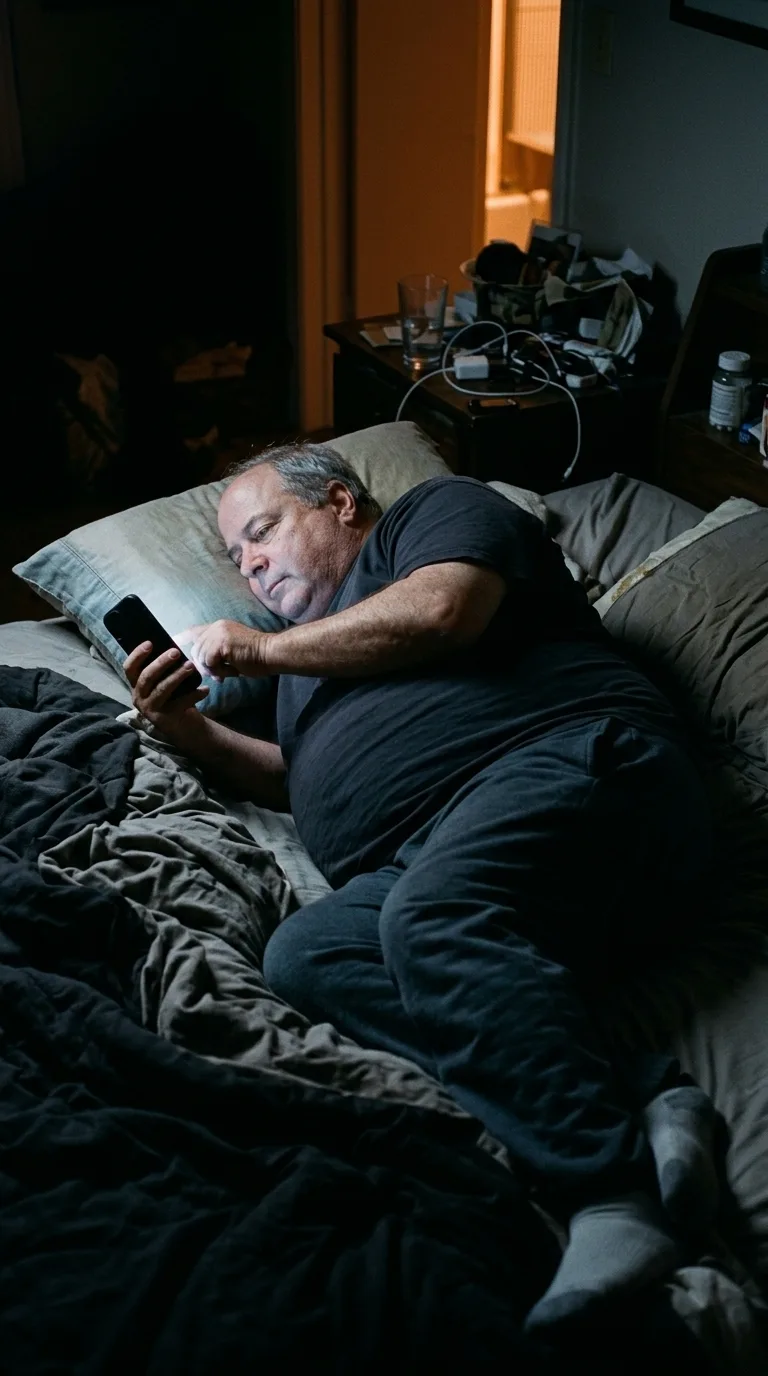
Rarest thing about him: Touches his face — common, 1 in 21
Season 1seed 147806826 · engine v11
Character card
lineage 2NZHHJ
His body-swap story
@connor.waskiewicz, wearing Lonnie Peebles, rolled the wheel on and woke up as Frank Mulvaney, spent under a minute in him, then spun the wheel and woke up as Fadi Haddad
You are still Lonnie Peebles when you decide, and Lonnie's knees are the reason. There is a loose tile in the kitchen, and a job he never got called back for. Under all of that, there is the quiet fact that for under a minute you were a man whose chest was thick with someone else's sorrow. You wanted nothing from it. The room had a radiator that knocked and a coat on a hook that was not yours. You stood in the dark hall with your shaved head in your palm and thought: not this one. The page is already open. The wheel turns and clicks, and you let it.
Light. A cheek lit blue. The phone is six inches from your eyes and your thumb is mid-stroke on a bright wall of other people's days. A bed takes your weight sideways, heavy, one arm folded under the pillow gone numb. You flick. The thumb is surer than you expected, and it keeps going past things he had stopped for.
Then the cloth touches you. The black T-shirt is soft from a thousand washes, and it lies on your belly, rising and falling. It gives you a morning: his hands, thick in the fingers, pushing the head through the collar in a bedroom with the shade up. Years back. Three kids' school photos on the dresser, and he hums, off-key, something from church. The cuffs of the sweatpants gather at your ankles, and the knowledge of a hundred such nights comes with them: lying here after the house went quiet, because quiet is when the long afternoons catch up.
Your free hand drifts up and touches your face, the jaw smooth and freshly shaved, though it is the middle of the night. It is a habit of his. He shaved for no one. He shaves every evening because the old girlfriend once said she liked his face best bare, and thirty years have not talked him out of it. There is a flash of her laugh in a kitchen, a screen door, a summer. It aches in a place under the ribs that is entirely his.
The phone is warm. In its glass you see his freckles, scattered across the nose and cheeks like spilled pepper. Under the thumb, a name: Tevita. A thread of messages. You know that name. You were Tevita a short while ago, and you know the assembly line and the cleft chin. Now you feel the other side of it: the friend who has texted him twice a week for fifteen years, the dumb jokes, the Giants scores, the promise of a visit. He never said how much it mattered. The message waiting is unanswered, and he meant to answer it tomorrow.
The mattress dips. The back aches in its low familiar place. The lungs are heavy and slow, an ex-smoker's lungs, and for a moment your mouth tastes the ghost of a cigarette he quit in a hospital parking lot. Money sits somewhere behind it all, a quiet, unspent comfort, and nobody to spend it on.
You lower the phone. You turn your hand over in the blue light, thick, freckled across the back, a wedding-less finger, and it is yours.
You look up and say, to the dark, in a voice with Brooklyn worn smooth into it, "Okay, Frank." It is the first time you have said the name. Somewhere in you, already, is the question of how long.