Frank Dziedzic
Fictional. Generated by AI — not a real person, and no likeness of one is intended.
39, contractor in Pittsburgh · rolled by @connor.waskiewicz · card — no film
History
who has worn him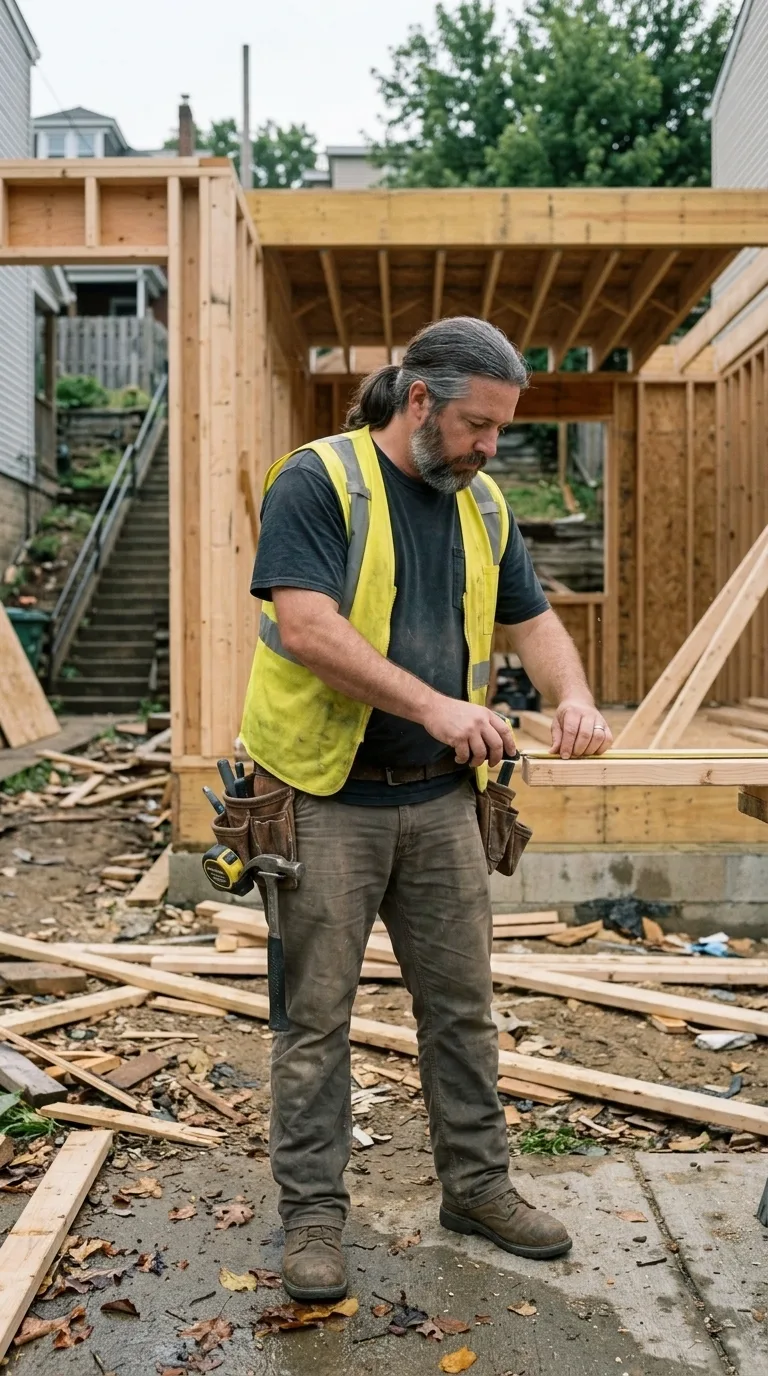
Rarest thing about him: A ponytail — common, 1 in 155
Season 1seed 335387411 · engine v11
Character card
lineage 2NZHHJ
His body-swap story
@connor.waskiewicz, wearing Vincent Tran, rolled the wheel on and woke up as Frank Dziedzic, spent under a minute in him, then spun the wheel and woke up as Neil Brannigan
You are standing in a bus driver's kitchen in New Orleans, and the coffee is already going cold in Vincent Tran's hand. The dimples are still in his face. His shoulders are wide, and you have only worn them for a few minutes. Outside, the street is blue and quiet, and a garbage truck is grinding two blocks away.
There was nothing wrong with him. That is what you cannot say aloud, even in an empty kitchen. A body that worked, a license, a route, a uniform on a hanger by the door. You pressed your thumb against the pad of his index finger and felt his whole life offer itself, orderly and warm and a little dull, and you wanted to be someone whose life you did not understand yet. Not out of hunger. Out of something quieter, the way you reach for a drawer you have already opened. The page is open on the counter. The wheel is waiting. You pay, and you spin.
The wheel slows, and there is no ticking, no falling. A tape measure is sliding under your thumb.
You are mid-motion. A pencil is in your right hand and a two-by-four lies under your left, edge cold and rough, and you have just made a mark in the wrong place. Your hand knows it before you do. It stops, and then it goes back and makes the mark again, slowly, on the line. The air is thick with sawdust and wet leaves and the green smell of fresh lumber. Your breath comes slower than the last man's. Your center of gravity sits lower, thicker through the middle, and your feet are planted wide in boots that have already been broken in around someone else's toes.
Then you check the cut. And the next one. And the next. Ten of them, each measured twice, on a job your hands could do blind.
Your thumb finds a ring on your left hand and turns it, a plain band, worn smooth on one side. That is where it begins.
The vest first: the zipper pull cold against his chest, and a kitchen, dark, before light. A woman's voice from the stairs asking if he found his other glove. He did not answer, because he was looking at the three lunch bags lined up on the counter, one with a dinosaur on it. He zipped the vest to the sternum. He always leaves it open now, because it digs when he bends.
The shirt, soft with washing, collar stretched. He pulled it on in the dark over his head, and the smell of detergent was hers, and he stood a moment with his arms still up, not wanting to move. Then the pants, stiff at the knees with dried glue. The belt, which he cinched a notch looser than last year. The pouch clinks against your hip and the hammer handle taps your thigh, and the tapping brings a different afternoon: a rented house, a basement stairwell he framed himself, his daughter's small hand flat against the new rail, saying it doesn't wobble, Dad, and him saying no, it doesn't. It was the proudest he has ever been of anything, and he told no one.
Your tongue finds the beard's edge. Your fingers go to the ponytail, to the dark dye that has never quite matched, and a bathroom mirror flashes up: him at thirty-nine, a box of color on the sink, laughing at himself because the gray at the temples always wins. Under the laugh is another feeling, small and sour. The girl before his wife. The recent one. A name he does not let himself think. A phone he turns face-down at night. You feel the guilt in his stomach like a swallowed nail, and then it passes, and you do not know what he did or did not do.
Your back aches low on the left. The knees complain when you shift. The arms, though, are strong, shorter than you are used to but dense, with real work in them. They want to lift something. The freckles on your cheeks itch under the cold wind. A beer waits at the end of every shift, then maybe a second, and the quiet of a kitchen with everyone asleep. There is almost no money, and the numbers sit in his chest like a stone he carries up the public stairs between the yards every night.
You look at your hands. The left one wears the ring. You turn it over, palm up, rough and square and freckled to the knuckles, scarred only by use. They belong to a man who is no longer behind them.
You lift your eyes to the gray morning and the half-built walls.
"Well," you say, in his low voice, "let's see how long you last."