Frank Dunnigan
Fictional. Generated by AI — not a real person, and no likeness of one is intended.
54, soldier in Los Angeles · rolled by @justin.moy · card — no film
History
who has worn him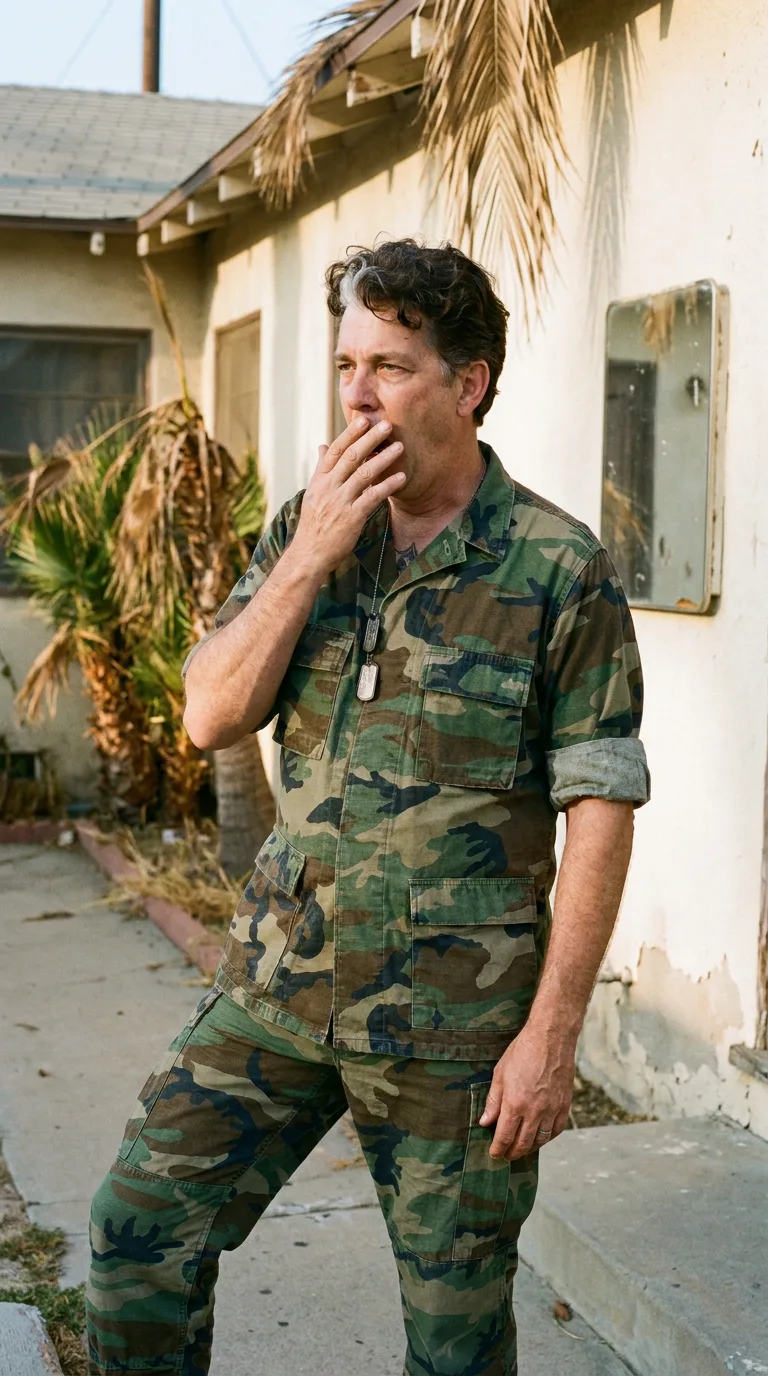
Rarest thing about him: A white streak in the hair — epic, 1 in 106
Legacyseed 1473046949 · engine v8
Character card
His body-swap story
---
You have watched him for eleven mornings and you don't know his name.
That's the strange part, if strangeness still means anything to you. You know the shape of his week. You know he comes out of the ground-floor unit at ten past five with his boots already laced, because he laces them sitting on the edge of the bed so as not to wake her, and you know that he stands in the courtyard a while before he goes anywhere, under the dead palm fronds, because inside the apartment there are two grown kids' worth of photographs on the wall and neither of them calls. You know he stopped smoking nine years ago and still puts two fingers to his mouth when he's thinking. You know there's a mirror bolted to the stucco out there — some previous tenant's idea, or a landlord's, to make the courtyard look wider — and its glass has gone foxed and silvered at the edges like an old tooth, and he doesn't look at it. Eleven mornings. He has not once looked at it. That's how you knew he'd be easy. A man who won't check his own reflection has already handed over something.
You don't know how you get in. Nobody does. You've stopped pretending it's a skill.
What you know is wanting, and you have wanted a body for so long that the word has worn smooth in your mouth. Not a young one. You learned young ones early: too much noise in them, too much future crowding the doorway. You wanted one that had already spent itself down to the bone and kept walking. Something with mileage. Something that had been used for a purpose and then set aside.
He is that. Fifty-four and six foot one and average through the middle, the build of a man who was hard once and is now merely durable. The hair is the tell, the thing you'd notice from across a parking lot: dyed a flat lifeless brown that fools nobody, gray coming up at the temples and pushing out at the roots, curls left full on top and cut down close at the sides, and running through the front of it a single white streak. He didn't dye that. Or he tried and it wouldn't take. Either way it's the one honest inch of him and it's the reason you chose this one out of a city of nine million tired men. A body that insists on telling the truth in one small place. You could love that. You do, in the way you love things you intend to keep.
Under the collar, when the shirt gapes: a unit insignia inked over the chest, faded to the blue-green of old newsprint. Dog tags on a ball chain that he wears out of habit the way another man wears a saint's medal, and there is a saint's medal too, somewhere, Catholic all the way down even if he only goes at Christmas and when somebody dies. On the left hand a plain band, worn thin on the inside. Not much else. No money to speak of — under five thousand dollars to a man's name at fifty-four, and a heart that a doctor has already drawn on a chart for him, arteries sketched in ballpoint, *we're going to want to keep an eye on this.*
You know all of that and you don't know what he's called. You'll find it on the mail.
Here is what you want him for, since somebody should say it plainly.
You want the weight. You want to feel a knee complain going down a curb. You want the taste of coffee gone cold in a stucco courtyard while the sun comes up orange over a shingled roof and the palm fronds rattle like paper. You want to be looked at by a woman who has been looking at the same face for twenty-six years and to be recognized. You want to stand in a formation of men in the pale hour before the day gets hot and belong to them by paperwork alone. You want a heart that might quit. You have never had anything that could stop. Everything you've ever been is a wanting without an off switch, and the mercy of a bad heart — that is not a thing you can explain to the living.
There is also this, and you'll admit it once: he thinks about a woman who is not his wife. Not constantly. On mornings like this one, standing under the palm, he goes somewhere for about forty seconds and comes back, and he never says her name out loud, so you don't have it either. The one that got away. Every man his age is carrying one; his is heavier than most. You have wondered whether the wanting in him would be there when you got inside, waiting like furniture in a rented room. You suspect it will be. You suspect it's the only room in there you'll actually recognize.
The eleventh morning.
Six o'clock, near enough. Sun already coming low along the wall, catching the dry palm and turning the stucco the color of a peach. He steps out into it and stops with his hands empty and nothing behind him but the mirror, and he yawns — a real one, jaw wide, eyes crushing shut, one hand going up to cover it the way his mother taught him fifty years ago. His shoulders lift. The dog tags shift on his chest.
You go in on the yawn. It is the only door a man ever leaves standing open.
He finishes it. His hand comes down halfway and he rubs one eye with the heel of it, hard, the way you do when you're deciding whether the day is real. And then the hand stops. Stays up. There's a half-second there where nothing is driving, where the arm just hangs in the air like a raised gate, and if his wife were watching from the window she'd think he'd heard something.
The hand lowers.
The eyes that come out from behind it are mine.
They go straight to the mirror. Of course they do — I've been waiting eleven mornings for something he wouldn't look at. The glass is foxed and cheap and it gives me back a big man in old camouflage with the sun on one side of his face, and there, at the front of all that dyed brown hair, a white streak burning like a filament.
Frank Dunnigan. That's the name on the mail.
There's no way back out of this and no clock on it. I didn't ask for one. I hold up his left hand — my left hand — and turn it over, palm, back, palm, and the band catches the light. Somebody's still asleep sixteen feet behind that wall. In twenty minutes I'll be standing outside a barracks in the gray with men who'll call me by his last name, and I will answer to it, because I am going to answer to it for the rest of a life that has a bad heart in it and four thousand dollars and two children who don't call.
Good. Let it be short. Let it be heavy. Let it be mine.
The palm rattles overhead. The white streak is the only thing in the mirror that isn't lying.