Francis Lonetree
Fictional. Generated by AI — not a real person, and no likeness of one is intended.
59, accountant in A monastery · rolled by @declan.michael.farrow · card — no film
History
who has worn him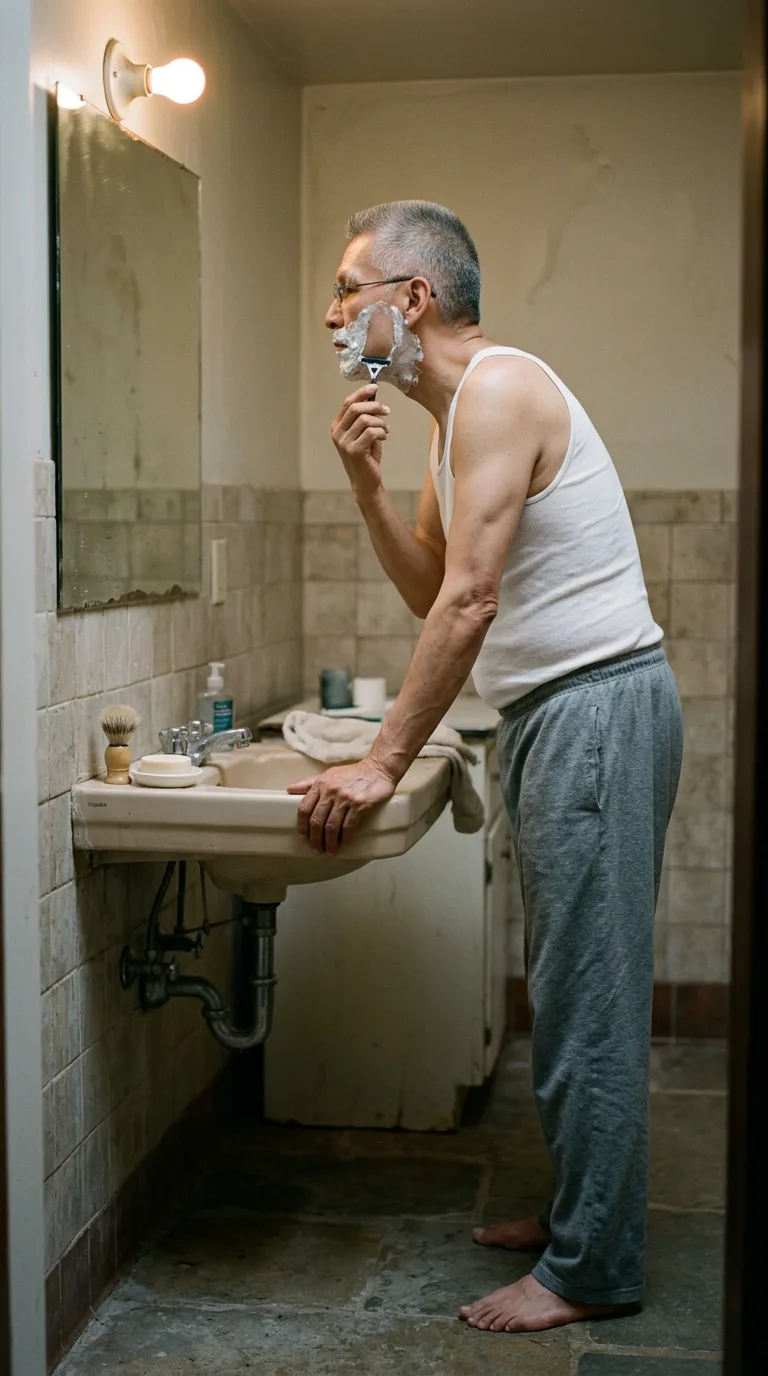
Rarest thing about him: A monastery — legendary, 1 in 1,661
Season 1seed 495650842 · engine v11
Character card
lineage 5OR92V
His body-swap story
@declan.michael.farrow, wearing Anthony Rahul Marchetti, rolled the wheel on and woke up as Francis Lonetree, spent 1 minute in him, then spun the wheel and woke up as Terrence Oyelaran
You have been Anthony Marchetti for one minute, and already you know what is wrong with him. He is nothing. He is a machine operator's shoulders and a blue-eyed stare, and the wanting in you has come up through him like damp through a wall. The end of the day is in his windows. His kitchen smells of someone else's onions. You stand there with his once-broken nose and his stubble and think: not this one. Not because he failed. Because he is the same as the one before, and the one before that, and you have the number of them in your chest like a stone. A hundred and twenty-two. The page opens. The wheel turns, and you let it.
Cold stone under your bare soles. The razor is against your jaw, stopped, and the foam is cooling on half your face. You are bent over a sink with your weight on one hand, and the bulb by the mirror is hot on your temple. Your breath fogs a little in the corner of the glass. Nothing has arrived. You are simply here, mid-stroke, in the second he was in.
The sink edge is cold porcelain under your palm, and it gives you something: a basin in a stone room, a bell, a line of men filing past a window white with fog. He lives among them. The rope of a morning bell is rough in a memory of this same palm. Then the razor handle, plastic, worn at the thumb, and a flash of the shaving brush, badger, a gift, a woman's voice saying you'll cut yourself to ribbons with those disposables, Frank, and her laugh, and the long unfinished ache of her. She was the one he did not marry. He is fifty-nine and still hears her.
The singlet is thin cotton, washed soft, and it has the morning in it. His arms went up through it in the dark before the first bell. He did his buttons by feel, then did not, because this is the hour for the razor. The sweatpants hang from his hip bones and his belly pushes the waistband: soft in the middle, thin in the arms, a man who sits. Your lower back aches the way it does after nine hours at a desk. Two monitors. A column of figures that will not close. Fluorescent hum behind the eyes. His fingers know the ten-key without being asked, and they tremble faintly on the razor, because under pressure they always did. A stutter lives in them. He speaks the same way, catching on the first consonant when a partner leans over his desk.
The scar in your eyebrow tugs when you frown. A fall from a bike on gravel, age nine, his mother's wet cloth, the taste of the creek. He kept the hair cropped so the scar would show. He smoked for twenty years and quit; your lungs remember it, a tightness, a pride. Rosary beads in the cardigan on the hook behind the door, though you do not touch them. A Catholic's quiet. Money in an account that no one will inherit.
The razor moves. Up the jaw against the grain, and at the corner of the mouth, where he always slowed, you do not. The second half goes faster than the first. Smooth skin, clean air on it.
You set the razor on the porcelain and turn your hand over under the bulb: brown, knuckled, dry, the nails clipped square. Then you lift your eyes to the mirror, to the scar and the foam-free jaw, and you say, steadily, with no stutter at all, "Well. Hello, Frank."
How long does a man last? Until the wanting comes back, and it is already somewhere behind the ribs, small and patient. You will find out when it speaks.