Firas Nazari
Fictional. Generated by AI — not a real person, and no likeness of one is intended.
34, spray painter in High-desert Nevada · rolled by @colin.hasbrook · card — no film
History
who has worn him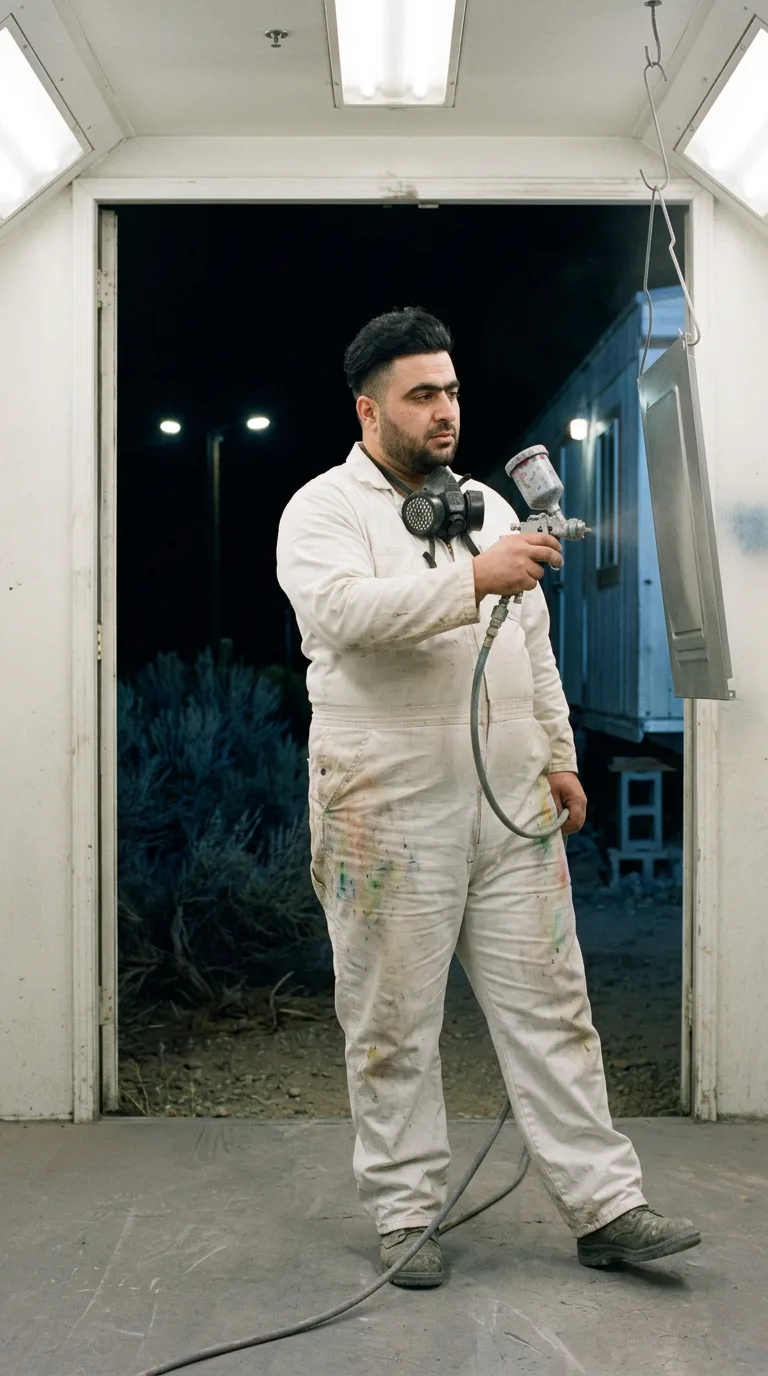
Rarest thing about him: Spray painter — common, 1 in 574
Season 1seed 638527073 · engine v11
Character card
lineage 2NZHHJ
His body-swap story
@colin.hasbrook, wearing Colm Ferriter, rolled the wheel on and woke up as Firas Nazari, spent under a minute in him, then spun the wheel and woke up as Grant Pelkowski
Colm Ferriter's kitchen is the color of a headache — fluorescent, too bright for the hour, the tattoo ink still under his nails from a job that ended nine hours ago. Forty years old, freckled, red hair flattened on one side from a pillow you didn't sleep on so much as sit out. You have been him for less than a minute and already the shine is off. It's not that anything is wrong with Colm. It's that you know the whole shape of him already, know it the way you know a hallway you've walked a thousand times, and the wheel is sitting there on the laptop screen, humming its small blue hum, and there is a version of tonight where you don't open it. You open it anyway. Not boredom, not exactly — closer to the thing that makes a man check a door he already locked. You have to know what's on the other side of this particular unopened one. Coffee, cold. Sun, hours off. You spin.
—
The spray gun bucks against your palm before you know you have a palm, and the line of paint that was going down straight starts to curve, and you correct it — too slow, then a beat too fast — and a voice in a head that is not your head says, quietly, in Farsi you did not know a second ago and understand completely: *not like that.* The panel hangs off its hook at eye level, half gray, half glare where the booth lights catch the wet. A respirator drags at your throat, hanging loose, not on your face. Heavy. Everything about this body is heavier than the one you left, low and solid, weight sitting in the gut and the thighs, boots planted wide like they've learned, over years, not to be knocked over. Outside the open bay door: black desert, a sagebrush smell coming in under the paint fumes, two sodium lights on poles doing nothing against all that dark. It is the middle of the night here. Nobody told this body that's strange. It has done this a thousand nights.
The gun is the first thing that talks. Aluminum cup, worn trigger, the particular drag of the hose behind you like a tail — and it gives you a whole decade in one motion: Firas at nineteen, palms this heavy already, learning off a video with the sound down so his father wouldn't hear the compressor's screaming through the trailer wall. It gives you the booth being *his* booth, built himself out of scavenged ductwork and a box fan and plastic sheeting that flaps when the wind gets up over the ridge, because the shop that used to sponsor this work folded two years back and he never told anyone he kept going out here alone, on spec, on nothing, because a panel he sprays clean is the only hour of the day nobody is asking him a question he doesn't have an answer to.
The coveralls come next, cotton gone soft and thin at the elbows, and they hand you a whole morning: this same white cloth, stiff from the line, going on one arm and then the other in a bedroom he shares with nobody, girlfriend two towns over asleep right now with her phone face-down the way she always leaves it, a woman named Mariam who laughs at how careful he is folding his prayer rug into the truck's glovebox like it might bruise. He is not thinking about her now. His hands don't think about her. His hands, when they're not full of a gun, know how to be still — five times a day they know how to be still, forehead to a mat he keeps rolled behind the seat, and that stillness is in the wrists right now, under everything else, like a second pulse.
The unibrow is not a thing he thinks about — it's a thing other kids mentioned once in a school he doesn't live near anymore, and it landed nowhere, because his father had one too, and his father is three years gone and this body, this exact face, is the only place the man still visibly exists in the world. That comes up out of the beard, somehow — the beard trimmed close because his father trimmed his close, because that's what a man's face is supposed to look like, plain, no vanity to it, just kept.
The panel is nearly done. Ten strokes come out of your hands checked, deliberate, each one re-walked like you're grading your own work, on a motion this body could do asleep — has, some nights, essentially done asleep, moving on muscle while the mind went somewhere else entirely, usually to money, always to money, the shop rent that isn't a shop, the truck payment, whether spec work like this will ever turn into a check. Underneath the care in the hands there's an ache set into both shoulders like furniture that's always been in that room — mask-strap grooves at the ears, a lower back that complains getting up off the trailer step in the cold, everything overworked and none of it broken. Thirty-four and built like a man who has never once had a job that let his body rest.
You finish the stroke. The gun goes quiet in your hand, hissing down. You look at the fingers wrapped around the trigger — thick, nicked, a rime of gray-blue paint dried into the creases that soap has stopped reaching — and you turn them over slowly in the light bleeding out of the booth into all that dark outside.
"Baba?" you say, out loud, to no one, in a voice that isn't asking anyone in the room, because there's no one in the room, and the word comes up before you can stop it or explain it, and it is the last true thing Firas Nazari's mouth ever says on its own account, and you don't know yet how long you get to be the one saying the rest.