Fadi Saleh
Fictional. Generated by AI — not a real person, and no likeness of one is intended.
35, mechanic in Chicago · rolled by @colby.marsh · card — no film
History
who has worn him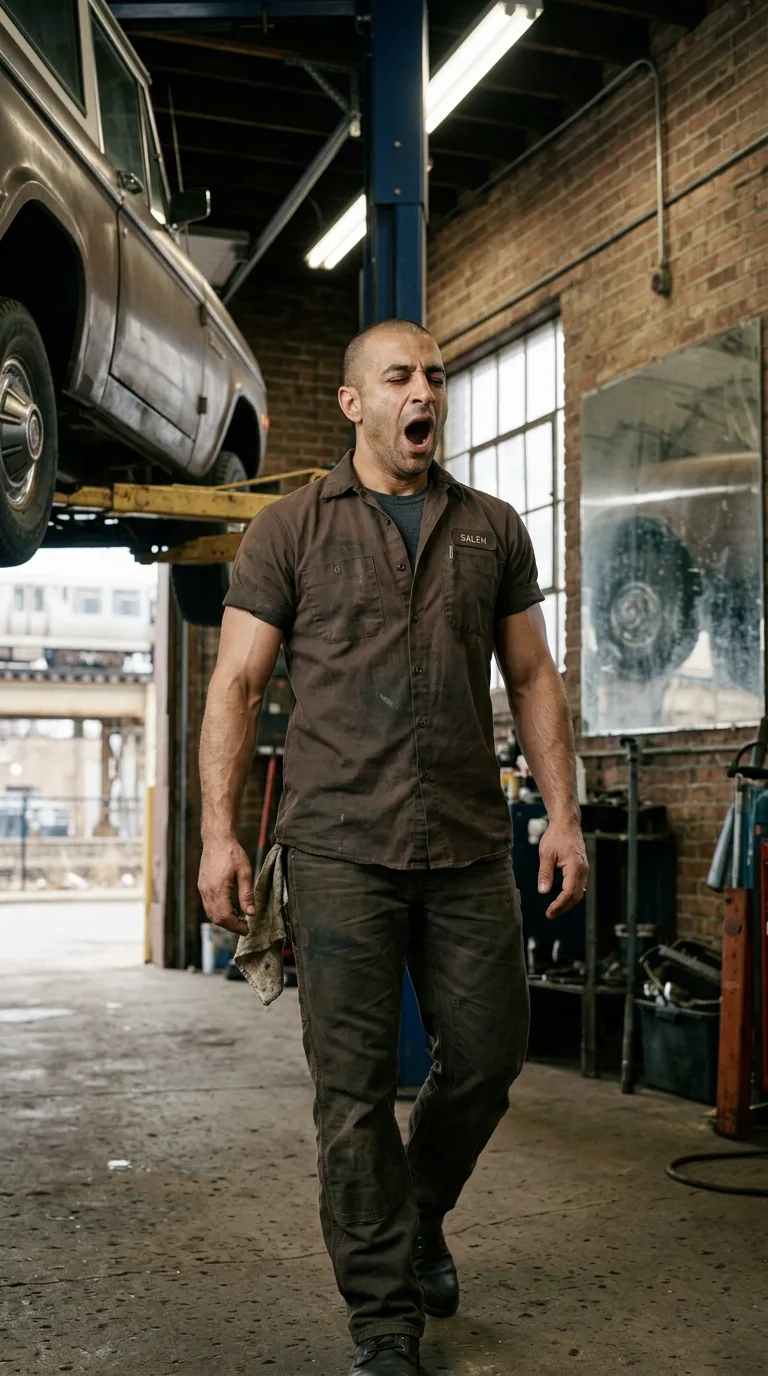
Rarest thing about him: Middle Eastern — rare, 1 in 34
Legacyseed 1571575906 · engine v8
Character card
His body-swap story
---
You worked eleven feet from him for six years and he never once asked you a question you couldn't answer with a nod.
That's the thing about Fadi. He's easy. Bay two, always bay two, because the drain there is level and he says the oil behaves. He comes in at six-forty with a thermos of tea, the good kind, cardamom, and by seven he's got the Wagoneer up on the lift and he's whistling something with no tune in it. He never drinks. He used to smoke — you know because he still does the thing with his hand sometimes when he's thinking, two fingers lifting to a mouth that isn't waiting for anything anymore, and then he notices and turns it into scratching his jaw. Eight years off them. He told you that once, proud, and you said good for you, man, and meant it, and hated him a little in a way you couldn't have explained at the time.
He sleeps badly. He's told you about the machine, the mask, the hose that snakes off the nightstand, how Rania calls it his elephant. He says he stops breathing forty times an hour and wakes up like he's been in a fight. You can see it in him some mornings — the yawns that take his whole face, that crack his jaw open like a hood, that make him stop walking in the middle of the floor. That's what you watched. For six years you watched a man be tired in a body that could pick up the front end of a Corolla, and you thought: he doesn't even use it. He doesn't even know what he has.
Because what he has is this. A wife who texts him at ten in the morning about nothing. Two kids who drew a card for his name day and he tacked it to the toolbox with a magnet shaped like a fish and he shows it to customers. A cross on a chain he tucks in his undershirt before he goes under a car, out of respect, he says, for going under a car. Sixteen thousand dollars in a credit union and a furnace that's going to die in February and he still tips the delivery guy from the taquería like a rich man. He's got nothing. He's got everything. Both of those are true and only one of them showed up on paper and you spent six years failing to explain to anybody, including yourself, why standing near him made your chest hurt.
You are not going to explain it now either. Nobody knows how you got in. Not you.
It's 7:40. The Wagoneer's up, the light off the snow comes in the window flat and grey, the L goes over and the whole building takes it in its teeth. He's crossing from the parts shelf with the rag hanging off his hip and nothing in his hands, and behind him there's nothing but the mirror they hung on the brick so you can see the door without turning around, the one with the wheel reflected in it.
And he yawns. The big one. Head back, mouth wide, that ugly honest full-body yawn of a man who did not sleep, that he'd be embarrassed by if he thought anybody was looking.
You go in on the tail of it.
He finishes it. That's the strange part, and you'll think about it for years — the yawn finishes itself, the jaw closes, the breath comes down, because bodies are machines and machines don't know when the driver changes. His hand comes up to rub one eye, knuckle to socket, the way he does forty times a morning.
Then it stops. Hand still raised. There's a second in there — no more than a second, but you have never had a second like it — where two people are behind the same face and neither of them has the wheel. You feel his tiredness arrive in you like water into a boot. It is so much heavier than you imagined. You'd thought of it as weather. It is a mortgage.
The hand lowers.
The eyes it uncovers are yours.
And they go straight to the mirror. Not to the lift, not to the door, not to the phone on the bench. To the glass on the brick, because the first thing you need, the only thing, is to see it from outside. You cross to it. Three steps in his boots — heavier heel-strike than you'd have guessed, the man walks like he's stepping on things — and there he is, there you are: thirty-five, buzzed down to scalp, a face that in six years you never got to look at long enough because looking too long is how people find out.
You look now. Nobody stops you.
You raise the left hand. The band is there, thin and plain and worn to a soft shine on the inside, and the finger under it has that pale channel that means he never takes it off, not for grease, not for the shower, not once. You turn the hand over. Callus in the crease of the palm, a nick on the thumb from a fan blade last week, the nail on the middle finger black at the root and growing out. This hand has hands that hold it.
Your throat does something and you don't know whose grief it is.
There's no way back. There was never a way back — you understood that going in, the way you understand a door is one-way while you're still deciding to walk through it. Somewhere there is no longer a man who whistled tunelessly in bay two. There is a shape of him that will get in his car at four, and drive north under the tracks, and take off its boots in a hallway that smells like bread and Windex, and be asked how the day was, and answer.
You'll answer. God help you, you'll answer, and she'll believe it, because a man this tired is always a little bit of a stranger by evening.
Out the window the train pulls away and takes its noise with it and the garage is just quiet and cold and yours. You put the palm flat on the mirror over the reflection of the face and you feel the glass fog under the heat of a hand that never once in its life reached for anything it couldn't have.
Then you take the hand down and get to work, because bay two is level, and the oil behaves, and he's got a Wagoneer up on the lift that isn't going to drop itself.