Ezequiel Sandoval
Fictional. Generated by AI — not a real person, and no likeness of one is intended.
34, farrier in Dallas · rolled by @colin.hasbrook · card — no film
History
who has worn him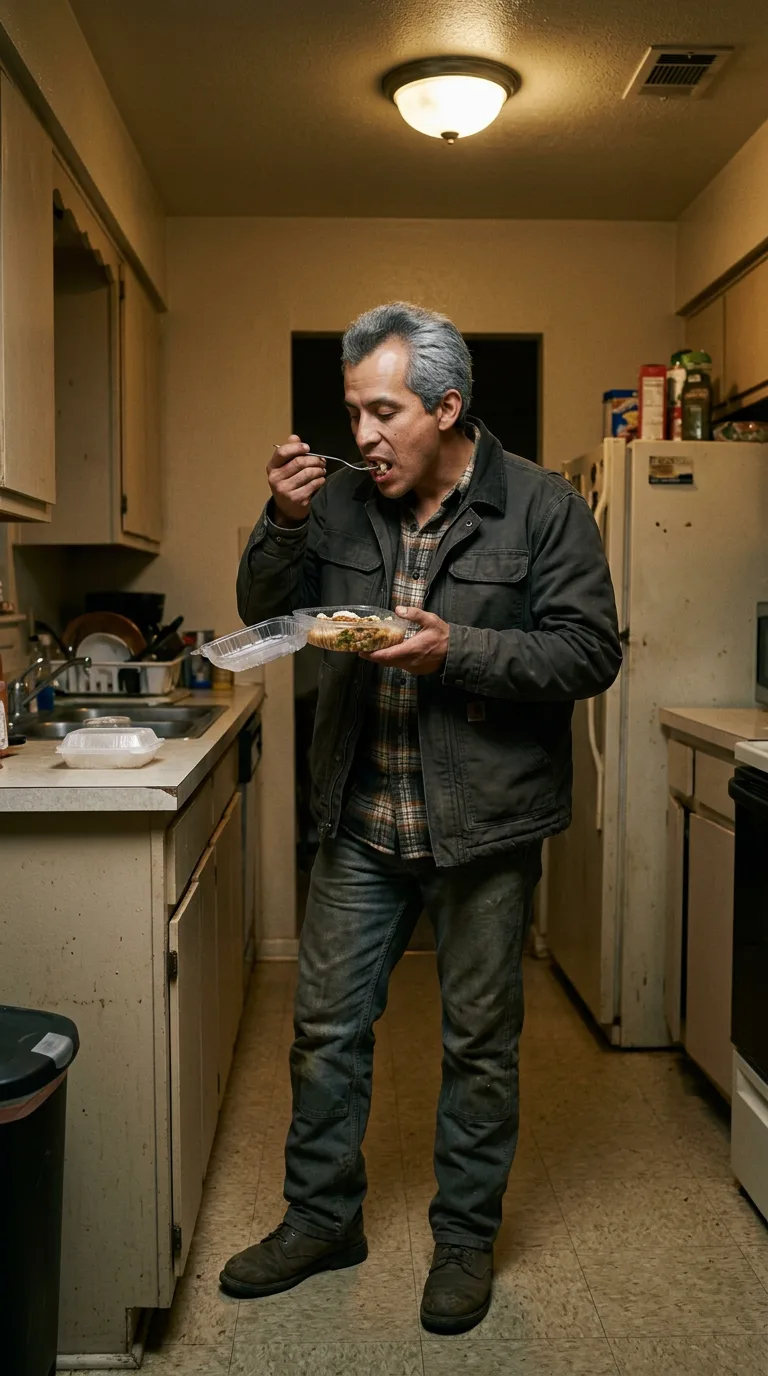
Rarest thing about him: Quitting right now — epic, 1 in 99
Season 0seed 1459911980 · engine v10
Character card
lineage 2NZHHJ
His body-swap story
@colin.hasbrook, wearing Kevin Nakamoto, rolled the wheel on and woke up as Ezequiel Sandoval, spent under a minute in him, then spun the wheel and woke up as Colin Braswell
The dorm room is gray with the almost-light of a San Francisco Monday that hasn't decided to start yet, and you are standing in it wearing a boy named Kevin, eighteen years old, dimples, hands too smooth to have ever done anything to them. He has been yours for seventeen minutes and already the wanting is back, quiet and total, the way it always comes: not boredom exactly, more like hunger arriving before the last meal is even finished. You look down at Kevin's fingers on the laptop trackpad, at the dorm-room clutter that isn't yours and never was, and think: not this. Not a body still deciding what it wants to be. You want one that already knows how to work.
You open vessel.cards. The wheel is already spinning before you've fully chosen, the way it always is, a decision made in the wanting rather than the deciding, and you let it go.
—
The fork is halfway to your mouth and then it is not moving at all, and you feel the whole weight of him arrive around you at once — shoulder to shoulder, the specific density of a body that has swung a hammer since he was nineteen. The fork lowers itself onto the counter with a small tap you did not intend, and there is a container of rice and something braised going cold in your other hand, and a coat still on your back though the kitchen is warm, and beyond the window is nothing but your own reflection and a black Texas yard. You shrug the coat off one shoulder at a time. It has been the middle of the morning here, apparently — you can feel it in the light, wrong for a man eating like this, wrong for a man still in his coat — and you understand, in the small factual way understanding arrives, that this is a man whose morning is somebody else's midnight.
You sit. You eat in even mouthfuls you didn't plan, looking at nothing, because the body does it without you, because it has done this exact motion in this exact kitchen more nights than either of you will ever count.
—
The shirt against your back gives it up first — cotton gone soft in exactly the way work shirts go soft, and with it a whole gray morning: hands pulling this same green shirt on, sleeve first, over a shoulder that's been sore since a colt named nothing in particular put a hindquarter down wrong on him two years back. Ezequiel Sandoval. The name comes with the shirt, the way his mother said it, two syllables of exasperation and love. You feel him get dressed — not you, him, the memory wearing your borrowed nerves like a glove — boots last, always boots last, laced twice because once never holds through a full day of standing bent at the waist under someone else's horse.
The apron. You're not wearing it now, it hangs somewhere off through that door still crusted pale with old hoof and black with old fire, but your palm remembers its weight anyway, remembers the forge ticking as it cools, the quench tub's steam going up into cold morning air, the particular ache that lives in his lower back by two in the afternoon and never all the way leaves. Farrier work. Twelve, fifteen horses some days, each one trusting him or not trusting him, each one four hundred pounds of animal deciding in the first ten seconds whether to stand still. He is good at it. He is proud of being good at it in a way he has never once said out loud to anyone.
The mole on the cheek — you feel it without seeing it, the way you feel a scar of your own would feel, except it isn't yours, it's a fact of a face a hundred people have mentioned to him at parties, at the feed store, on dates that didn't go anywhere.
A date that did go somewhere, once. Selene. You get her whole in a rush off the plastic fork still loose in your hand — three years, an apartment near Oak Cliff, her laugh at something stupid he said, and then the leaving, unhurried and total, the way the good ones sometimes leave, no fight in it at all, just a slow closing door and him standing in it wondering what he'd have done different. He still keeps her number. Never uses it. The wanting to use it lives somewhere under his ribs permanently, low-grade, like the anxiety his doctor has him on something for, like the gum he's chewing right now — you feel it, actually, a wad gone flavorless in his cheek, jaw working without him — like the patch on his other arm where a cigarette used to be, three weeks quit and still lying to himself about it daily.
The tattoo under the rolled sleeve — cross, praying hands — comes with his mother's rosary rattling in a car on the way to Sunday Mass, an ordinary devotion, unspectacular and entirely his own, load-bearing in a way he'd never examine out loud.
The container's almost empty. Thirty-four years old, skinny in the durable way of men who work outside, silver come in early and hard at both temples like his father's did, and none of it slowing his hands, which even now, full, chewing, alone in a rented kitchen at whatever hour this actually is for him, know exactly what they are for.
—
You set the empty container down and look at your hand — his hand, scarred faint white across two knuckles, a burn scar gone shiny near the wrist, nails permanently a little dark no matter how he scrubs — and turn it over slowly in the kitchen light like you've never once seen a hand do that before.
Then you lift your eyes to the black window, to your own reflection standing there in a stranger's kitchen, and you say, quiet, mostly to see if the voice is really yours to use now:
"Okay. Okay, let's see what you can do."