Ezequiel Marrufo
Fictional. Generated by AI — not a real person, and no likeness of one is intended.
31, longshoreman in Anchorage · rolled by @colin.tarwater · card — no film
History
who has worn him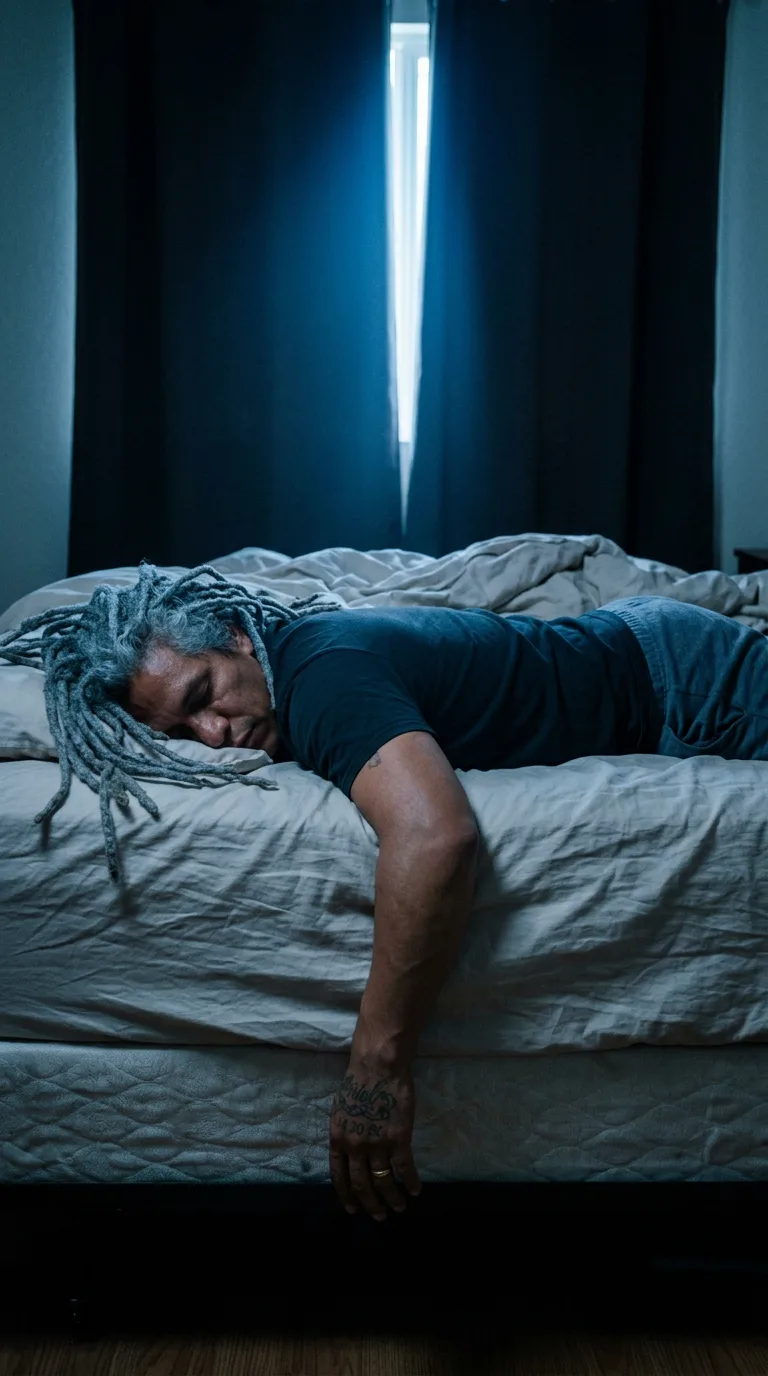
Rarest thing about him: Jehovah's Witness — epic, 1 in 158
Season 0seed 879991920 · engine v10
Character card
lineage COEU7T
His body-swap story
@colin.tarwater, wearing Nikhil Shenoy, rolled the wheel on and woke up as Ezequiel Marrufo, spent under a minute in him, then spun the wheel and woke up as Suresh Bhandari
The guard booth smells like microwave burritos and the particular mildew of a building that has been rebuilt twice on the same footprint. You are standing in a body you have worn forty-two times before this morning — skinny fat, bald by choice, a scar splitting one eyebrow like a hyphen — and it is a body that has stopped being interesting to you sometime in the last three weeks, though you couldn't say the day. The badge on the lanyard says a name that isn't yours either, not really. You have been him long enough that his coworkers have stopped asking why he's quieter than usual. You clocked out forty minutes ago. You are sitting in the man's parked Civic in the garage under his building with his phone in your lap, and you are bored in the specific, itchy way that has nothing to do with him and everything to do with you — the boredom of a person who has learned that any door can be opened and has started opening them just to hear the sound. You open vessel.cards instead. You always tell yourself it'll be the last one for a while. You don't believe it either.
The wheel spins and there is no sound, no falling, nothing you could call travel — one instant you are looking at a phone screen through a stranger's eyebrow, and the next you are lying face-down in unmade sheets, one arm dead-hanging off the edge of a mattress, and a thin blade of streetlight is lying across the wall like it's been there for hours. Waiting for you specifically. The air smells like laundry detergent and, underneath that, the ghost of fry oil. Your breath — his breath — goes from ragged to even in the space of one inhale, and the arm that was hanging draws itself up without your having decided anything, and you roll onto your back, hands folding over your chest like a man laid out for viewing, though nobody has told this body to do that. It just does it. It has never once slept this way before and it is doing it now because you are in it.
The mattress under your shoulder blades. Cotton against a back that's shorter than the one you left, thicker through the middle, thirty-one years of weight settled into it in a way that reads, once you're inside it, as strength rather than softness — a body built by pulling on things, not by sitting. Your hair is heavy on the pillow, dreadlocked, and gray-silver at thirty-one, which lands as its own small shock, a color that in your last body would have meant sixty and in this one means something else entirely, something the memories haven't explained yet.
Then the shirt.
It's not on you now — you're bare-chested under the sheet — but your hand finds the T-shirt balled at the foot of the bed, the one he stripped off twelve hours ago before this sleep, and the second your fingers close on the fabric it opens like a door. Ariel. The name goes through you not as a word but as a whole climate: a delivery room in Providence Hospital, a nurse handing him something six pounds and furious, and him — you, now, this is his and you're only borrowing the shape of it — crying in a way he never let anyone see again after that day. The date under her name on his hand, inked into the same skin his wedding band sits on, is the date of that room. There's a second name at his throat, higher up, half-hidden by the collar he usually wears — a boy's name, younger, a second morning at a different hospital with his wife's hand crushing his fingers.
The gum. Even now, jaw slack in sleep, there had been gum in it before he crashed, an old worn-down piece stuck to the inside of his cheek, chewing being the thing his mouth does when his hands have nothing to hold and his hands, God, his hands have never had nothing to hold — thirty-one years of them wrapping shackles and choker cables and container-corner castings under a gantry crane that is, right now, silent, because it is Saturday and he worked through last night's shift and is asleep at the wrong hour of a bright Anchorage morning because that is what longshoremen do, they live sideways to the sun. Congress Street terminal comes back in pieces — the cold that gets into a broken nose worse than any other part of the face, the particular ache of standing sixty feet up in a crane cab watching a lashing crew work a deck, the clang that never fully leaves the ears. His hands know knots his mind couldn't diagram. They know the give of a wire rope a half-second before it protests.
The wedding band gives you Marisol — an argument about money that resolved itself in the kitchen at 2 a.m. with her laughing despite herself, his forehead against hers, both of them too tired to keep being angry. And under that, quieter, guiltier: a woman he isn't married to, a name he doesn't let himself think in the daylight, a stretch of months last year that he has confessed to no elder, no wife, not even fully to himself, folded now into the marriage like a stone swallowed whole. He goes to the Kingdom Hall on Saturdays when he isn't working and he has not had a drink since the year the second boy was born and he does not smoke and he did not, this once, manage to be the man he tells himself he is. It doesn't come back as guilt exactly. It comes back as weather — a front that passed through and left the ground still wet.
The gray hair. Not age — a thing that happened to him young, that people ask about at the union hall, that he stopped explaining around twenty-six because the explanations were never as interesting as people wanted.
His nose, crooked under your fingers when you finally touch your own face — broken at nineteen in a way the memory won't fully surface, just a flash of pavement and someone's fist and the sound like a green branch — sits exactly where the photograph would show it, exactly where his wife likes to say she can tell it's him from across a parking lot.
You lie there a moment longer, chewing on nothing, jaw working out of habit, feeling thirty-one years of ordinary hardness settle into a frame five inches shorter and considerably more solid than the one you left sitting in a parking garage in another time zone, another light.
You lift the hand with the ring on it and hold it above your face, turning it in the thin blade of streetlight, watching the tattooed date catch and lose the light.
"Ariel," you say, out loud, to the empty room, in his voice, tasting the name like it's the first true thing you've said all morning — and you don't know yet if you're going to be the one who says it again tomorrow.