Everett Dabney
Fictional. Generated by AI — not a real person, and no likeness of one is intended.
50, teacher in Seattle · rolled by @everett.dabney · card — no film
History
who has worn him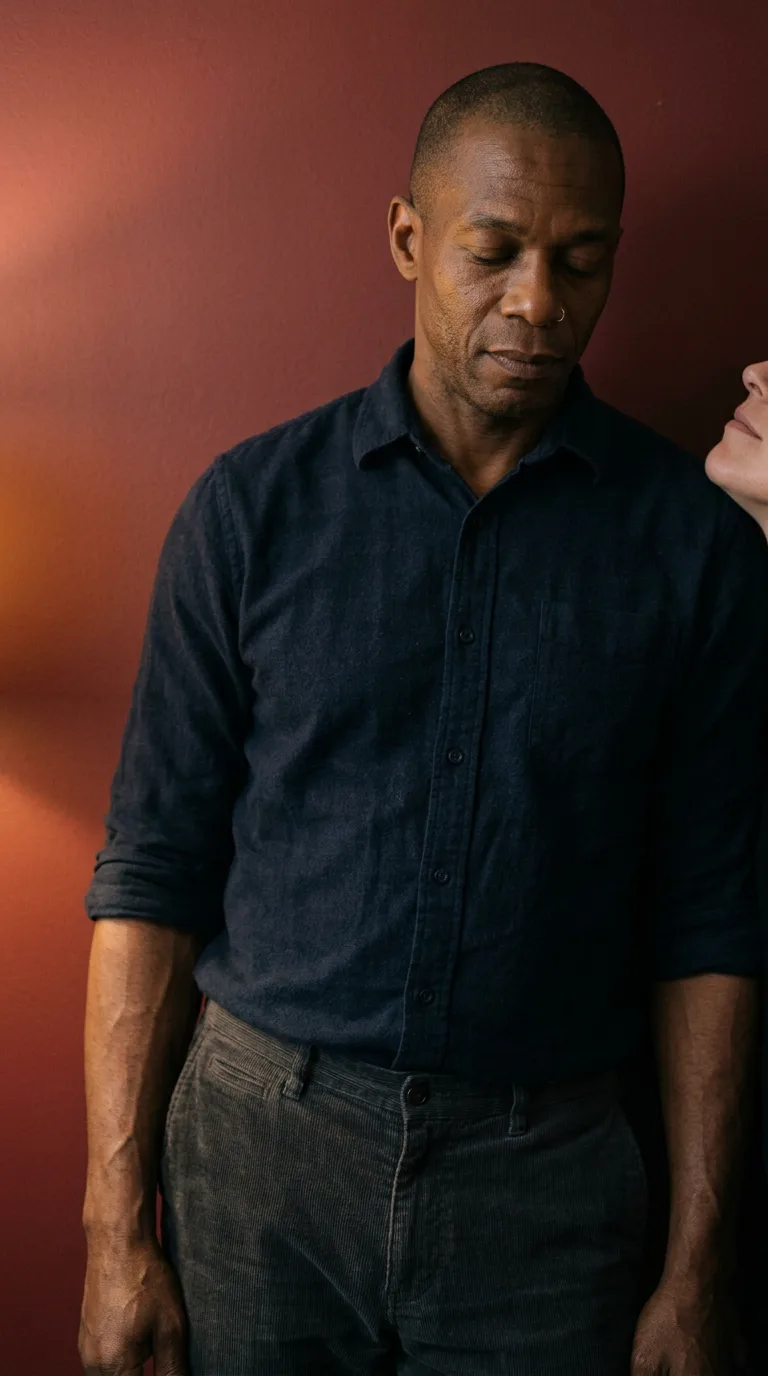
Rarest thing about him: Nose — legendary, 1 in 104
Legacyseed 1916914555 · engine v8
Character card
His body-swap story
---
You have watched him for four years from a desk two doors down, and what you have mostly noticed is how little there is to notice. That is not an insult. It is the whole architecture of him. Everett Dabney at fifty is six feet of unremarkable competence — buzzed head, thin silver ring through one nostril, shirts the color of weather. He does not raise his voice. He does not have a signature phrase. Students who loved him can't tell you why, only that they did. When the district sent the observation team, they watched him teach for forty minutes and wrote *effective* and nothing else, because there was nothing else to write, because the man is a clean pane of glass and you can't describe a window, only what's on the other side of it.
You used to think that was emptiness. You've come to understand it's discipline.
He's your boss. Department head, English, and the one who signs the form that says whether you come back in September. You have sat across his desk more times than you can count and watched him not say the thing he was thinking. That's the tell, if you're looking. His hands. He keeps a brass Zippo in his right pocket for the cigars — two a month, maybe, out on the back step of the school in the rain, the only vice he's kept — and when he isn't thinking about his hands, that lighter comes out and starts turning. Flip. Flip. Snap of the lid, catch, flip. He did it the whole time you told him you were behind on your rent. He did it the whole time you did not tell him about the seventy-one thousand dollars.
Seventy-one thousand. You want to say it out loud somewhere it counts. Cards, then a loan to cover the cards, then a man in Georgetown who does not require paperwork and does not forget. You've stopped opening the mail. You've started calculating what your body is worth in parts, which is how a person ends up learning what you learned, in a room above a laundromat on Rainier, from someone who did not want money for it because money is not what the thing runs on.
It runs on contact. Skin, breath, the mouth. And it is permanent, which is the part they tell you last and gently, the way a doctor tells you the surgery is not reversible. There is no going back. There is no term on it. You get the body and you keep your own memory and your own hunger, and everything else — the man, the whole quiet lit interior of him — goes out like a match in a wind.
You told yourself you chose him for the salary. Sixty-eight after step increases and stipends. Sixteen years of pension. A condo he owns outright on a side street in Columbia City, brick, coffee shop on the corner, the window glow laid out on the wet asphalt every night like something spilled. No wife, no ex who calls, no kids to look at you with a child's terrible accuracy and know. Single, straight, tidy, unsurveilled. A life with no witnesses. On paper, a door standing open.
But you are not honest with yourself about the salary and you know it now, standing in his hallway with the rain going on the window and his wall painted that deep clay red he chose himself and never explained. You chose him because he is unremarkable. Because you have been remarkable — remarkably late, remarkably behind, remarkably a problem to be managed — and you wanted, one time before the end, to be a man nobody has to write anything about.
He'd invited you back after the faculty thing. That's not what he thought he was doing. He'd said *you look like hell, come get a real drink, we can talk about the leave paperwork.* A big night once or twice a month is his limit; he'd had two whiskeys and gone soft around the eyes and told you about his blood pressure, the pills, the doctor saying *fifty is when it starts collecting.* Spiritual but not religious — he said that too, unprompted, the way men his age do at that hour. *I don't think anybody's up there taking attendance. I think there's something. I just don't think it's got a name.*
He is very close to you now. There's a woman's jaw at the edge of your sight — his neighbor, the one who came up for the last twenty minutes and stayed, the one whose glass is still on the counter. It doesn't matter. What matters is he has closed his eyes. Everett Dabney with his eyes closed is the most defenseless thing you have ever been permitted to see, and it is not defenseless because he trusts *you* — you've clocked that clean. He's just tired. Fifty years of being the pane of glass and no one asking what's behind it.
You go up on your toes and you put your mouth on his.
And there is no violence in it at all, that's the thing they don't tell you either. There's a pressure like descending in a plane. There's a moment where you are in two places, feeling your own hand and feeling his hand at the same time, and then there is a lurch — not a fall, a *going* — and then his knees are your knees and they are locked because he was standing braced against a wall, and his heart is your heart and it is running high and thick and wrong, the pressure he carries, a pulse behind your right eye like a knuckle knocking.
You open his eyes. Slowly. The lids are heavier than yours were.
The red wall. The rain. Two brown shoes far away at the ends of legs that are longer than any legs you've had. The jaw withdraws from the frame of your vision, she's saying something, she's saying *Ev?* — and you don't answer because you have to know first.
You bring two fingers up and touch your mouth.
Yours. Not the mouth that kissed. The mouth that was kissed. Yourself on it, faintly, the whiskey and the salt, and under that the taste that is just him, that is simply what the inside of this man tastes like at eleven at night in October, and it is nothing, it is clean, it is bread and rainwater, and you understand with a horror that arrives a full second late that you have gotten exactly what you asked for. There is nobody in here to argue with you. There is nobody in here at all.
Your other hand has gone into your right pocket without being told. It has found the brass. It comes up flipping — snap, catch, turn — and you watch it do that, watch this body run the little program it has run ten thousand times while its owner was thinking about something else, and you feel the debt lift off you like a coat off a chair, seventy-one thousand dollars of it walking home tonight in a body that will be found or won't, that will make its calls or won't, that is no longer your problem in any way that a court could describe.
You will be back in that classroom Monday at 7:40. You will stand at the front of it after the last bell with the chairs empty and the grey Seattle light coming in flat, and you will be effective, and no one will write anything else about you, forever, which is what you wanted.
She says your name again. His name. Yours.
You look at your hand.