Evan Bakalar
Fictional. Generated by AI — not a real person, and no likeness of one is intended.
33, accountant in Los Angeles · rolled by @colby.marsh · card — no film
History
who has worn him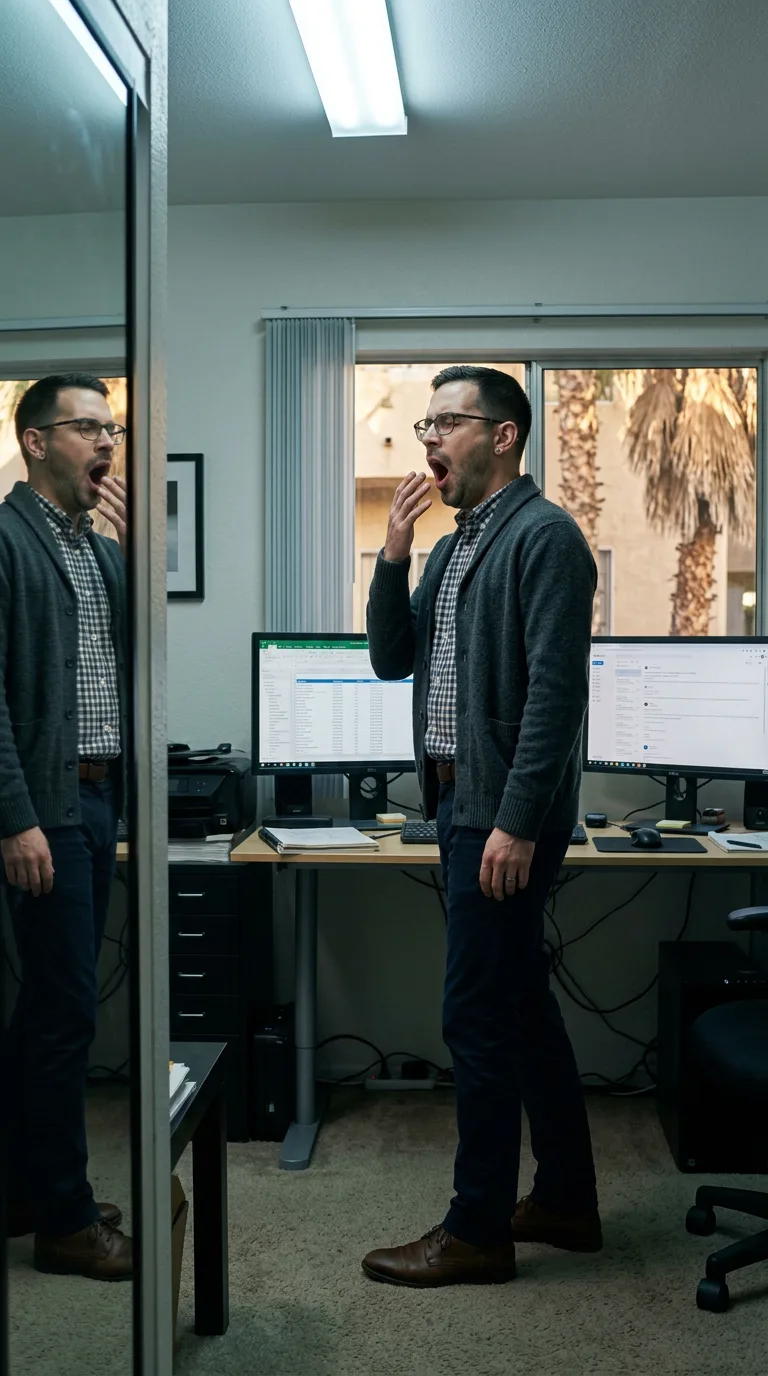
Rarest thing about him: Both earlobes — epic, 1 in 37
Legacyseed 88458648 · engine v8
Character card
His body-swap story
---
You knew his desk before you knew his face. Second cubicle from the window at Marchetti & Ross, the one nobody wanted because the afternoon sun came in sideways off the parking structure and turned both his monitors into mirrors from two o'clock on. You sat behind him for four years. You watched the back of a crew cut go grey at the edges and never once mentioned it.
Coworker. That's the word for it, the one HR would use. It doesn't cover anything.
You knew he took the stairs. You knew the studs in his ears were the only thing about him that had ever been a decision, and that he put them in every morning like a man reciting something he still half believed. You knew the mole high on his left cheek, dark as a full stop, because you had spent whole quarterly closes looking at it while he talked and you nodded. You knew he clenched his jaw when he read anything with a number in it he didn't like — you could hear it, a small dry tick, from behind.
You knew about the bottles because you helped him carry a box out to his car once and heard them.
You knew about Danny — not the name, he never gave the name, but the shape of him. Once, at the terrible holiday thing in the conference room with the tinsel taped to the whiteboard, he stood next to you with his second or fifth plastic cup and said, *the thing is I would have moved. He never asked. I'd have gone anywhere and he never once asked me to.* Then he laughed at himself and went and got another drink, and on Monday he was polite to you the way you are polite to somebody who has seen your kitchen.
You never told him one thing about yourself. That was the arrangement, though only one of you signed it.
You wanted the desk. That's the small, embarrassing truth of it — you wanted the sun on your monitors and the tick of a jaw and the whole ordinary morning of being a man in a cardigan with nothing behind him but the mirror. You wanted to yawn and have it be a yawn and not the last thing anybody notices about you.
Nobody knows how you got in. Not the mechanism, not the hour, not you. There's no bargain to describe. There is only the fact that you are here and he is not, and that it does not come undone.
---
He is standing in the little home office at 7:40 on a Tuesday, in front of the closet mirror, with nothing in his hands. Two monitors already awake behind him, one green with a spreadsheet, one white with mail he has not opened. Out the window, the courtyard — stucco going peach, a palm gone dry at the fronds, the light doing the thing it does here in the last quarter hour before it turns flat and ordinary and stays that way until seven.
He yawns. Wide, unguarded, a hand up near his mouth the way people do when there's no one to be polite for. He rubs one eye with the heel of that hand.
And then the hand stops.
You arrive the way water arrives in a shoe. There is no push. There is no seam. The hand is still up in front of the face and it is his hand for the length of a breath and then it is a hand you are holding up, and the difference between those two things is everything and shows on nothing.
The eyes come open behind it. Light for a second — that white flare that comes off the fluorescent tube overhead, off the glass of the closet door, off something under the skin, you will never be sure — and the head goes back with it, mouth still open from the yawn, throat lit from inside like a lamp with a bad shade. It cuts out. He sags. The hand comes down.
You go straight to the mirror.
Here is what you did not expect: how much you would want a moment first. To look at him before you look through him. But he's gone. There's just a man of thirty-three in the glass, five foot six, ears with two small studs in them, hair short and flat across the top and clean at the sides, a dark mole up high on the cheek, brown eyes that used to be very tired and are now something else entirely.
You lift the left hand and turn it over. The palm. The knuckles. The pale band of skin on the ring finger where he wore something he never talked about — you find yourself pressing your thumb into it, and the pressing tells you nothing, and you understand that you will never know now, and that there is no one to ask, and that this is the shape of the rest of it.
The jaw clenches. Not you. Him — the body, the groove worn in it, the tick you used to hear through a cubicle wall. It happens without your permission and it happens again and you know already that it will happen for years.
At the closet mirror, in his shoes, wearing his cardigan and his morning and his mole, you look up and out and say the only thing you have.
*I sat behind you for four years.*
Then you go put the earrings in — they're already in. Then you pick up the keys. There's a stairwell to take and a spreadsheet to open, and the desk by the window is yours now, and the sun will be on the monitors at two, and nobody at Marchetti & Ross will look up from their screens.