Esteban Rivas
Fictional. Generated by AI — not a real person, and no likeness of one is intended.
27, machine operator in Los Angeles · rolled by @marco.villagrana · card — no film
History
who has worn him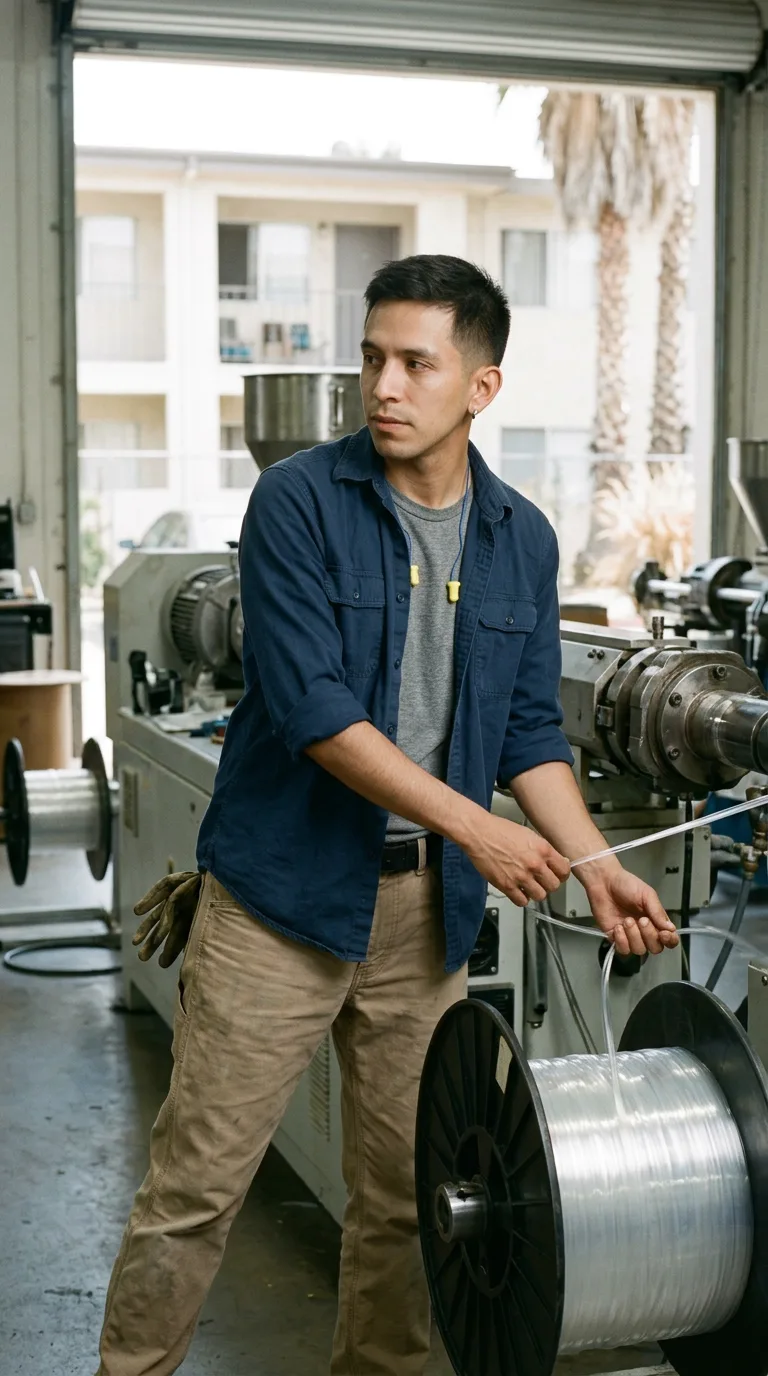
Rarest thing about him: Muslim — common, 1 in 42
Season 1seed 1844900360 · engine v11
Character card
lineage LJL8SV
His body-swap story
@marco.villagrana, wearing Yusuf Haddad, rolled the wheel on and woke up as Esteban Rivas, spent 4 minutes in him, then spun the wheel and woke up as Trevor Lindqvist
You are standing in a doorway that smells like drywall dust and diesel, and you are already bored of him.
Four minutes ago you were nobody, and now you are Yusuf Haddad, 22, a construction laborer in Dallas, and his shoulders ache in a way that is not your ache, a good clean physical tired that you did not earn. The site behind you is closing down for the day, men calling out to each other in two languages, and the sun is doing the long orange thing it does over a parking lot full of trucks. You lift his hand — his hand, still not yours no matter how many times you use it — and look at the calluses on it, and you feel nothing. That's the whole problem. Four minutes and there is already nothing here you want. He has a body that works and a paycheck coming and somewhere, probably, a mother who calls him, and none of it is interesting to hold. You spun him up out of boredom with the one before, and now you are bored again already, faster this time, and you know what that means: it is not going to stop getting faster. You take your phone out — his phone, cracked case, a lock screen of a woman you don't recognize and don't care to — and you open vessel.cards with his thumb, and you spin.
The line is running when you land. His hands — your hands now, for however long now means — are threading nylon filament off a spool the size of a truck tire, feeding it toward the die head, and the motion is so old in these muscles it happens without you, which is exactly the half-second where it goes wrong. The line catches wrong. You correct it, too slow, then again, correctly, deliberately, like a man relearning to walk. Ten more spools go by checked, watched, each one a decision that used to be nothing at all. Sun is coming in low and flat through the open garage door behind you, and somewhere past it there's a courtyard, dry palms standing still in afternoon heat, and stucco going gold. A small hoop of silver is warm against your left earlobe. Your leg has already started bouncing, on its own, against the concrete, before you've told it anything.
The shirt is what opens first — navy twill, sleeves rolled twice, a little stiff at the collar from the dryer — and it gives you a morning: him standing in front of a mirror in an apartment with one window and a swamp cooler that never quite keeps up, pulling this shirt on over the gray tee, rolling the sleeves because his forearms get too hot otherwise, checking the hoop in his ear out of habit rather than vanity. He wasn't thinking about anything that morning except being five minutes behind and not wanting to be. That's most of his mornings.
The gloves clipped at his belt loop give you the machine itself — not fondness for it exactly, but familiarity so total it has stopped being a feeling. Three years on this line. He knows the sound it makes when it's about to jam a half-second before it jams. He knows which spools run true and which ones from the bad batch two months back still throw a wobble. Nobody has to tell him anything anymore, which is its own kind of loneliness, being the guy who doesn't need telling.
The spool's cold aluminum rim against his palm gives you a woman — not clearly, just the outline of her, a name that surfaces and then won't quite resolve, the particular ache of somebody who left in a way that wasn't dramatic, just a slow accumulation of Tuesdays where she stopped answering the same way. You get the shape of missing someone without ever seeing her face. It sits under everything else he does, low and constant, like tinnitus.
The concrete under his boots gives you the whole shift, start to now — clocking in, the smell of hot plastic, a joke somebody made about the Dodgers that wasn't funny, a text he read on break and didn't answer, prayer he meant to make time for and didn't, again. He drifted from drink years ago without deciding to and never missed it; he never started smoking because his uncle died coughing and that was enough of a lesson. He is twenty-seven and none of his choices are dramatic. He is, by every measure that would go on a form, fine. Comfortable, even. That is somehow the saddest fact you're holding.
You look down at his hands, threading filament that doesn't need threading anymore, and there is a version of this that is peace, if you let it be. You don't let it be. You already know — the way you knew about the last one after four minutes — that peace was never what you came here for.
"Not this one either," you say, out loud, to no one, and the line keeps running in front of you, patient, waiting for you to remember it's there.