Elias Nabil Haddad
Fictional. Generated by AI — not a real person, and no likeness of one is intended.
62, Orthodox priest in New York · rolled by @brian.okafor.lynch · card — no film
History
who has worn him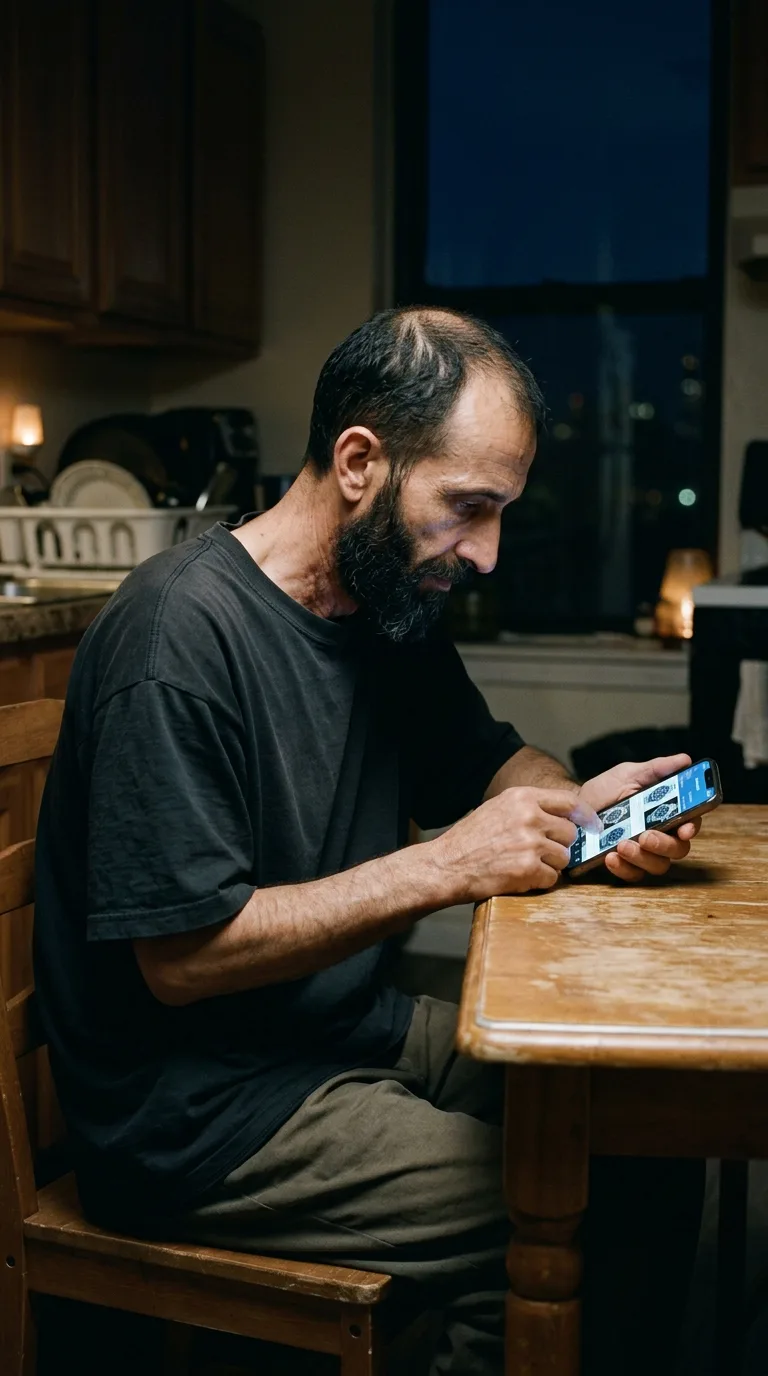
Rarest thing about him: A burn scar — uncommon, 1 in 164
Face-off rating 1484 · not ranked yet
Season 1seed 1896048831 · engine v11
Character card
lineage 79CGDV
His body-swap story
@brian.okafor.lynch, wearing Dwight Lamar Pettigrew, rolled the wheel on and woke up as Elias Nabil Haddad, spent 3 minutes in him, then spun the wheel and woke up as Hadi Castellanos
Dwight's knees are the reason. Not the first reason, but the one I can name. Forty-nine minutes of him, and I am already sitting on the edge of a Pittsburgh bed with my hands hanging between my legs, a man built for carrying drywall, and what I feel is how much of him is spoken for. His shoulders are a schedule. His back has a seven a.m. in it. I put his thumb on the site, and the wheel is there, patient, a circle with no opinion.
Nothing is wrong with him. That is the part I would not say aloud. He works, he is strong, he is the right height for doorways. I just stood in his kitchen and opened his refrigerator and wanted somebody who had never been looked at by that light. I pay. I spin.
The kitchen is dark and my thumb is on glass.
A price stops under it, a number with too many places, a watch on a steel bracelet, and the thumb lifts and stays lifted. Cold from the window on the left side of my face. A wooden chair holding me, its slats against my spine. Beneath the table my knees are bony and tucked, and the body is light, so light, a thin man's weight hanging from the ribs. Dishes drying in a rack. A lamp somewhere low and orange. Outside the dark window, a city lit in small pieces.
I turn the phone face-down on the counter. No, the table. The wood is scarred and pale along the edge where an arm has rested for years. The moment my forearm lies there, something opens.
Sleeve first. The black T-shirt, washed gray at the seams, pulled over his head this morning after the liturgy, after the cassock came off and hung on its hook. His hands know the hook. His hands know the buttons of the cassock, the small cloth ones, from the throat down, one at a time, forty years of it, and the cap set last, with both palms. The shirt is the part he takes off the world. He feels it as relief, a body let out of a shape.
The table gives more. A boy at a table like this, a different one, in a country with a hot wind, a mother's voice, bread torn instead of cut. Then a Brooklyn winter, a cold church, his first parish, a congregation of nine. Then the thing under it: his fingers go to his mouth. My fingers do. The thumbnail is already ragged, bitten to the quick, and the taste of it is a lifetime of vigils, of waiting out other people's grief with nowhere to put his own hands.
His beard is thick against my knuckles, two inches, wiry, gray at the chin. My other hand rises to the side of my neck and finds the scar there, shiny and tight along the jaw, and it floods: a kitchen, a pan, a boy's shout, heat, a neighbor's coat smothering it, and the long years of people not looking at it and looking at it. He has forgiven it. He has not stopped feeling it when he swallows.
The watches. This is his, too, and it comes through the phone's cold edge under my palm: not vanity. His father had one, a plain steel one, lost when they left. He has never owned a watch. He scrolls them at night the way other men pray, without expecting anything. He has more money than he lets anyone see, a savings from a family sale of land, untouched, kept for the church roof, for the poor, for a reason he will not name. Wanting one anyway is his small private sin, and he confesses it and keeps it.
My knees ache with kneeling. My back is a long straight line from habit. My heart is slow and steady, a man at peace with a few things and stubborn about the rest.
I lift both hands and look at them. Thin, dark-haired at the knuckle, callused at the thumb from the censer chain, nails chewed ragged. I turn them over. The palms are lined and warm. They are not Dwight's. Nobody's are mine.
I look up at the dark glass and the city in it, a bearded face I have not met looking back, hazel-eyed, patient, the scar a pale line.
"Well," I say, in a voice with an accent I did not choose. "Hello, Father."
Somewhere under my ribs the wanting is quiet. It is quiet now. I do not ask how long.