Efraín Solórzano
Fictional. Generated by AI — not a real person, and no likeness of one is intended.
60, baggage handler in High-desert Nevada · rolled by @bryce.holloway · card — no film
History
who has worn him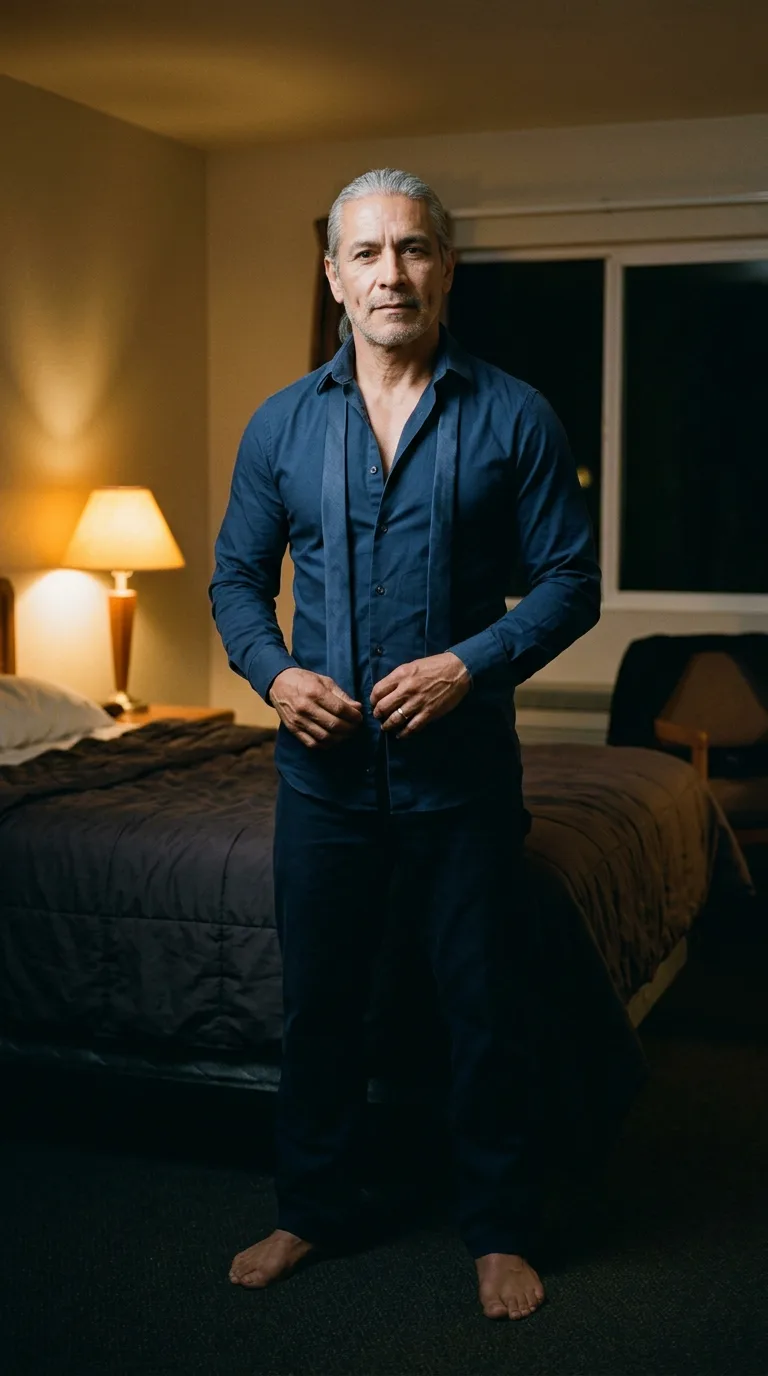
Rarest thing about him: Baggage handler — uncommon, 1 in 1,623
Season 1seed 768367491 · engine v11
Character card
lineage UBMQCL
His body-swap story
@bryce.holloway, wearing Sean Thrake, rolled the wheel on and woke up as Efraín Solórzano, spent 4 minutes in him, then spun the wheel and woke up as Colton Freeburg
---
Three minutes is not long enough to learn a face, but it's long enough to hate a leg.
You're sitting on the edge of Sean Thrake's bed — his bed, his condo, his silence — and the leg won't stop. Left knee, up-down, up-down, a metronome you didn't ask for and can't seem to stop even now that he's you and you're him and none of that sentence means anything anymore. Three minutes ago you spun a wheel on a website at two in the morning and became a 41-year-old manager with freckles and gray hair he's too young for, and the first thing you noticed, before the address, before the name, was that his body would not sit still. You thought it would pass. It hasn't. You've been rich for three minutes and jittering for three minutes and you are done with both.
It isn't really about the leg. You know that, sitting there in his dark bedroom listening to the traffic outside a window that isn't yours. It's that Sean Thrake, in the four minutes you inhabited him before this pause to think it over, turned out to be a man who has never once in his life reached for anything with his whole hand — who taps at glass, who hovers, who apologizes to elevators. You wanted, badly, plainly, to hold something the way it's meant to be held. So you open the laptop that isn't yours either, and you find the page again, the wheel still spinning lazy behind the login, and you pay, and you spin, and somewhere in the desert a phone that isn't ringing might as well be, because you are already gone from here and already there.
—
The shirt is wrong.
That's the whole of it, the first thing: your hand flat on your own chest, and under the hand a body built differently than the one you left — shorter, denser, real weight low in the hips and shoulders, the kind of mass that comes from lifting, not lifting weights — and the shirt buttoned one hole off, collar sitting crooked at a thick brown throat with two days of silver stubble on it. A tie hangs loose and unknotted around the collar like it's been there, undecided, for longer than a man usually leaves a tie undecided. You feel ribs under your palm that ache in a way that isn't pain exactly, just forty years of use.
Your hand finds the buttons on its own — not your hand, his, but it's the only hand you've got now — and undoes them, and does them up again, correctly this time, without you deciding to. And the tie: it moves too, into a shape you didn't teach it and don't recognize, some knot this closet has genuinely never seen tied in this room, and you understand dimly that this is the body doing what it knows before you've caught up to knowing anything at all.
—
The shirt is talking to you before the room is.
It's soft from a hundred washes, a good navy cotton somebody chose carefully, and against your back it says: *she picked this one out at the Kohl's in Pahrump, held it up under the fluorescent light and said it brought out something in your eyes, and you laughed at her, Marisol, because you don't have eyes that anything gets brought out of, you have hazel eyes like a paper bag, and she swatted you with the hanger and bought it anyway.* That's not your memory. It arrives anyway, whole, smelling like store lighting and her perfume from a decade of Christmases, and it sits in your chest like it belongs there because in this body it does.
His name comes up through the collar, through the tag his thumb brushed a thousand mornings buttoning: *Efraín.* Efraín Solórzano. Fifty years old — no, sixty, the tag doesn't say that, the knees say that, something in the lower back says that when you shift your weight and it answers with an ache that has opinions. Sixty years old and built like something that was made to carry, shoulders wide enough to load a jet full of strangers' lives every night of every week for coming up on thirty years now, out on the ramp under sodium lights with the desert going black and cold all around the taxiway and the cargo hold breathing its diesel breath up into the sky.
The tie finishes itself and you feel, underneath the strangeness of watching hands you don't own do something they've done ten thousand times, the specific pleasure of a body that is *good* at something. These hands know the weight of a suitcase before they lift it, know how to swing it up onto a belt loader without letting the shoulder take the jolt, know the particular give of a duffel bag packed by someone who has never once flown before and packed it like a coffin. Thirty years of luggage. Thirty years of learning what forty pounds feels like versus fifty, what's fragile before the sticker says so.
The bedroom comes in through the soles of your bare feet on the carpet — cheap, a little damp with desert cold that gets into a single-wide no matter how good the furnace is — and with it a whole marriage arrives sideways, unasked: Marisol asleep behind you right now, has to be, though you haven't turned to look yet, her breathing slow and even in the dark because she works days at the elementary school cafeteria and he works nights out at the airfield and their whole life together has been built out of these hinge-moments, him dressing in lamp-light while she sleeps, her dressing in daylight while he sleeps, a marriage conducted mostly in the handoff. Thirty-one years of it. No kids — that ache is old and quiet now, worn smooth like a stone you've stopped noticing you're carrying, mentioned once a year maybe, at Christmas Mass, in a prayer neither of them says out loud anymore.
The wedding band is a small cold weight on the left hand and it opens a whole afternoon by itself — a churchyard in Reno, his mother crying not from sadness, his own hands, younger, steadier, sweating through the ceremony, Marisol's veil catching light like something on fire. Catholic to the bone, the two of them, rosary in the truck's glovebox, a Guadalupe decal peeling off the dashboard for a decade now and neither of them ever quite getting around to a new one, because why would you replace her.
He never drank much, gave it up entirely somewhere in his forties without a story attached to the quitting, just a quiet decision after a cousin's funeral that didn't need repeating to anyone. Never smoked. His body is clean of all that, which is maybe why sixty feels, standing here, more like fifty-five — dense muscle still holding, dimples denting into his cheeks even now, at rest, a face built for smiling whether or not there's anything funny going on. You feel them on your own face right now, two grooves the years carved out of good humor rather than worry.
Outside the window it's black desert night, no city glow, just hard stars and a highway sound very far off, and you understand with the shirt and the tie and the ring all telling you at once: it's the middle of the night here because he works the graveyard ramp, because right now, somewhere close, a widebody is sitting on the tarmac with its belly open to the cold waiting on him, and he was running three minutes behind and Marisol mumbled something from the pillow about the tie being crooked before she went back under.
The leg starts before you've told it to. Left knee, bouncing, an old habit this body reaches for the second it has a spare second to be nervous in, a habit that has outlasted the drinking and outlasted, probably, whatever it first showed up to soothe.
—
You look down at your hands.
Broad, brown, the knuckles thick with thirty years of belt loaders and cargo netting, one thin white ring of untanned skin where the wedding band has sat since a Reno churchyard. You turn them over slow, both of them, palms up under the lamp, like you're checking they're real, like maybe they'll answer back.
Then you lift your eyes off them, and out the window at the black desert, and finally into the lens of whatever is watching, and the dimples come in without your asking, a smile that was never yours to give and isn't quite one now either.
"Marisol," you say, quiet, not turning around, "I think I buttoned it right this time."