Donnie Zawadzki
Fictional. Generated by AI — not a real person, and no likeness of one is intended.
43, delivery driver in Pittsburgh · rolled by @colin.hasbrook · card — no film
History
who has worn him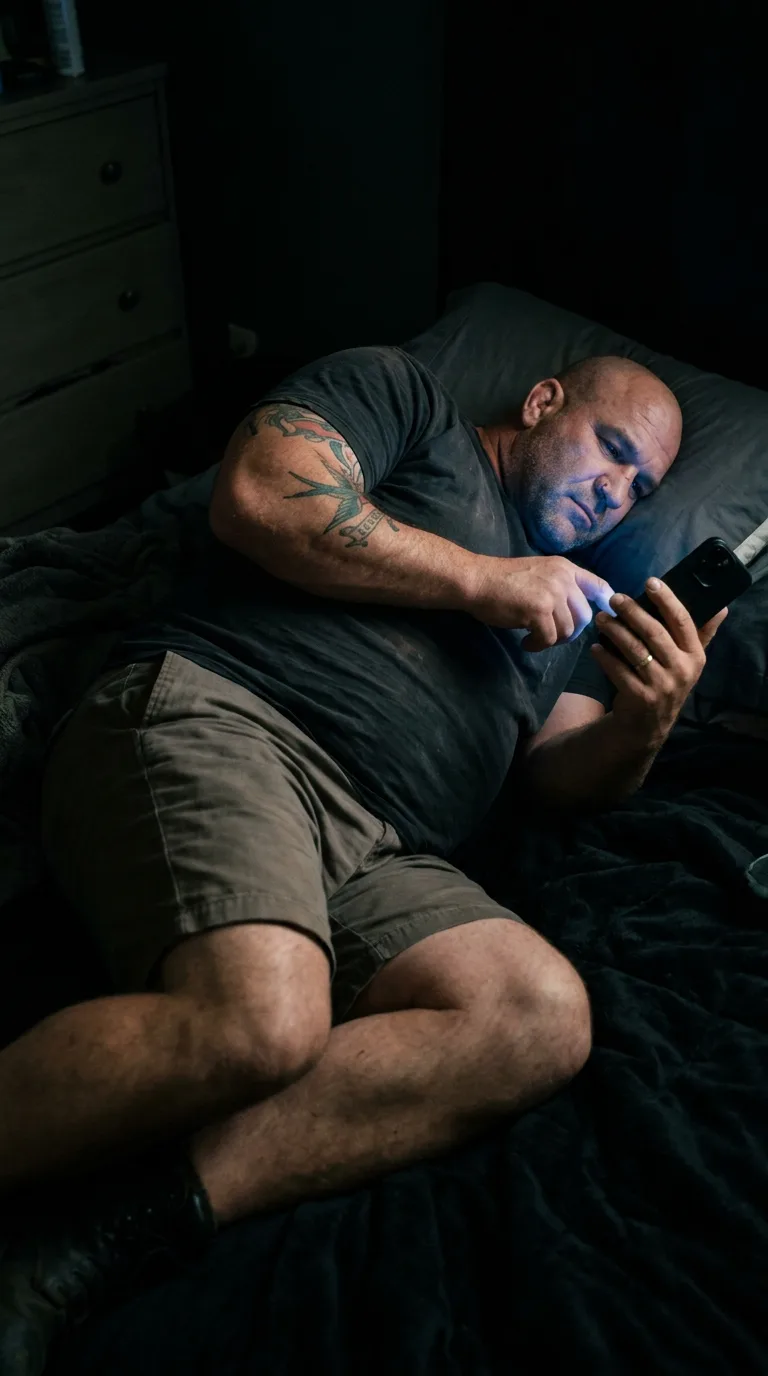
Rarest thing about him: Nose — epic, 1 in 69
Season 0seed 1471508916 · engine v10
Character card
lineage 2NZHHJ
His body-swap story
@colin.hasbrook, wearing Marcus Reyes, rolled the wheel on and woke up as Donnie Zawadzki, spent under a minute in him, then spun the wheel and woke up as Patrick Malinowski
The kitchen light in Small-town Ohio is the ugly kind, greenish off the tile, and Marcus Reyes's cleft chin is still catching it in the microwave door's reflection when you decide you're done with him. Forty-four, an accountant, a body that sits too much and complains about it in small ways — the knee that clicks on stairs, the tightness low in the back from a chair that doesn't fit right. You've been him less than a minute, standing in his own kitchen holding his own phone, and already you know: this is not a man, this is a spreadsheet wearing a cardigan. There's a wife somewhere in this house you haven't met yet and don't want to. There's nothing here. You open the site with his thumb before his blood has even finished being his.
vessel.cards. The wheel spins the way it always spins, a color wheel with no names on it, and you feel the old cheap thrill of it, the one that hasn't dulled in two hundred and eighty-seven turns, and you think, not unkindly, sorry Marcus, and then you are gone from him entirely, the way a hand leaves a glove.
The thumb keeps moving before you've caught up to it. That's the first thing — the hand already knew what it was doing and you're just late to it, flicking through a feed too fast to read, faster than the man lying here ever scrolled, steadier too, no hesitation in it, no thumb hovering back over something that stung. Blue light on a cheek that isn't the same cheek. Wider. Softer along the jaw. A nose bent a few degrees off true, you can feel it in the air displaced past your own face, the way breath catches slightly wrong going in. You are lying on your side in the dark in a room that smells like fabric softener and someone else's sleep, and the mattress under your hip is a working man's mattress, worn to a shape that was never yours until four seconds ago.
The shirt is what opens him first — not the phone, not yet, just the cotton of the t-shirt dragging cool against your back when you shift your weight, and it comes in like a held breath let go: a bathroom mirror, morning, fluorescent and unkind, and thick fingers — Donnie's fingers, you have his name now, it arrived with the shirt like a label sewn in — working a top button that never quite reaches the collar right because the collar was sized for a man twenty pounds lighter than the one he became. The brown uniform shirt. Two pockets. He shrugged into it that morning the way he's shrugged into it six thousand mornings, one arm and then the other, tucking the sleeve down over the swallow and the banner on his upper arm without looking, an old reflex, some got-it-at-twenty-two ink he stopped being proud or embarrassed by around thirty. The wedding band clicked once against the third shirt button, a small sound he doesn't hear anymore. He clipped the scanner to his belt like a man holstering something. He was thinking, that morning, about nothing — about coffee, about the Steelers, about whether the kid needed a ride to practice — and that nothing is its own kind of memory, warm and unremarkable, and it comes to you heavier than a big one would.
The mattress gives you the rest. Fourteen years of it — no, longer, married before this house — a wife's laugh from a kitchen two floors down that you can almost place a face to but not quite, three kids' worth of noise soaked into these walls, a stairwell out back between yards where he sits some evenings with a beer he only drinks a few times a year, wet leaves gone dark on the concrete, October light going long and orange and then blue. He is a man who chews a toothpick without knowing his jaw is doing it, who carries a blood pressure number he doesn't mention to his wife, who goes to Mass more Sundays than not and believes, mostly, without making a thing of it. Twenty-some years hauling boxes up other people's stairs, knees complaining, back holding anyway, strong across the shoulders in a way that isn't for show. None of it his idea to be remarkable. All of it, somehow, is.
It's a Tuesday where he's lying and a different hour where you left Marcus standing, and something in you notes, distantly, that this man should be up at five for a route, and he's here at eleven scrolling in the dark instead — a day off, maybe, or a shift bid he took for the extra hour with his wife asleep beside him, her back a warm wall an inch from yours that you haven't turned to look at yet. You don't need to know which. The body already knows how to be tired in exactly this specific way, evening-tired, day-off-tired, and it isn't fighting you for the phone.
You stop scrolling. You bring the hand up — his hand, wide, a nick of old callus along the side of the thumb, the wedding band catching the last of the phone's light — and you turn it over in front of your face like you're checking it for something.
Then you lift your eyes off it, into the dark of the room, toward nothing and no one, and you say, quiet enough not to wake her:
"There he is."