Devon Ashby
Fictional. Generated by AI — not a real person, and no likeness of one is intended.
25, teacher in Small-town Ohio · rolled by @connor.waskiewicz · card — no film
History
who has worn him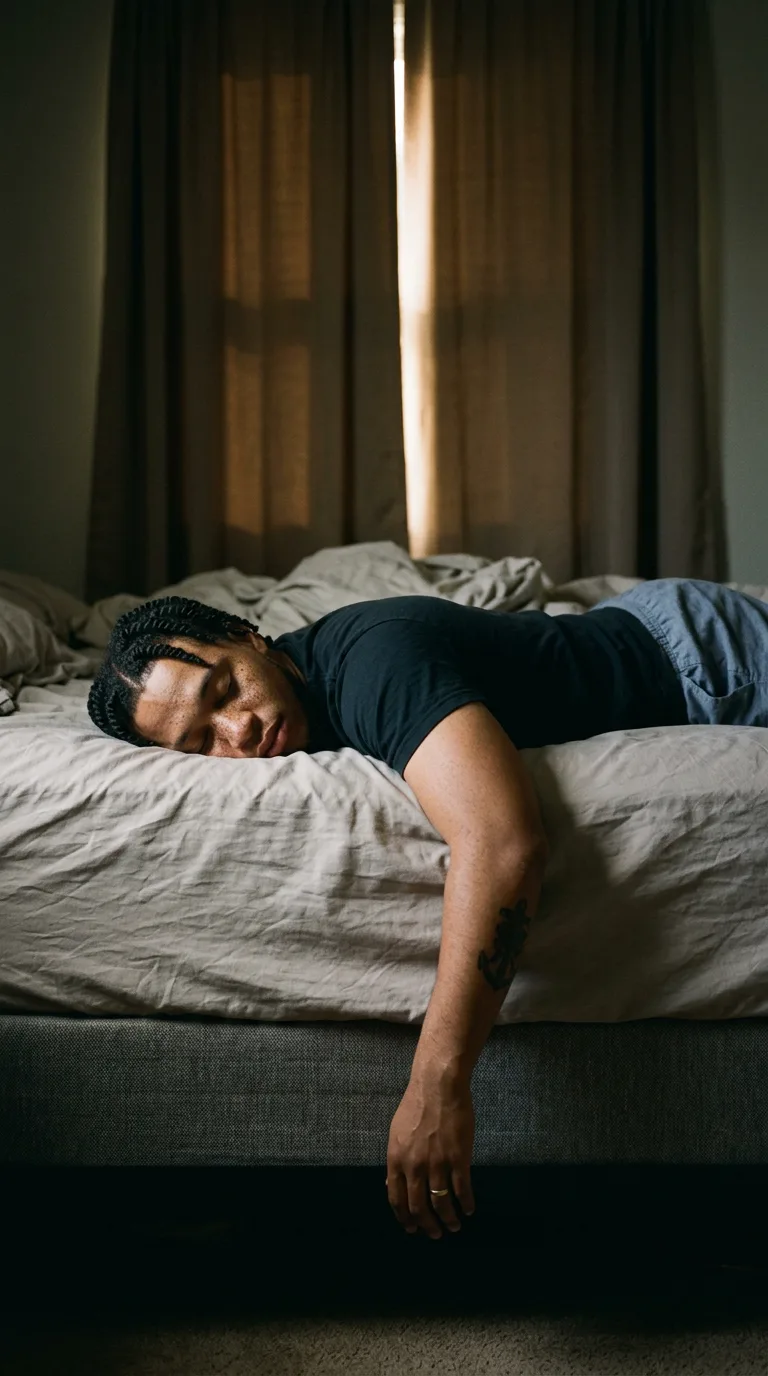
Rarest thing about him: Twists — rare, 1 in 393
Season 1seed 1821115048 · engine v11
Character card
lineage 2NZHHJ
His body-swap story
@connor.waskiewicz, wearing Denny Aubuchon, rolled the wheel on and woke up as Devon Ashby, spent under a minute in him, then spun the wheel and woke up as Marcus Adeyemi
The call center floor is empty except for the hum of the vending machines, and you have been sitting in this particular skin — fifty-nine, gray-haired, the headset cord looped twice around a wrist gone soft — for less than a minute of clock time and nine hundred and thirty-five other men. That is the thing nobody tells you about wearing somebody: the boredom does not wait a decent interval. It comes in fast, before the seat is even warm. You spun this one two nights ago because his knees didn't hurt and you wanted that, just that, for a while. Now the knees don't hurt and there is nothing else here — a cousin who doesn't call, a studio apartment with the blinds always down, a job you do not have to be good at to keep. Freckles on his nose that you notice in the reflection of a dead monitor and feel nothing about. You get up. You walk past the break room, past the punch clock, out to where your phone is charging on a folding chair, and you open the page with the wheel on it, because there is a specific flavor of nothing happening here and you already know eight hundred and thirty other flavors it could be instead.
You spin.
The breath goes from ragged to even in a single pull of air, and that is the first thing — not sight, not thought, just breath finding a rhythm it didn't have half a second before. Then the arm. It had been hanging off the mattress, dead weight, fingers grazing carpet, and now it lifts, folds up and across, and the whole body turns from its face-down slump onto its back like something remembering how to be laid out properly. Hands come together at the sternum. Streetlight through a gap in heavy curtains draws one bright seam across the ceiling. Twenty-five years old in the shoulders, in the give of the mattress, in a body that does all of this on its own before you have caught up to being in it.
It is the middle of the night here too, but wrong-shaped — not the deep 3 a.m. you left, something closer to the hour after midnight bleeding toward one, and there's a wrongness underneath even that: he was in unmade sheets, alone in the bed on his side of it, when the facts of a married man with three kids should have him surrounded. You don't know that yet. You will.
His pillow still holds his smell — drugstore shampoo, coconut, something he probably picked because his wife likes it on him — and that alone drags up school. Fluorescent light, a whiteboard half-erased, twenty-six desks and one of them with a kid's jacket still slung over the back because he forgot it again, Devon, he always forgets it, and the feeling underneath that is not annoyance, it's fondness so worn-in it doesn't have a name anymore. You didn't choose this name. It arrived with the pillow.
The mattress under your shoulder blades gives him next — a whole stretch of exhaustion, grading papers at the kitchen table at eleven at night while the baby monitor hisses on the counter, his wife's hand landing on the back of his neck on her way to bed, not stopping, just landing, a kind of punctuation they've used for years. Three kids upstairs or down the hall, small sounds you can't quite place yet because he can't either, half-asleep, cataloguing them by instinct. A marriage that isn't dramatic. That's the whole feeling of it — steady, a little tired, loved in a way that doesn't need to announce itself.
Your own — his — hand finds the wedding band on the other hand without meaning to, a thumb running the inside of it the way he does when he's thinking, and that single loop of metal gives you a whole afternoon: a courthouse steps wedding because the church one got too expensive, her laughing at him for crying, him blaming allergies that didn't exist. Cheap tux. Best day. Scraping by since, always scraping, the check from the district arriving three days late every single month and somehow it's always enough, barely, and he has never once wished for different.
The forearm tattoo is under the sheet now, pressed to cotton, and it gives you sharper, harder: a unit insignia inked at nineteen in a strip mall shop two blocks from a base that doesn't exist for him anymore, brothers whose names still catch in his throat sometimes when the news runs a certain kind of story, a discharge that came with more silence in it than he's ever explained to her. He doesn't drink. Some of the men he served with drink enough for ten. He decided a long time ago which kind of man he was going to let himself become.
Freckles under fingers that aren't yours yet either — his hand drifts to his own face in his sleep the way it always does, unconscious, the same gesture a thousand nights running, tracing along the bridge of his nose like checking something is still there. His wife teases him about it. Copies him sometimes, just to watch him laugh.
The empty classroom comes last, faint, a held-over feeling from hours ago that hasn't fully drained out of the muscles yet — chalk dust, the particular quiet of a room built for thirty voices and holding none, the last bell still ringing somewhere behind his sternum, the small satisfaction of a Friday finished. He was tired walking to this bed. He earned this sleep.
You lie there a moment longer in his stillness, hands folded on his chest like a man laid out for a photograph, and lift them — his hands, twenty-five years of them, calloused faintly at the first knuckle from years of chalk and worksheets, warm, someone else's entirely and now, simply, yours. You turn one over in the striped light, studying the lines of it like they might answer something.
You say, quiet, to the dark and the gap in the curtain and nobody: "Not yet."