Desmond Farrow
Fictional. Generated by AI — not a real person, and no likeness of one is intended.
53, firefighter in Boston · rolled by @colin.hasbrook · card — no film
History
who has worn him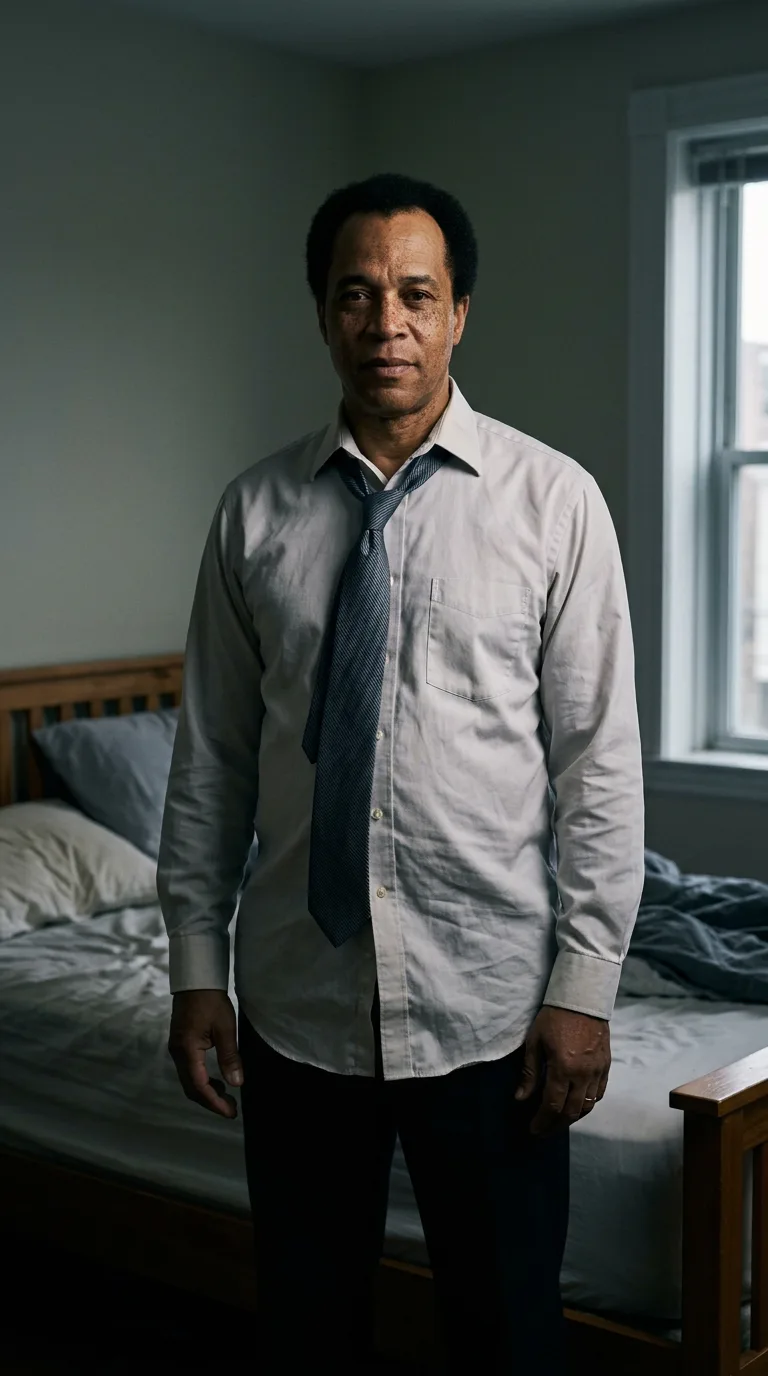
Rarest thing about him: Orthodox Christian — epic, 1 in 75
Season 0seed 1257785786 · engine v10
Character card
lineage 2NZHHJ
His body-swap story
@colin.hasbrook, wearing an unnamed body, rolled the wheel on and woke up as Desmond Farrow, spent under a minute in him, then spun the wheel and woke up as Gerald Dunmore
The line cook's hands smell like scorched garlic and bleach, and that's the whole problem right there.
You've been him eleven hours. Eleven hours of a fryer basket dragging your shoulder down, a walk-in that never gets warm, a manager who calls you "chief" like it's an insult he's saving up. Two hundred and eleven days ago some stranger on the other side of a screen paid to feel five-foot-three and muscular-fat and bald with a white streak, and now that stranger is you, standing in a service alley on a break that isn't long enough, phone out, thumb already moving before the decision finishes happening. It's Friday afternoon in New York. You tell yourself it's just to look. You know better. Looking is never just looking, not after four hundred and fifty-two times.
The wheel loads. You don't even read the odds anymore, because there's a rule against believing in them. You spin.
—
The shirt is buttoned wrong by one, and your hand is flat against your own chest, feeling ribs that go higher than they used to, wider than they used to. Cold bedroom air on skin that used to be someone else's. The button under your fingers undoes itself and does itself back up, correctly this time, without you quite deciding to. A tie hangs loose at the collar, patterned, narrow, and your fingers — long fingers now, unfamiliar — take it up and knot it in a four-in-hand nobody in this house has ever tied. You are standing at the foot of a bed. The comforter is thrown back. The window behind you is the flat gray of Boston overcast, a Friday afternoon that on this clock is the deep middle of a night shift's morning — the man you're wearing slept through the daylight the way firefighters do after a bad tour, and is dressing now, for a start-of-shift that his body clock insists is evening lying to him.
—
The shirt against your shoulders gives it up first, sleeve by sleeve, the way it always does: this exact cotton, worn thin at the collar, a wife's hand smoothing it flat across your back last winter before a hospital fundraiser you didn't want to go to, her voice saying you clean up alright, Dez, for an old man, and the two of you laughing in a doorway with your coats already on. That's Renata. The ring on your left hand — his hand, yours now — is warm the way rings get warm from being lived in, and it brings her whole, her laugh loud in restaurants, the fifteen years, the fight about her sister's wedding that lasted into September, the way she still reaches for your knee in the car when your leg starts going without you.
Your leg is going now. Bouncing, heel drumming the floor, a thing this body does whether you tell it to or not, has done since some tour eleven years back that the memories won't hand you all at once — just heat, and a stairwell, and a name you don't get, and the pills on the nightstand that came after, small and blue and taken every morning without a story attached, just a habit, just maintenance, just the quiet unglamorous work of staying upright.
The tie gives you more: your ex, Carla, decades gone and somehow still there in the muscle memory of this exact knot, because she's the one who taught you it, on a bed in an apartment neither of you can picture anymore, laughing at how bad you were at it. You haven't spoken to her in six years. You still tie it her way. Renata's never noticed. Or maybe she has and never says.
The floor under your feet is the same floor your kids learned to walk on — a boy who's twenty-two now and calls on Sundays, a girl who's nineteen and doesn't call enough, and both of them are in the freckles you can't see but can feel, faintly, the way you feel your own father in your face some mornings, freckles he had too, across the nose, a Farrow thing, an inheritance nobody asked for and everybody kept.
The apron of the firehouse comes up unbidden too — the smell of diesel and the particular cold of a Boston engine bay at odd hours, the guys who call you Cap without meaning captain, just meaning old enough to know better, the fires that were nothing and the two that were everything and the fact that you still, fifty-three years old, get in the truck every time the bell goes without letting your face show what it costs. Church on Sundays you can make it to. The icon over the bed, small, gilt-edged, that Renata's mother gave you both, that you touch sometimes without noticing you're touching it, the way you're not noticing your own thumb finding your wedding band right now, turning it once.
This body is tall in a way that took getting used to decades ago and never stopped being useful — doorways, ladders, reaching what other men send someone else up for. Fifty-three and still strong enough that nobody on shift treats you like fifty-three, though your knees have opinions about it he'd never voice out loud. Average build going soft at the edges the way it does at this age no matter what you do about it. Big night out once, twice a month, never more, because more doesn't sit right anymore, and no cigarettes ever, not once, a thing his mother drilled into him that outlasted her.
—
You look at your hands. Long fingers, a wedding band, no scars you were braced for, freckles scattered faint across the backs where the light from the window catches them. You turn the right one over slowly, like it might mean something different on the other side.
Then you lift your eyes to nothing in particular — a mirror, a window, whatever's in front of you — and you say, quiet, almost testing the voice before you trust it:
"Who tied this."