Dennis Aucoin
Fictional. Generated by AI — not a real person, and no likeness of one is intended.
56, house painter in Atlanta · rolled by @colin.hasbrook · card — no film
History
who has worn him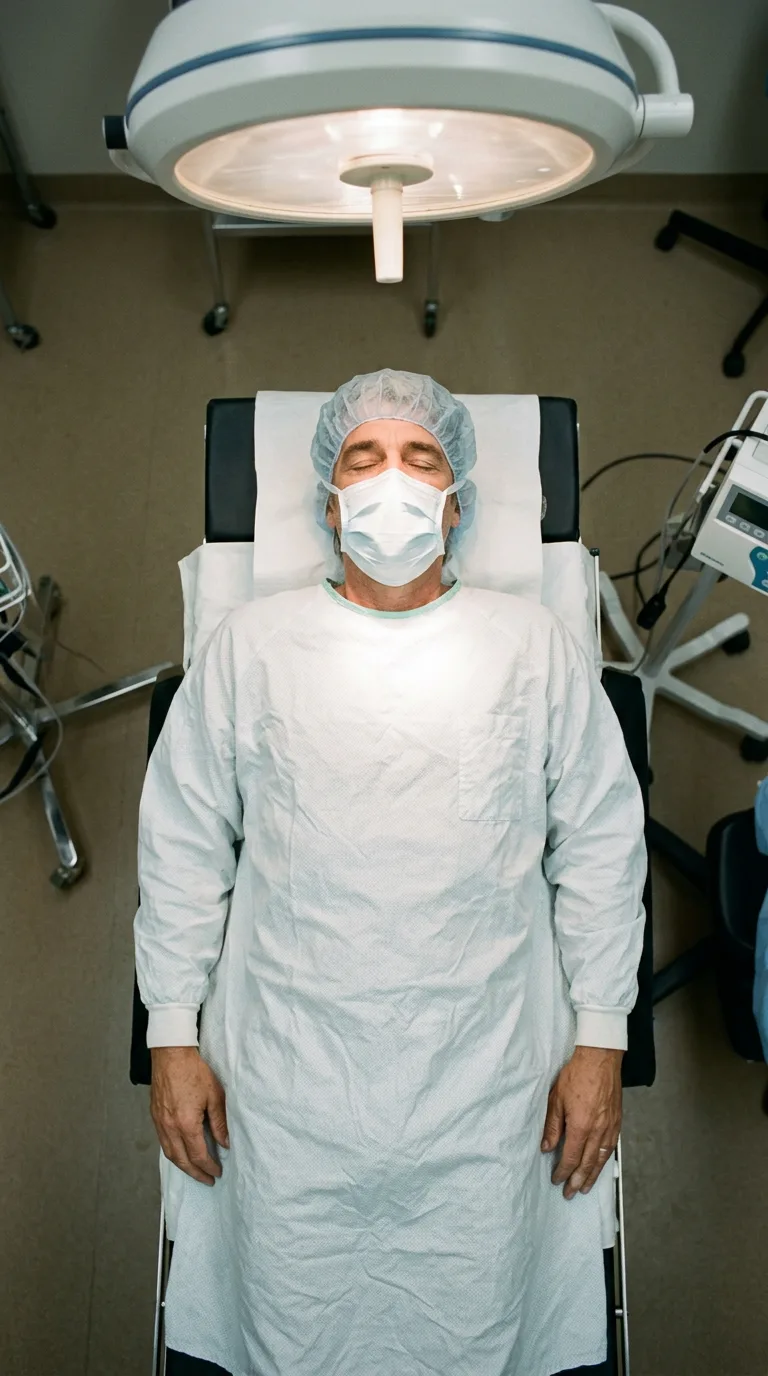
Rarest thing about him: A shag — rare, 1 in 168
Season 0seed 871887314 · engine v10
Character card
lineage 2NZHHJ
His body-swap story
@colin.hasbrook, wearing Ross Delaney, rolled the wheel on and woke up as Dennis Aucoin, spent under a minute in him, then spun the wheel and woke up as Marcus Tillery
The chair is hard plastic and the sun in Denver is already too much at eleven in the morning, and you are so tired of being twenty-nine. That's the thing nobody warns you about the good ones — the beautiful body gets boring faster than the ugly ones do, because there's nothing left to discover in it. You have been Ross Delaney for less than a minute and already you know the whole shape of him: the shoulders, the freckles, the whistle around his neck that you have not once had to blow. You called in that you'd cover a Monday shift you don't actually have, just to be alone somewhere with a phone, which tells you something about how little this body's life is worth to you already. The wheel is open in your lap, glare washing out the number on your balance, and your thumb — his thumb, tan, blunt-nailed, a stranger's — is already on the spin before you've decided anything at all.
It lands.
You are standing. That's the first wrongness, because you were sitting, and now you are on your feet in a place with no sun in it, a ceiling light cold and round and close overhead, and your face has cloth strapped over it and your legs have nothing under them because you are lying down, not standing, the body lying flat and you inside it the way water finds the shape of a glass. Under the lids your eyes drag once, left to right, taking a room that is beige and humming. A hand at your side — his hand — opens, closes, opens again, like it's checking a lock. Somewhere above you a machine keeps counting a heartbeat that isn't asking your permission to keep going.
The paper gown against your back is the first thing that talks. It gives you a hallway, fluorescent, the smell of the surgical center's coffee burning in a pot nobody refills, a nurse named Carol asking if you have any metal in your body and you saying only the fillings, ha. Then the gown becomes the folded one in a locker at a house on Winthrop Drive, years back, the one you wore camping with the kids before the knee started going, and there's your daughter's voice somewhere, nine years old, asking if bears could smell marshmallow through a tent — that one has weight to it, real weight, more than the coffee, more than Carol. The hospital band at your wrist gives you the surgeon's name, spoken once by a woman's voice on the phone weeks ago, calm, a hernia, nothing to worry about, outpatient. It gives you the copay you didn't have and put on the card anyway.
The cap over your hair — his hair — gives you almost nothing, just the barber on Cheshire Bridge who's cut it same as always for eleven years, gray now where it used to just be dishwater, and the comment the barber makes every time about how you're due to donate it to a bird's nest.
But it's the hand that gives you the most, because it is a hand that has held things its whole life and none of them gently. It gives you a brush loaded with eggshell white, the particular give of a two-inch angled sash against baseboard, the smell of a house with the windows shut against Atlanta August, drop cloths taped at the corners, a radio somewhere playing classic rock low enough not to bother the homeowner upstairs. It gives you thirty years of that — the knees that ache going up ladders now, the reading glasses you need for cutting a clean line you didn't need ten years ago, the way you tape trim with your eyes half-shut because your hands already know the angle. It gives you a wedding band that isn't there anymore, a pale strip of skin on the ring finger that the light from a hundred job-site windows tanned around but never through, and with it Denise's voice, not unkind even at the end, telling you the drinking wasn't the only reason but it was the reason she could point to. It gives you Sunday mornings at Christ the King with your mother when you were a boy, and Sunday mornings alone now, in the back pew, still going out of something more stubborn than belief. It gives you your son's graduation, five years ago, you in the good shirt sweating through it, proud enough it embarrassed you. It gives you last night — no, hours ago, the night before the mask — a six-pack on the back steps because you couldn't sleep thinking about a surgery you'd put off two years, and the last cigarette you told yourself was the last one, lit off the stove because you couldn't find the lighter, and it gives you this morning too, the paper gown going on over your head with a nurse's hands helping the armholes because your shoulders don't lift right after fifty, and the small flare of shame at being helped into clothes like a boy.
Under all of it the body just sits there being itself: fifty-six years worn into it, skinny through the chest and soft everywhere else, feet that ache in boots you're not wearing right now, a low hum of thirst that's the diabetes talking even under anaesthesia, fingers that want, want, want to find a nail to worry at and can't, taped as they are to a board at your side. None of it hurts exactly. All of it is tired in a way that has nothing to do with sleep.
Then the hand is yours to move, and you move it — off the board, up, into the light — and you look at it the way he never had time to. Nails bitten to the quick. Paint, old and ground into the creases, that no soap ever fully got. The pale ghost of a ring he stopped wearing three years before this table.
You say it around the mask, muffled, thick with whatever they gave him, to nobody in the room who's listening yet:
"Denise—"
and stop there, because you don't know the rest of that sentence any more than he did anymore, and somewhere behind you a monitor keeps its long patient rhythm going, indifferent to whether you spin again in a minute or a decade.