David Yoon
Fictional. Generated by AI — not a real person, and no likeness of one is intended.
36, real estate agent in New York · rolled by @colin.hasbrook · card — no film
History
who has worn him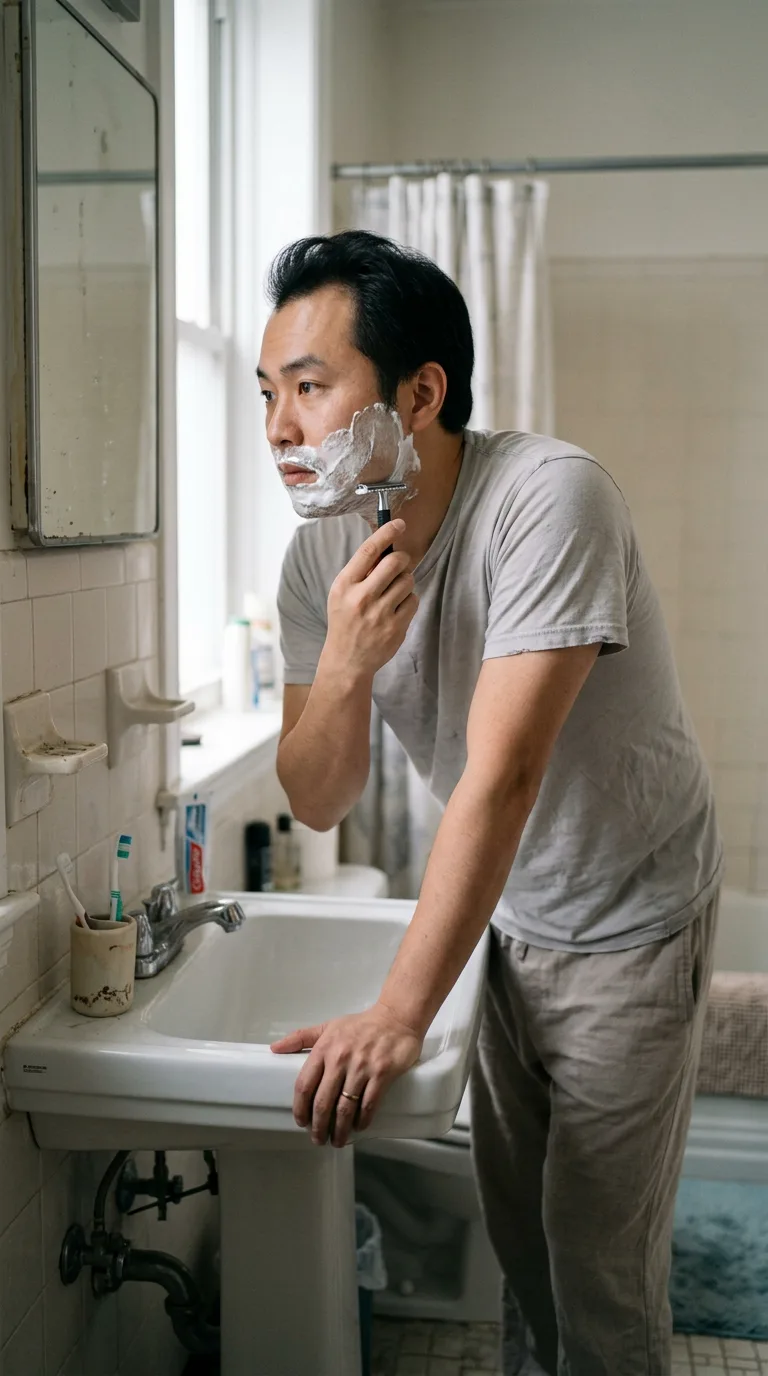
Rarest thing about him: An autoimmune condition — rare, 1 in 66
Season 0seed 1226945401 · engine v10
Character card
lineage 2NZHHJ
His body-swap story
@colin.hasbrook, wearing Cole Bertrand, rolled the wheel on and woke up as David Yoon, spent under a minute in him, then spun the wheel and woke up as Danny Fiorillo
You are Cole Bertrand for less than a minute, and already you know it isn't going to work.
You are standing in a trench in New Orleans heat that has no business being this thick on a Monday afternoon, and the trowel in your borrowed hand keeps catching on a root that isn't a root, and there is a supervisor twelve feet away asking Cole a question that Cole — that you, wearing Cole — do not have the first idea how to answer. Twenty-five years old, hazel eyes squinting against glare, blond hair gone dark with sweat at the collar, and underneath all of it a body that knows fieldwork the way you never will. His hands want to brush soil in figure-eights, patient, practiced. Your wanting doesn't fit inside them. It hasn't fit inside anybody for a while now, if you're honest, which you are not going to be, not even alone in your own head, not even now. It is not boredom exactly. It is the particular itch of a life that was interesting for exactly as long as it took you to realize you'd have to keep doing it. You set the trowel down mid-stroke. Nobody around you notices anything, because nothing has happened yet where they can see it. You are already gone.
The sink is cold porcelain under his left hand and the razor is warm from his own skin under his right, and the second half of his jaw goes smooth in one clean pass that his old rhythm never allowed — no pause at the corner of the mouth, no careful little check. You do it without hesitating because you don't know yet that there's a hesitation missing. Foam still cools on the other cheek. The mirror in front of you is spotted at the corners, and behind you a shower curtain hangs slightly translucent with steam that hasn't started yet, and outside the window it's brighter than a body ready for sleep should be looking at.
That's the thing that comes first, before anything else: the light is wrong for him. David worked until four in the morning showing a Bushwick two-bedroom to a couple who couldn't decide, and got home and lay in bed not sleeping until past dawn, and only went under an hour ago, and here he is at the sink at an hour his body reads as the deep middle of night pretending to be a normal man's morning. The tiredness comes up through the soles of his feet first — a bone-tired that has opinions about being awake at all. Then the shirt. It's not on him yet, it's draped over the towel bar, pale blue, and touching past it with a wet hand gives you a full year in half a breath: him buttoning this exact shirt in this exact bathroom before a closing that fell through twice before it held, him practicing in the mirror the sentence he'd say to the sellers, him too warm in the blazer at the signing table and not letting it show. The blazer itself, gray wool-flannel, hanging on the door — that one comes with cold: an open house in February, his knuckles white around a lockbox, an older couple asking him three times whether the roof was new, a commission check that mattered more than he'd ever admit to anyone he was related to.
His body is thirty-six and carries it in small ways only he would notice — a stiffness low in the back that flares without warning, some mornings worse than others, an inflammation that has a name he's tired of saying out loud to doctors. His jaw aches faintly on the left, an old habit of clenching in his sleep. His hands, when they aren't doing anything, want gum — the ghost of spearmint sits at the back of his throat for no reason at all. There's a hairline receding at both temples that he stopped fighting two years ago, and a wedding ring's worth of muscle memory in a hand that hasn't worn one in eleven months, since Priya packed the last of her plants out of the apartment and didn't leave a forwarding address, only a note about the lease. He thinks of her sometimes brushing his teeth. He is thinking of her now, a little, underneath everything, the way you think of a bruise you keep testing.
Church comes back through the smell of the soap — his mother's kitchen, incense on Sunday, a candle he lit for his father two winters ago and the quiet he found kneeling that he has never once explained to a client or a date or himself in words that satisfied him. He believes, plainly, unfashionably, the way he was raised to. It sits in him like furniture, not like an argument.
You feel all of it arrive in no particular order, stacked instead of sequenced, his whole ordinary unremarkable weight settling into a body that is — you notice this last, the way you always do — nothing special to look at, nothing anyone would point to on the street. Average height. Average build. A face so unmarked by anything dramatic that it could belong to a hundred men getting off a hundred trains. That is exactly, precisely, why you're here.
You look down. The razor is still in your hand, foam-flecked, and past it your fingers — his fingers — blunt-nailed, a little dry at the knuckle, a faint ghost-groove where a ring used to sit. You turn the hand over once, like checking it for a flaw, and there isn't one, and that's the part that satisfies something in you that boredom in Cole Bertrand's trench never touched.
You look up into the spotted mirror, into brown eyes that are yours now and were never yours a minute ago, and you say, to no one, in his voice, testing its weight like a coat:
"Okay. Let's see what you're worth."