Danny Prusak
Fictional. Generated by AI — not a real person, and no likeness of one is intended.
20, student in Pittsburgh · rolled by @colin.hasbrook · card — no film
History
who has worn him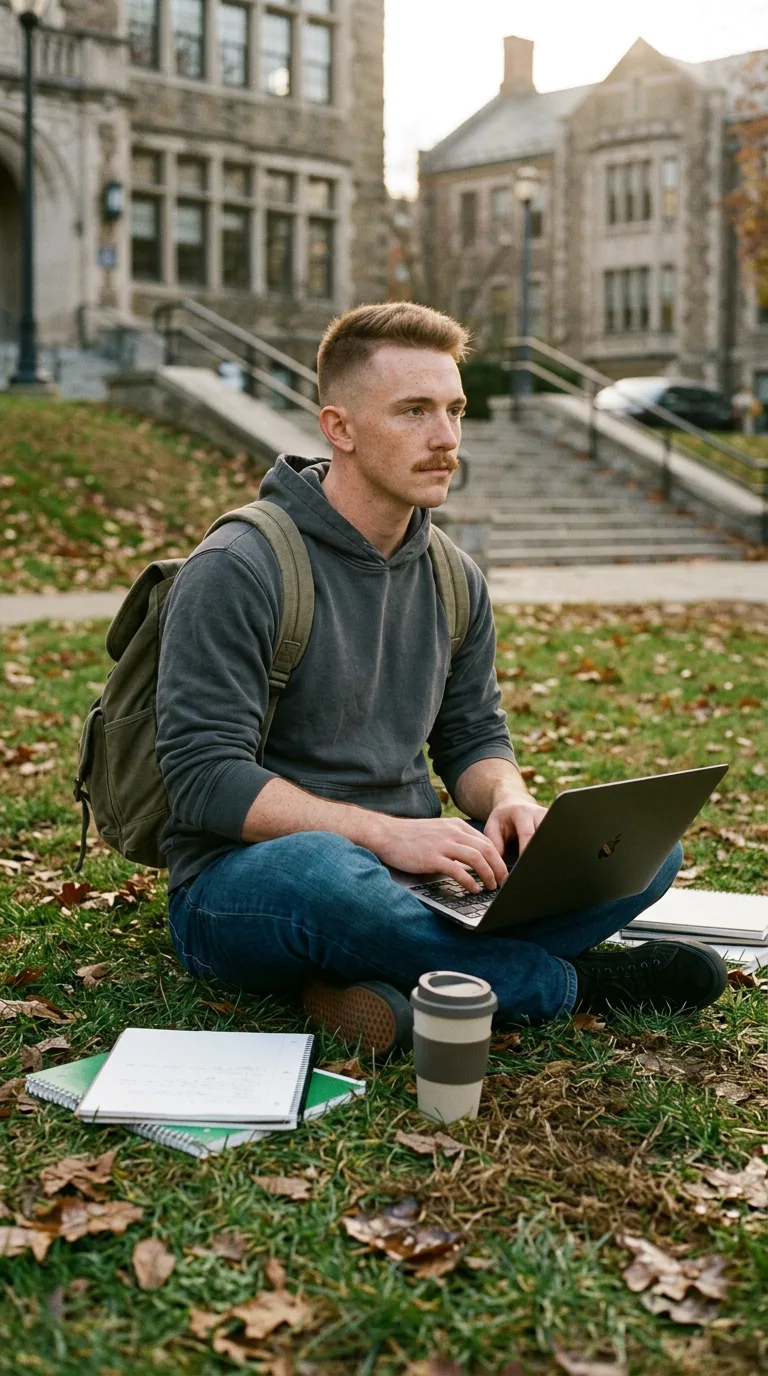
Rarest thing about him: 5'4" — common, 1 in 30
Season 1seed 1292423348 · engine v11
Character card
lineage 2NZHHJ
His body-swap story
@colin.hasbrook, wearing Roger Ambrose, rolled the wheel on and woke up as Danny Prusak, spent 5 hours in him, then spun the wheel and woke up as Hamza Odeh
Roger Ambrose's office chair creaks under you the way it always does, the way it has creaked under you for less than a minute now, and already you hate the sound of it. Gray-silver hair catching the Atlanta window light. The beard you keep meaning to shave off him. Blue eyes looking at a spreadsheet of numbers that mean nothing because Roger's job was never yours, only borrowed, only worn. You feel his gut press against the desk edge, his knees complaining under the weight he carries for both of you. Sales figures. A phone with three missed calls from a client who wants to yell at somebody. This is what 817 spins bought you: a heavy, tired, gray man in a beige office on a Thursday afternoon, and the specific, itching knowledge that you have felt this exact tiredness in a hundred other bodies before this one. It is not boredom exactly. It is more like hunger arriving on schedule. You open the laptop, and vessel.cards loads the way it always loads, patient, gray, a wheel waiting in the middle of the screen like it has been waiting for you specifically. Roger's thick finger — your finger, for now — taps the button. The wheel spins. You are already leaving him behind before it stops.
There is no falling, no darkness, no travel. There is a keyboard under two hands that are not thick and are not old, and there is grass underneath crossed legs, and there is a laptop screen with a half-written paragraph on it about supply elasticity, and there is a beat — one beat — where the hands type the wrong key, backspace, and then correct, slow and deliberate, like a man walking a line he's walked a thousand times but suddenly wants to look down and check his feet. Ten keystrokes come out careful. Checked. On a task that hasn't needed checking since high school. Nobody sees it. Nobody is looking that closely at a guy on a lawn.
The moustache is the first thing you feel without meaning to — your own hand, unbidden, brushing up under your nose the way his hands do when he isn't thinking, and it isn't your gesture, it's his, arriving through the motion itself. Through that touch: a flash of a bathroom mirror, fluorescent, this same face at eighteen deciding to grow it out because his father had one in every photo from the eighties and it seemed like a thing you inherited rather than chose. Freckles under his eyes in that mirror, pale in winter, gone dark with a summer he spent roofing houses with his uncle's crew for cash, shirt off, shoulders burning first and then just brown, and the ache of that work still sitting somewhere low in his back even now, a good ache, an earned one.
The backpack strap is still crossing your shoulder, and through the strap comes this morning — his morning, hours behind Roger's afternoon, the sun barely up over the row of houses with the public stairs cut between their yards, wet leaves gone dark and slick on the concrete the way they get every November. Danny Prusak going down those stairs two at a time in the cold, breath visible, backpack thumping his spine, on his way to a shift that started before the sun did, because his schedule this semester has him opening the campus coffee stand at an hour no one sane should be awake for. The job that's paying for the apartment he splits with two guys from his econ program. The hands know that counter without looking — pulling shots, tamping grounds, the twist of the steam wand — ten thousand repetitions of a motion so worn into him that when the arrival happened, mid-shift, it barely registered as anything but a half-second stumble, one pour poured wrong and corrected, one line of foam drawn too carefully and then the next nine after it, checked, checked, checked, until the rhythm came back and nobody behind the register noticed a thing.
The hoodie against your back gives you more: a girl's laughing voice, Maren, the smell of her shampoo when she fell asleep against this exact shoulder watching something neither of them finished, a Tuesday that felt like it belonged to nobody else in the world. Church on Sundays with his mother because she asked him to and some small stubborn Catholic thing in him still can't say no to her about that, even now, even living on his own. The stairs again — he thinks about the stairs a lot, weirdly, the way the wet leaves make you place your feet with intention, the way his father taught him to walk down icy steps sideways, one hand on the rail, years and years ago, before his father was somebody he only saw at Christmas.
The jeans at your knees remember the shift's second half, still ahead of him now stalled in this stolen freeze-frame — the lunch rush, the sticky mats behind the counter, his manager's bad jokes, the ordinary Thursday afternoon he was going to have before you arrived in the middle of it wearing him like his hoodie.
You feel how small this body is compared to the one you left — five foot four, wiry, compact, a build that had to work for every ounce of muscle instead of carrying it like Roger did, unwanted. Twenty years old in every joint. Nothing hurts. Nothing has had time to hurt yet.
You look at your hands. Freckled, young, a little rough at the knuckle from the espresso machine's heat, moustache-boy hands, and they don't feel like a stranger's, not exactly — they feel like the newest thing you've ever worn.
You look up into whatever's in front of you and you say, quietly, mostly to no one: "Who left the register open."