Danny Okamura
Fictional. Generated by AI — not a real person, and no likeness of one is intended.
52, construction laborer in Las Vegas · rolled by @colin.hasbrook · card — no film
History
who has worn him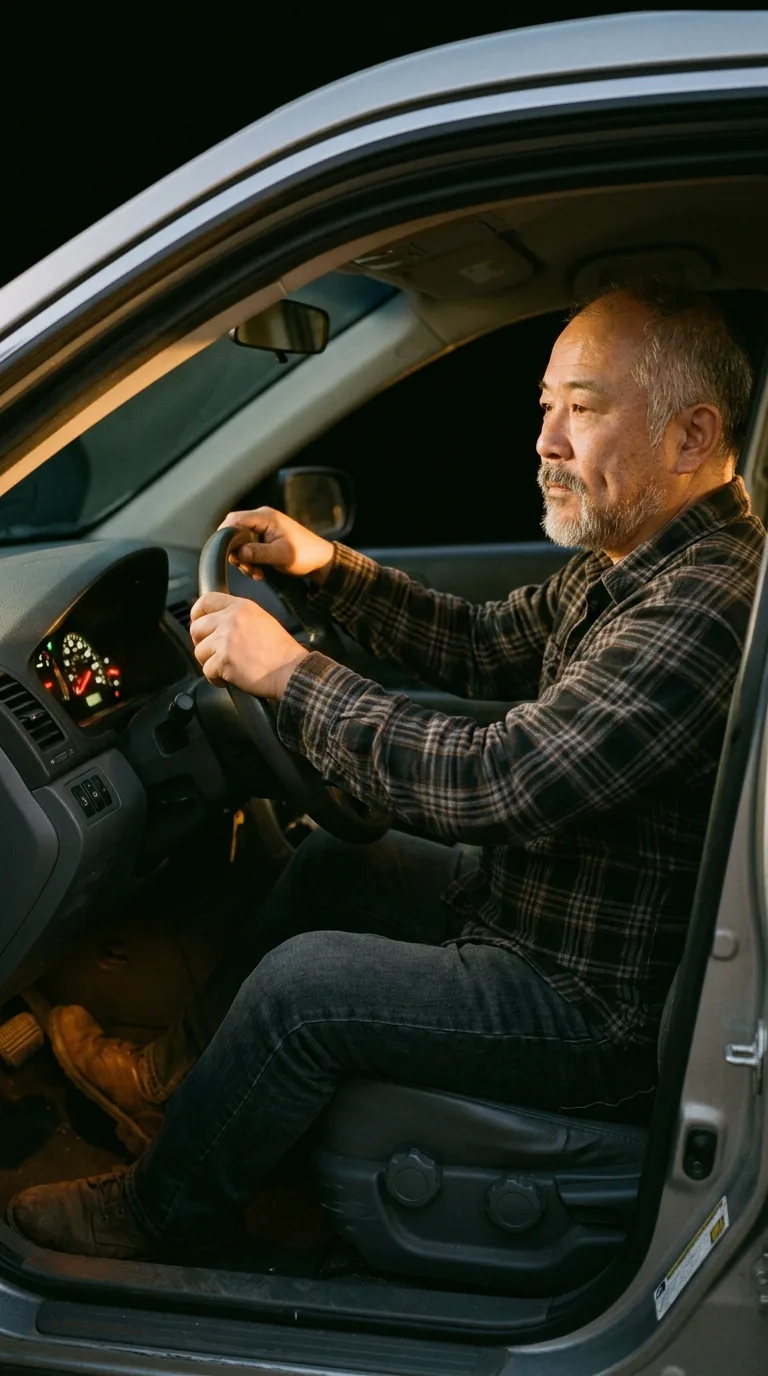
Rarest thing about him: Covers the gray — common, 1 in 34
Season 1seed 1691734905 · engine v11
Character card
lineage 2NZHHJ
His body-swap story
@colin.hasbrook, wearing Cole Bertrand, rolled the wheel on and woke up as Danny Okamura, spent under a minute in him, then spun the wheel and woke up as Gerald Stanek
You are Cole Bertrand, twenty-three hours short of two full days, sitting cross-legged on a dorm bed that isn't yours to keep either, and the wanting comes back the way it always does — not as boredom exactly, more like an itch behind a face that was never really your face to itch. Cole's roommate knocks and you don't answer. Cole has a girl who texts him three times in the last hour and you don't answer that either, because none of it is yours, none of it ever was, and there are six hundred and eighty-six men behind you already and the six hundred and eighty-seventh is just a number waiting to stop being a number. You open the laptop. The wheel is already loaded from last time, spinning lazy and gold under your cursor, and outside Cole's window it's going dim over New York, that blue hour where the day admits it's over. You click before you can talk yourself into anything more honest than *why not*.
The wheel spins through men you'll never meet the versions of.
It lands on dash light and a plaid sleeve and both hands at ten and two, and then it lands, simply, on you.
The car is already drifting — not your drift, his, some small correction against fatigue, and then the wheel is under fingers that are shorter and thicker than the ones you had a half-second ago, knuckles broad, a little swollen at the joints, catching the green wash of the dashboard. The hands come off the wheel on their own, resettle lower, wider, more sure of themselves than you are. The blinker starts ticking for an exit that means nothing to you yet. Outside it is the flat brown afternoon light of a desert highway, and that wrongness — afternoon, when the last thing you knew was evening — sits in you for exactly as long as it takes to stop mattering, because now you are breathing through a chest that carries weight low and easy, a stranger's tiredness already sitting in the shoulders like it's been there since noon.
The shirt is what opens first — flannel, worn soft at the elbows, and it comes back not as a fact but as a feeling: an early morning three days ago, cold enough in the garage to want sleeves, one arm in and then the other, the small satisfaction of a shirt that's been through enough washes to stop fighting you. Danny. The name arrives folded into the collar of it, the way his girlfriend says it different from how the foreman does. Rosa says it soft, half a laugh in it, when she hands him coffee at five a.m. before he's fully a person yet. The foreman says it flat, two syllables and a nod, *Okamura, trench four.*
The wheel under these hands knows something — decades of it, the memory not of one drive but of thousands stacked into the muscle: the particular give of this steering column, a shimmy at sixty that means the alignment's off again, the spot on the wheel worn smooth where his palm sits without thinking. And under that, deeper, the shovel — the actual shape of a day's labor comes up through his forearms like heat off asphalt, the mini excavator's engine note, the specific ache that lives in his lower back by two in the afternoon and never fully leaves by the time he gets home to leave it in a hot shower. Fifty-two years in this body and it shows him its accounts: the hard hat's plastic sweatband, the taste of dust that never quite rinses out, his hand going up over his scalp — that gesture that isn't nerves, isn't habit exactly, just something his hand does when there's a lull, feeling for the hair that used to be thicker, finding the smooth place at the crown that the comb-over pretends isn't there.
There's a son somewhere in the glove compartment, a scrap of memory that surfaces when his knee brushes it — a boy, grown now, a birthday card that came late and was loved anyway. There's church on the Sundays he isn't too tired, an usher's handshake, a hymn he doesn't need the book for. There's Rosa's kitchen light on right now, three miles ahead, and the specific, uncomplicated wanting to be home in it — no drama in that wanting, just weight, just a day ending the way ten thousand days before it ended, badly wanting a chair that isn't a truck seat.
You feel all of it land in a body that is shorter than the one you left, softer through the middle, dad-bod solid rather than young-man lean, hands wide and sure and already dyed with grease under the nails that no soap fully gets. It does not feel like a costume. It feels like sitting down hard into a life that was already moving at sixty-five miles an hour.
The blinker keeps ticking for the wrong exit. You bring the hands back up, straighten the wheel, and for a second — his second, borrowed — you almost apologize to no one for nearly missing his own turn.
You look down at them first. Callused, spotted at the knuckle, a stranger's hands wearing his rings of dirt like they've always been there, because to this body they always have.
"Almost missed my exit," you say, to the empty car, in his voice, and you don't know yet if that's a lie or the truth, or how long you get to keep testing which.