Danny Han
Fictional. Generated by AI — not a real person, and no likeness of one is intended.
50, streamer in Philadelphia · rolled by @colby.marsh · card — no film
History
who has worn him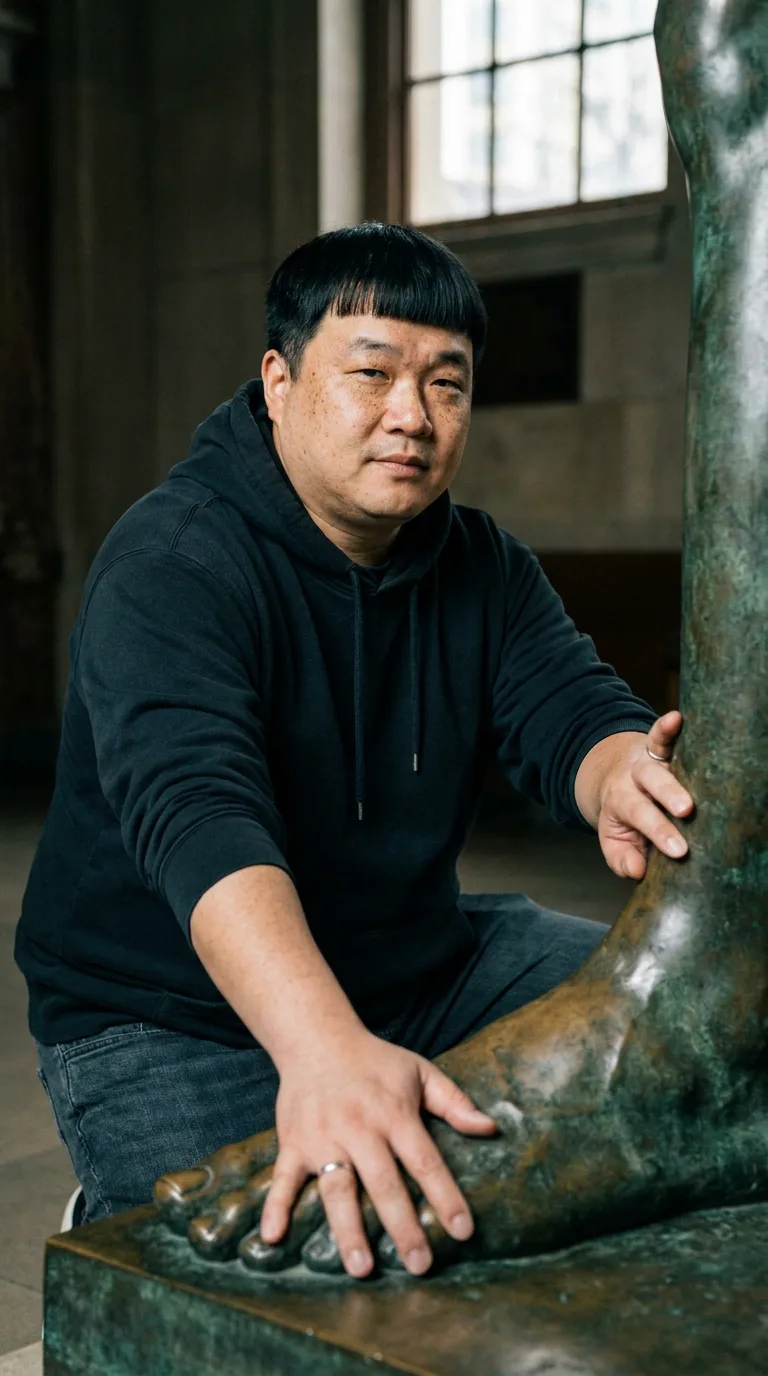
Rarest thing about him: A caesar — rare, 1 in 66
Legacyseed 393047433 · engine v6
Character card
His body-swap story
---
You are nobody's. That is the first fact, and you have carried it so long it stopped being grief and became a kind of weather.
You do not know his name when you put your hand down. You know only that the light in the station concourse is the color of weak tea, that the bronze foot is polished to green-gold where a hundred thousand palms have rubbed it, and that a man in a black hoodie has knelt at the base of it like a pilgrim who isn't sure what he's praying to. He's got both hands out. One flat on the toes, one up on the shin. Heavy shoulders. A haircut like his wife does it in the kitchen — black, blunt, straight across the forehead, no vanity in it at all. And freckles. That's the thing you notice, that's the thing that undoes you before anything else happens: freckles scattered over the nose and up onto the cheeks, dark on that skin, a spill of them, the kind of face a person gets born with and never quite grows into being serious about. You didn't expect freckles. You expected a stranger.
You put your hand on the same foot. There is no reason for it. You are drifting through a place with a ceiling high enough to hold weather, and a man is touching a statue, and you want — you have wanted for a long and unmeasured while — to touch the same thing as somebody.
The bronze goes warm. Not sun-warm. Blood-warm.
Then you are behind his eyes.
---
Here is what a life feels like from the inside on the first second.
Sugar. A slow wrongness in the blood, a thirst that lives under the tongue and never lifts. Type 2, five years of it, a phone alarm at nine and again at nine at night, a wife who counts things on his behalf. The knees complain about the kneeling. The lower back has a pinch in it from ten hours a day in a gaming chair. There's a small numb patch of gum where the dip sits, and the ghost of mint and tobacco in the back of the throat, and shame about it, the specific domestic shame of a fifty-year-old man who spits into a Gatorade bottle and hides the bottle.
And under all of it, the thing you actually stole: a whole warm crowded room of people who belong to him.
Danny Han. That's the name that comes up when you reach for it, the way a word comes when you stop chasing it. Danny Han, fifty, of a rowhouse on a block in South Philly where the marble stoops are worn hollow in the middle like soap, where at six in the morning the first sun comes down the street level and low and lights the whole row of them up white. Two kids, both grown enough to be embarrassing to and be embarrassed by. A wife named Grace who leaves his insulin pen on the counter with a Post-it that says EAT SOMETHING FIRST, IDIOT, and means it as an endearment, and he takes it as one.
An ex-girlfriend, too, from eight months ago, and this is the part he was praying about at the statue's foot, if he was praying. You get it all at once, unsorted, the way you get a house when someone dies. A woman from the internet. A donor with a good voice who became a Discord DM who became six weeks of something he will not name even to himself. It ended. He ended it. He has not told Grace. He came down here because a therapist he can't afford twice a month said *go somewhere with a high ceiling and be honest with yourself*, and he walked and walked and ended up at a bronze figure and put both hands on its foot and asked whatever's out there — he's spiritual, not religious, he'd say it just like that, a little apologetic — asked it to make him a man who could sit at his own kitchen table.
You are, at the moment of arrival, the answer to that prayer, and you are the worst possible answer.
---
The other hand lifts away from the bronze. Yours stays. You feel the metal cool under the palm, ordinary, a statue again.
You take his hand back and you hold it up in the tea-colored light and look at it. Wide palm. Short nails. A plain gold band, thin, no engraving you can see, worn down on the inside from twenty-two years of being turned by a thumb. You turn it with his thumb. It's a gesture that was already in the hand; you just gave it permission.
You look at it like a gift because it is one. That is not a figure of speech and it is not innocence. Nobody has ever handed you anything before.
---
The first week you are very careful and very bad at it.
The stream is the easiest part, which surprises you. He works from a corner of the back bedroom, desk rig, three monitors, a keyboard that sounds like rain on a tin roof, RGB strips behind the shelf cycling slow through violet and cyan and back, and a camera light that snaps on white and makes his face into a face on television. Sixteen hundred people watch a fifty-year-old man play games badly and talk about his day. You expected to have to be him. You don't. You only have to be somebody in that chair. You say less than he did. Chat says *bro are you good today.* You say, in his voice, which is lower than you expected and has a little Philly in the vowels, "I'm figuring some stuff out." Nine hundred people type hearts at you. You have to take the headset off.
The freckles are what get you in the mirror. You stand in the bathroom under a bulb that isn't kind and you put his fingers up on his own cheek — his hands do that, you learn, they go to his face all on their own the second his attention wanders, thumb along the jaw, knuckle to the cheekbone, an old self-soothing that predates you — and you press the pads of his fingers over the freckles like you could count them. Thirty-something on the nose. More on the left cheek than the right. Somebody made this. Somebody's mother has a photo of this face at six, freckled, fringe cut straight across with kitchen scissors, and the fringe is still straight across because that is who he decided to be and he never revisited the decision.
You cannot ask her about the photo. That's the shape of the theft. It is not a body you took; it's a witness.
---
Grace knows something in nine days. Not the truth — there is no room in a life for the truth of this — but something. She stands in the kitchen doorway and says, *You've been nice to me.* Like an accusation. Like a woman who has been braced for a blow for eight months and cannot bear a kindness arriving instead.
You look at her over the rim of a coffee cup with his brown eyes and you know everything he did and none of the reasons, because reasons don't transfer, only facts do. You have his memory of the woman from the internet and none of his hunger for her. That's the mercy in this, if there's one anywhere: you inherited the debt without the appetite.
So you say it. Not all of it. The shape of it. You sit down at the kitchen table and you tell her there was someone, and it's over, and it was eight months ago and six weeks long and he — you say *I*, you have to say *I*, you have never said *I* about anything before and the first time you use it is to confess a sin you didn't commit — and you watch her face do a thing you will be paying for as long as you live in this house.
She cries in the pantry with the door shut. You stand in the hall with your palm flat against the door like a hand on bronze.
You are the one who has to live in what he did. He got the six weeks. You get the rest of the marriage. You would not trade. That is the fact you keep turning over like the ring on the thumb: you would not trade.
---
There is no way back. You checked. You went to the concourse in the first month and knelt at the base of the bronze and put both his hands on the foot and asked, and the metal was cold, and a guard asked if you were all right, sir. Sir. You said yes. His knees hurt on the way up.
So: for good. Fifty years old, five foot six, two hundred and some pounds, a bad pancreas, a good marriage in intensive care, two children who call you Dad and mean him, and a chair with a light on it where sixteen hundred strangers are waiting for you to say something.
You take the insulin. You take it on time, you took it on time from the first day, because whatever else you are you are not a man who wastes a body. You quit the dip in March and it was the hardest thing you have ever done and you have done nothing else, so the comparison is meaningless, and you tell chat about it anyway, day forty, day ninety, and they clip it and it goes further than anything he ever made.
In summer you get up early and sit out on the stoop with coffee. The marble is cool through his sweatpants, worn hollow in the middle by a century of people sitting exactly here. Down at the corner the first sun comes level along the row and lights up every white step on the block at once. You put his fingers on his face without deciding to. Thumb on the jaw, knuckle on the cheekbone, over the freckles.
Somebody made this face and then left the door open, and you walked in, and you are going to be good in it. Not because you deserved it. Because it was given, and nobody ever gave you anything before, and you find you cannot stand the idea of giving it back worse than you got it.