Danny Escobedo
Fictional. Generated by AI — not a real person, and no likeness of one is intended.
32, bouncer in Pittsburgh · rolled by @marco.villagrana · card — no film
History
who has worn him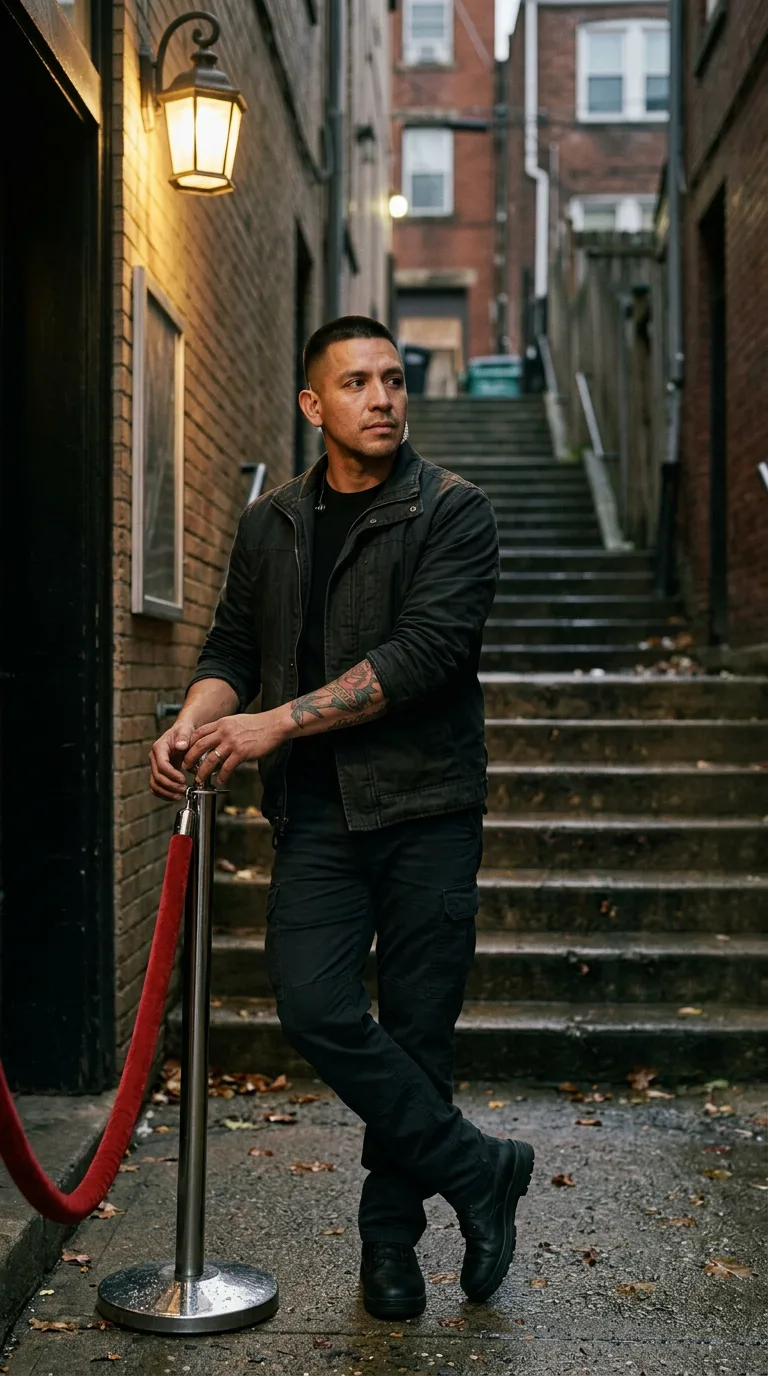
Rarest thing about him: Can't stand still — rare, 1 in 51
Season 0seed 1360810160 · engine v10
Character card
lineage LJL8SV
His body-swap story
@marco.villagrana, wearing Saul Rosenthal, rolled the wheel on and woke up as Danny Escobedo, spent 4 minutes in him, then spun the wheel and woke up as Kaimana Souza-Fetu
---
The gold tooth catches the light every time Saul Rosenthal opens his mouth, and by minute three you already hate it. Not him — you don't hate him, you barely know him, you've been him the length of a cigarette you didn't smoke because he quit thirty years back too — but the tooth. The way it clicks faintly against the others when he talks. You are standing in the vestibule of a train that isn't moving, Monday evening bleeding orange through dust on the window, and you already know this is not the one. Sixty-three is a fine number to be but it sits on you like borrowed boots, and the light out here is the tired kind, the kind that makes a rural stretch of Texas track look like the end of something rather than the middle. You did not spin fifty times to end up somewhere the day is already closing. You want more evening left in you. That's all it is. That's all it ever is, if you're honest, which you are not going to be, not even to yourself, not really.
You take out your phone — his phone, cracked case, a photo of a granddaughter you have never met set as the wallpaper — and you open the page with the wheel on it, and you spin.
There is no seam. One half-second you are lifting a lantern to check a coupling that does not need checking, and the next you are a different weight entirely, shorter, denser, thirty years younger in the knees, standing with your hand already closed around cold steel — a stanchion, a rope looped through it, red velvet gone a little matted at the seam. Your own — his — breath goes out through your nose in a short practiced huff, breath that has done this exact motion ten thousand times: unclip, re-clip, check the line, nod the next four in. Your hand does it wrong. Fumbles the clasp, feels the wrongness of it a half-second before you do, and does it again, slow, deliberate, like a man double-checking a knot he's tied since he was nineteen. The next ten people through the rope get the same treatment — checked, each one, on a job that stopped needing checking years ago.
The jacket is what gives you the first of it — canvas gone soft and grease-dark at the cuffs, and under your palm where you touched the zipper pull there's a flash: a coat store on the South Side, a guy named Freddie behind the counter saying *that one, that one right there, that's the one that'll last you*, and it did, it has, four winters now and it still holds the cold out at the door where the wind comes down off the stairs. Danny Escobedo bought this jacket the year he made it eighteen months at The Vault without missing a shift, and he remembers thinking that was worth something, that staying somewhere a year and a half was itself a kind of promise he could keep.
The shirt under it, black, plain, you feel it settle against your back and it brings the morning whole: him standing in a bathroom with bad light, pulling it on inside out first, laughing once at himself, alone, no one to laugh with, flipping it right-side and doing it again. Coffee he didn't finish. A missed call from Marisol that he meant to call back before the shift and didn't, and the small guilty itch of that sitting under his ribs all day the way it always does, low-grade, the kind of thing his therapist calls a pattern and he calls Tuesday. He takes the pills at the same time every night, small orange bottle on the bathroom shelf, and has for three years, and it works, mostly, except on nights like tonight when the itch shows up anyway just to prove it still can.
The tattoo on his forearm warms under the sleeve when you notice it's there — rose, dagger, banner beneath it faded to the color of an old photograph — and that one goes back further, twenty-two years old and stupid with a woman named Renata, the first one, the one whose name he still doesn't say out loud in front of Marisol because some things you just don't hand a person you're building something new with. Renata is the one who got away, not because she left him but because he was the one who couldn't stay, back then, and some nights — not tonight, tonight he's steady — some nights he still runs the tape of what he'd say to her if the rope ever let go and she walked up out of the dark and got in line like everyone else.
The boots under you know this concrete without being told — the crack by the second stair, the wet leaf that's been sitting greasy on the third step since October, the give of the mat right at the door. Athletic weight, thirty-two years in a body that has never once let him down at this rope, hands that will not sit still even now, tapping once against the stanchion, an old tic older than the job. Ring on the right hand — not married, just a ring, a habit, something Marisol laughs at and he never explains.
The line moves. Somewhere behind you the lamp over the door hisses faint and gold, and up the alley the stairs climb into a dark that smells like wet brick and somebody's cigarette three windows up, and none of it — none of it — needed you at all. He would have unclipped that rope the exact same way with nobody home behind his eyes.
You look down at your hand on the stanchion, brown and blunt-knuckled, a stranger's ring on a stranger's finger, and you turn it once in the lamp light like you're checking it for a tag.
"You're up," you say, to the four people waiting, to no one, to him — and step back, and wave the next one through.