Danny Cabral
Fictional. Generated by AI — not a real person, and no likeness of one is intended.
22, soldier in Los Angeles · rolled by @colin.hasbrook · owned by @colby.marsh · card — no film
History
who has worn him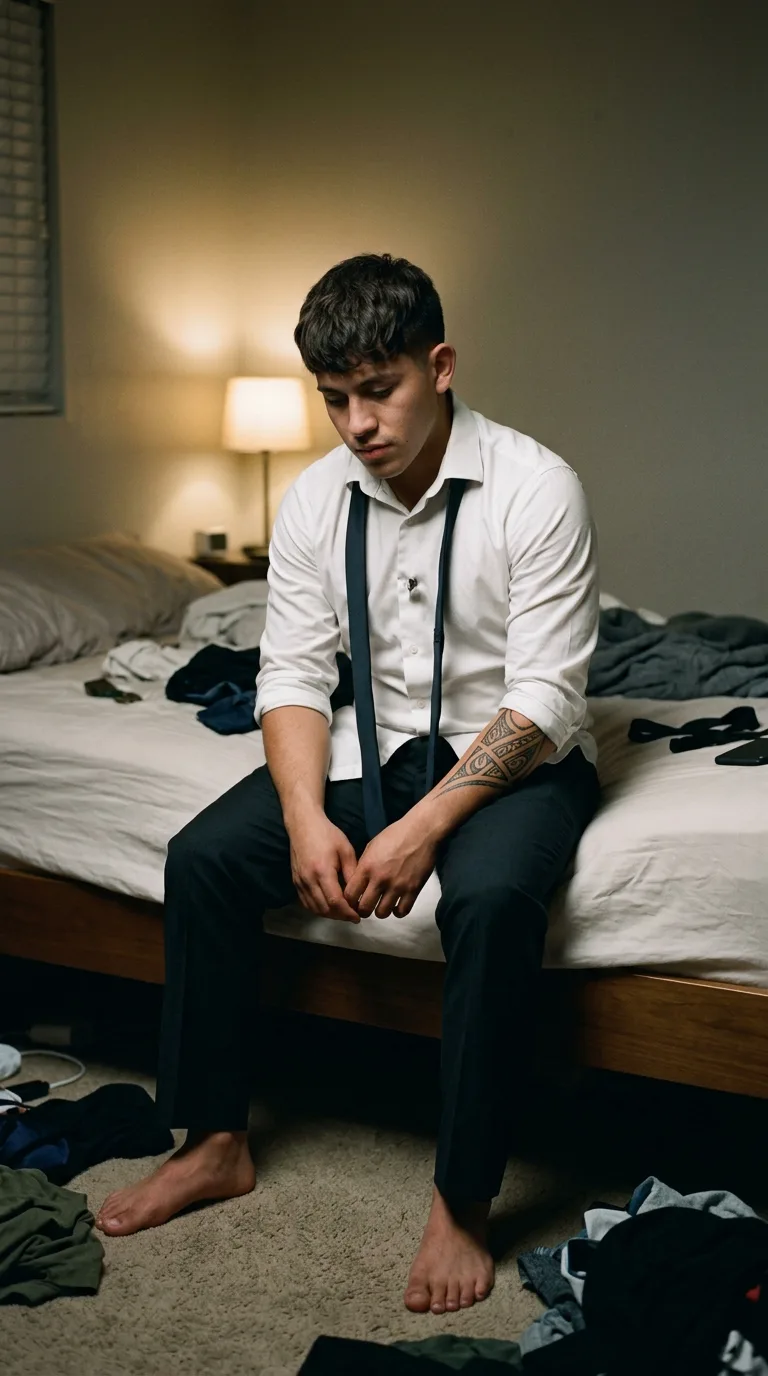
Rarest thing about him: Epilepsy — epic, 1 in 171
Season 0seed 83808737 · engine v10
Character card
lineage 2NZHHJ
His body-swap story
@colin.hasbrook, wearing Óscar Beltrán, rolled the wheel on and woke up as Danny Cabral, spent 1 minute in him, then spun the wheel and woke up as Marlon Iverson
---
The horse doesn't like you today, and that's the first thing.
You've been Óscar Beltrán for less than a minute, and already the animal in front of you — a big gray gelding, patient with everyone else on this property — is pulling its foot back from your grip like it can smell something wrong. It probably can. Forty-seven years in this body and you inherited none of its instincts, only its knees, which ache, and its gut, which hangs low and soft over the belt, and its hands, thick-knuckled and sure around a rasp until about ninety seconds ago when they became yours instead of his. It's before dawn in Brisbane. Cold enough that your breath — his breath — shows. Somewhere behind you a kettle is starting to complain on a stove you've never used, in a kitchen you walked through once, this morning, like a man checking into a hotel he'll never see again.
You didn't come here for the horse. You came here because Óscar Beltrán, whoever he actually was, is not a life so much as a chore with a body attached, and you have spent your allotted minute inside him mostly noticing that his lower back has opinions about bending over. Ninety-five other men live in you now, filed away like coats in a closet too full to close, and every single one of them was more interesting in the first sixty seconds than this one. That's the whole reason, if you're honest, which you're not required to be. Boredom. A body that works fine and simply isn't worth wanting. So you leave the shoe half-set on the anvil, walk back toward the house past a dog that doesn't know to be suspicious of you yet, and open the site on a phone with a cracked corner, the wheel already spinning before you've finished sitting down.
—
The wheel stops and the world underneath you changes shape entirely, mid-breath, mid-motion, no seam between one and the other.
You are sitting. Barefoot, on a made bed gone half-wrecked with thrown clothes, and your hand — smaller now, younger, a hand that has never known a rasp or a horse's underside — is flat against your own chest, feeling the ribs move under a shirt that's on wrong. Afternoon light through blinds, thin gold bars across the carpet. A tie hangs loose and unknotted around your neck like it gave up. The top buttons don't match their holes. You feel that before you see it — some wrongness registering in fingertips that already, on some level below thought, know exactly how this shirt is supposed to sit, because they've done it hundreds of mornings before today, just never with you inside them.
The buttons come undone. Then, without you quite deciding to, they go back up, correctly, one after another, fast, the way a task gets handled by muscle that learned it long before you arrived. The tie knots itself into something neat and narrow that this bedroom, this closet, has apparently never seen — an accident of your hands doing what they know from ninety-five other closets, ninety-five other ties, layered now under fingers that are twenty-two years old and don't recognize the motion as unusual at all.
—
The shirt is the first thing that talks to you, because it's the first thing you're really touching, and it doesn't waste time.
It comes back sleeve first — this morning, or what was his this morning, standing at an open closet in this same dim light, humming nothing, dog-tags cold and then warm against the sternum before he even had the shirt on, tags he touches without looking, an old habit, worn smooth at one corner from a thumbnail that's worried it a thousand times. Danny Cabral. The name arrives with the shirt somehow, folded into the collar like a label. Base is a forty-minute drive. He's due at eleven-hundred, dress uniform, some ceremony he doesn't care much about but has to stand still for — and under that, plainer and heavier, the fact that eleven in the morning is not morning for him at all, it's the hour he's usually still climbing toward sleep, because the schedule they've had him on this month runs him through the night and spits him out somewhere around dawn feeling like he's swallowed static. He is dressing for a day that started for his body sideways, at the wrong end of exhaustion, and some of the shakiness in these hands — small, easy to miss — isn't nerves. It's just tired, worn thin the way a wire gets before it finally goes.
The tattoo on the forearm gives you the shop, the buzz of the gun, twenty years old and stupid with a friend who's since moved to Sacramento and stopped texting back, the tribal pattern chosen off a wall because it looked like something and not because it meant anything, which he half-regrets now and half doesn't.
The tie — narrow, navy, cheap — gives you a girl's hands adjusting it for him once, laughing at how he couldn't do a full Windsor to save his life, her fingers quick and sure at his throat in a kitchen that smelled like her candles. Marisol. Nine months now. She likes that he's steady, she says, doesn't know yet that steady is partly a thing he built on purpose after the last one, after Ana, after two years of a version of himself that flinched every time his phone lit up. Ana still surfaces sometimes at odd hours — not wanted, not fully gone — a text he didn't answer last month that he still thinks about more than he'd admit to Marisol or to himself.
The carpet under your bare feet gives you almost nothing, just cold, ordinary, a floor he's crossed ten thousand times.
But your own skull gives you the other thing, the thing nobody else in this apartment knows to watch for — a warning that lives just behind the eyes, a flicker he's learned to recognize in himself the way you'd learn a neighbor's car by its engine sound alone: too little sleep, too much of yesterday's one beer, a flash of light through blinds hitting wrong, and some circuit in here will occasionally just — go. He carries a card in his wallet about it that he's never once had to hand to anyone, and a girlfriend who knows and a mother who doesn't, and a private, constant arithmetic about how many hours he's slept that he runs without ever mentioning it aloud. It sits under everything else in him like a floor that's mostly solid.
Your hands know how to strip a rifle blind, how to stand at attention until your knees lock without swaying, how to fold a shirt into a square tight enough to bounce a coin off — twenty-two years of a body that is, whatever else is true of it, young and quick and entirely uncomplaining in a way Óscar's never was. It is a relief you didn't know you were waiting for, moving in something that doesn't ache first and answer second.
—
You look down at your own hand — his hand — turning it over in the gold afternoon light, watching the fingers open and close like you're testing whether they'll do it twice.
Then you lift your eyes to find the phone lying screen-down among the thrown clothes, and past it, without meaning to, straight into whatever is watching.
"Wrong tie," you say, low, almost amused, not sure yet whether that's true or whether it's just the first thing this mouth wanted to say.