Danilo Reyes
Fictional. Generated by AI — not a real person, and no likeness of one is intended.
61, paralegal in San Francisco · rolled by @danilo.reyes · card — no film
History
who has worn him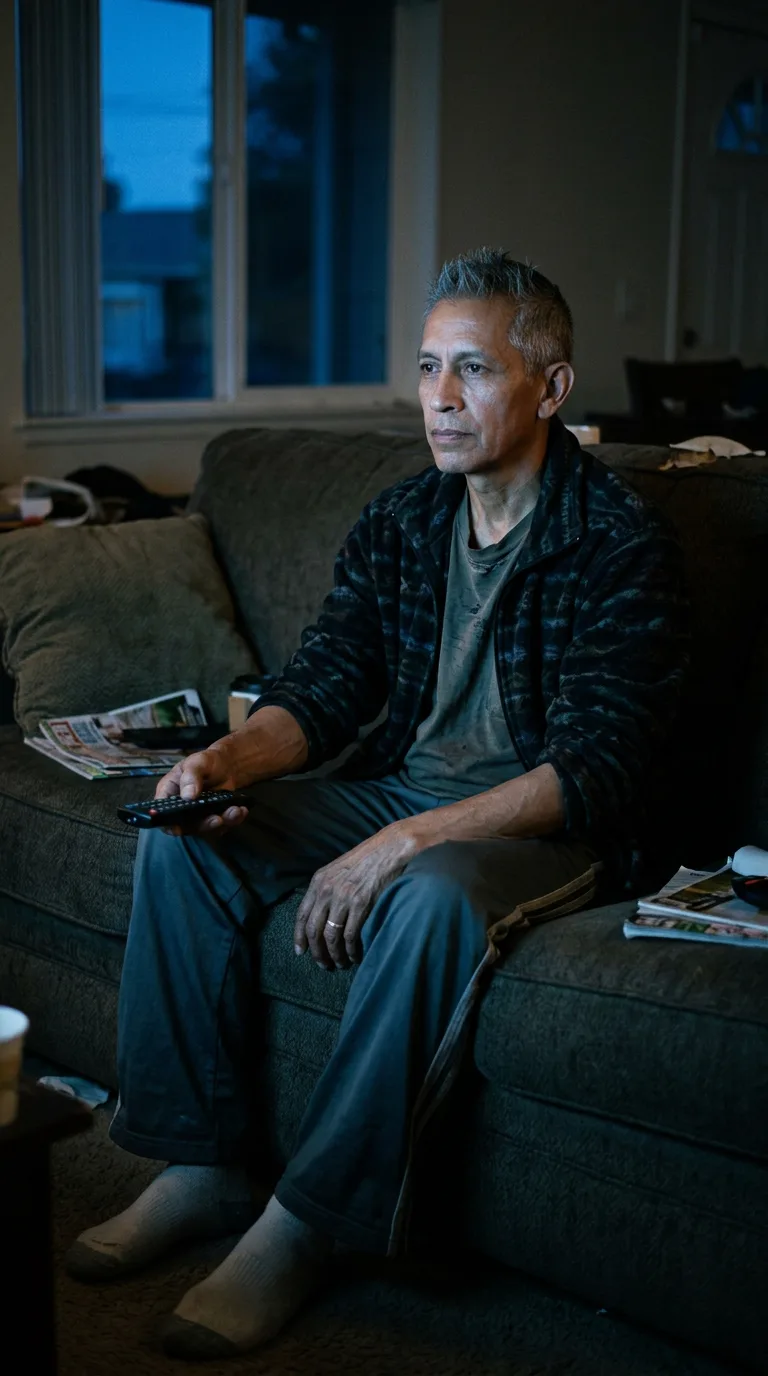
Rarest thing about him: Unitarian or liberal faith — uncommon, 1 in 165
Season 1seed 437230439 · engine v11
Character card
lineage Y8OTTX
His body-swap story
@danilo.reyes rolled the wheel on and woke up as Danilo Reyes — their first
---
Midmorning where you are. Wednesday. The blinds are doing nothing against the light and you have been scrolling since you woke up, through the usual nothing, until the usual nothing stops being nothing. An ad, or not even an ad — a link somebody dropped with no context, the kind of thing you'd have scrolled past a hundred times before. vessel.cards. A wheel on a plain page, no pitch, no testimonials, just a price and a spin button and a kind of quiet that websites don't usually have. You have wanted this since before you could have said what "this" was — every swap movie you half-watched twice, every thread at two in the morning about waking up in someone else's life, the particular ache of wanting to just *be* a different arrangement of a person for a while. It was never for sale before. You pay. Your thumb is over the button longer than it needs to be. You spin.
There is no falling, no tunnel, none of the things you privately rehearsed. There is a couch under you that was not under you, and a weight in your legs you did not have, and a room gone the deep blue-grey of a window at the day's end, a television throwing its light sideways across a face that is now, somehow, the only face you have.
He was mid-laugh at something and the mouth doesn't finish it. The remote is loose in the hand — his hand, heavier than any hand you've imagined having, knuckles a little swollen, a pale stripe on the ring finger where you can feel, immediately and for no reason you could explain, that something used to sit. The show cuts to a bright frame. Outside, it is the end of a Tuesday that was never going to end any other way, and for the man whose body this is it would have been sitting and watching reruns alone in the dark until it was late enough to pretend he was tired. You sit up straight. You set the remote down on the arm of the couch with a care you didn't choose, because the hand already knows how to do that, the way it knows other things before you ask it to.
The jacket first — fleece, zipped, worn soft at the cuffs — and through it, touching nothing but its own weight against your arms, comes a Sunday: him pulling it on in a cold garage apartment because the heater's been off since the gas bill, a radio playing something in Spanish low enough not to bother anyone, nobody to bother anyway. The T-shirt under it, older than the jacket, the collar gone a little slack — his daughter gave him this one, Christmas, three sizes right then and looser now because he's thinner than he used to be, some good years ago, and he never throws away a thing she's touched. Socked feet against the carpet bring the apartment up around you whole: the under-house garage with its own door onto the steep driveway, the bay window upstairs that belongs to the house above his, the particular cold that comes up off a concrete floor no matter how many rugs you put down. You've lived here four years. Since the divorce plus one, because the first year you stayed in a corporate extended-stay and told yourself it was temporary.
The wedding band is gone from the finger but the tan line isn't, and that's the deepest handle in the room — touch the bare skin of it and there's a whole marriage, nineteen years, a wife named Carla who still calls sometimes about their son, who is thirty now and lives in Sacramento and doesn't call either of you enough. The divorce wasn't a fire, it was a slow leak, two people who ran out of things to fight about because they'd stopped fighting for anything. You remember — he remembers, and it comes to you as his, heavy and unornamented — signing the papers at a table in a lawyer's conference room much like the ones he files exhibits for now, the small practical joke of that not escaping him even then.
The job comes up through the pressed cotton still faintly starched at the collar though he's not wearing it now, the ghost of Tuesday's shirt lingering in the muscle memory of buttoning it this morning, one-handed, the way you do a thing you've done four thousand mornings: a law office two blocks off Market, banker's boxes stacked chest-high in a windowless room, the smell of toner and old paper, a job he fell into at forty and never loved and never quite hated either, good at the parts that were just sorting the world into the right folders. Thin arms, a paralegal's arms, not a laborer's — strong enough for boxes, worn in the wrists from forty years of small repeated motions, lower back that complains climbing the stairs up from the garage. Gray hair gelled into its small vanity of spikes this morning in a bathroom mirror with the fan too loud, a thing he still does because someone once told him it suited him and no one has told him otherwise since.
Under the sweatpants, his legs ache faintly where they always ache, a thin man's knees. Nothing in particular about him — that's the plain truth sitting under everything you've just been given, a decent unremarkable man at the end of a Tuesday nobody will remember, watching a show that used to make him laugh in a room that doesn't belong to anyone but him.
You look down. The hand with the pale stripe where the ring was turns over in the blue light, fingers spreading slightly like it's checking they still work.
"Huh," you say, to no one, in his voice, and it doesn't sound like disbelief so much as a man noticing the room is colder than he thought.
You don't know how long you get to sit in it.