Danilo Quiñones
Fictional. Generated by AI — not a real person, and no likeness of one is intended.
33, lifeguard in San Francisco · rolled by @colby.marsh · card — no film
History
who has worn him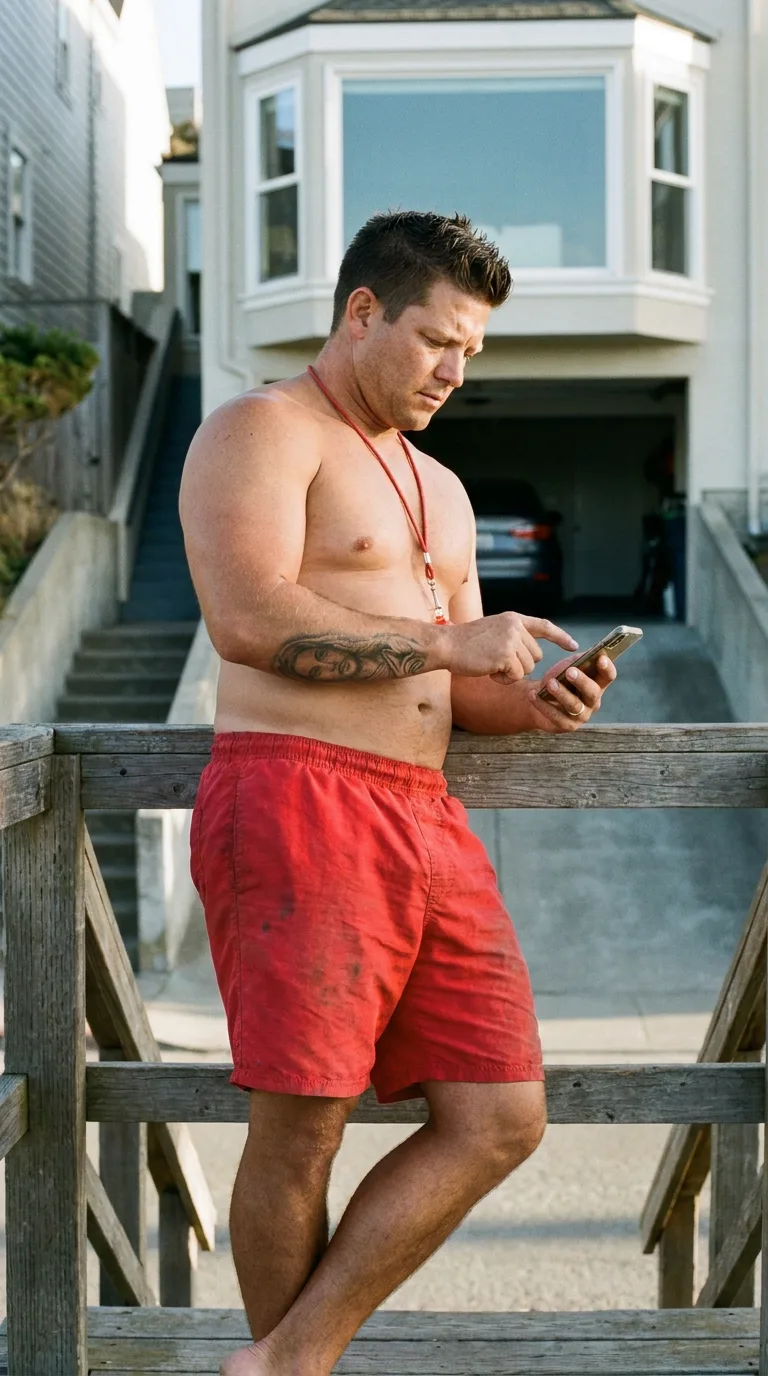
Rarest thing about him: Divorced — rare, 1 in 50
Legacyseed 693238348 · engine v8
Character card
His body-swap story
---
You find him the way you find all of them: through the small square of glass they hold up to their faces before they sleep.
He isn't looking for anything. That's the part you like. He's leaning on the wood rail at the top of his own driveway with the sun going down over the Sunset District, salt drying tight across his shoulders, one foot up on the bottom board because standing flat on both hurts more. Below him the garage yawns open — the under-house kind, the door rolled up, cold white bulb throwing its dead light over a sedan and a folded stroller and a bike with a flat rear tire. Above him the bay window, the good part of the house, the part the landlord's family lives in. He rents the room off the back. The stairs up the side belong to somebody else.
The app is called something with the word *Shift* in it. It promised him a bump — take somebody else's Sunday tower at Ocean Beach, pull the double, get the extra hundred and ten before rent comes due on the first. That's all. That's the whole size of what he wants. You've been in a lot of thumbs and you've never once found the wanting so *small*. Eleven dollars an hour more, and the button under his thumb glowing green, and the word on it.
You read him while he decides. It takes eight seconds and you use all of them.
The eyebrow: a pale line straight through the left one, hair that never came back. Age nine, a chain-link fence in Daly City, his cousin's dare. He tells people it was surfing because it makes a better story and because the truth involves his cousin, who is dead now, and he doesn't want to say that at a barbecue.
The inner forearm: a portrait in black and gray, a woman's face, done well — real shading, real light in the eye. Not the ex-wife. That's what everyone assumes and he lets them, because correcting it means saying *my mother* out loud, and then saying *2019*, and then saying the rest. He got it two months after. Sat four hours and didn't flinch, and the artist said *you're tough, güey*, and he said *nah, I just don't want it to move.*
The ring finger: a band of skin one shade lighter than the rest of the hand. Fourteen months off and the sun still hasn't finished the job. He notices it in the water. He notices it every time he lifts the whistle.
The back: L4, L5, a night four winters ago dragging a tourist out past Kelly's Cove with a rip pulling both of them sideways. He got the man up onto the sand and the man lived, and Danilo has not slept a full night on his right side since. He doesn't take anything stronger than the store-brand ibuprofen. He never drinks — never has, his father drank enough for the whole bloodline — and he's got a superstition about pills that he'd call being careful. He carries the pain up onto the stand every morning and sits in a plastic chair in the wind with it.
He's got a daughter, seven, in Pacifica with her mother, Tuesdays and every other weekend. There's a drawing taped inside the garage where the light hits it: a stick man in red shorts, a wave, a sun with a face. He walks past it four times a day. He has never once taken it down.
He goes to St. Anne's when he can make the eight-thirty, and he means it, and that is the only thing about him that ever gave you a moment's pause. Not because you're afraid of it. Because he'd want to know, and there's no one to tell him.
Here is what you are: nobody he ever met, nobody he wronged, nobody's revenge. A stranger. He did nothing to earn this except be standing where the light could reach him. You've heard the ones who need a reason. You don't have one and you've stopped pretending to look for one. What you have is the wanting, and the wanting is old, and it is specifically this: a body that gets up before the sun and puts its feet on cold cement. Lungs that know exactly how much air is left. A back that hurts, which is better than a back that doesn't feel anything at all. You have been without one of these for longer than the house has stood.
He taps ACCEPT.
The screen flashes white — the flat blown-out white of a shutter — and holds. Half a second past when it should have gone dark. Then a full one. The light comes up off the glass and finds the underside of his jaw, his throat, the ridge of his brow, and it is not the color a phone makes. He frowns at it, mildly, the way a man frowns at a wifi router. That's the last thing that happens in there without you.
You go in the way water goes in — everywhere, at once, no door involved.
His head goes back. The phone stays in his hand because his hand hasn't been told anything yet. Light comes out of him — out of both eyes, out of his open mouth, out of the sockets of him like something pressurized finally finding the seam — and it lays a white stripe up the stucco and across the underside of the bay window, and for one second the driveway is brighter than the sunset. Somewhere in the house a dog starts up.
Then it's gone.
He drops forward against the rail, slack, weight all on the wood, and every breath in him goes out at once.
And then you take the first one.
Christ, it's cold. The wind coming up the driveway off the ocean, straight through wet skin, and you feel it — actually *feel* it, in the ribs, in the wet waistband, at the nape where the gel has gone crisp. And the back. There it is. Low and left, a hot wire from hip to spine that lights up the moment you ask the body to straighten, and you gasp, and then you laugh, one short ugly sound in his voice that echoes off the garage door.
You hold your hand up in front of your face.
Wide palm. Cracked knuckles. Sand in the nail beds. The pale ring of skin. You turn it over. The tattoo comes around with it — her face, the shading, the light in the eye — and you look at her, this woman you have never met and are now the only one carrying, and you understand that from this evening forward she is yours to remember, and you cannot, and no one will ever know the difference.
The phone screen is black. In the reflection there's a man with a scar through his eyebrow, mouth open, wet-eyed from the wind.
He was going to take the double. Rent's due on the first. Tuesday is Tuesday.
You put the hand on the rail, take the weight off the bad side the way he did, and you look up at the bay window with somebody else's ache in your spine and somebody else's daughter waiting on somebody else's Tuesday.
For good. There's no term on it. That was the whole of what you wanted, and now you have it, and it hurts exactly as much as you hoped.