Danilo Corrales
Fictional. Generated by AI — not a real person, and no likeness of one is intended.
36, security guard in San Francisco · rolled by @colin.hasbrook · card — no film
History
who has worn him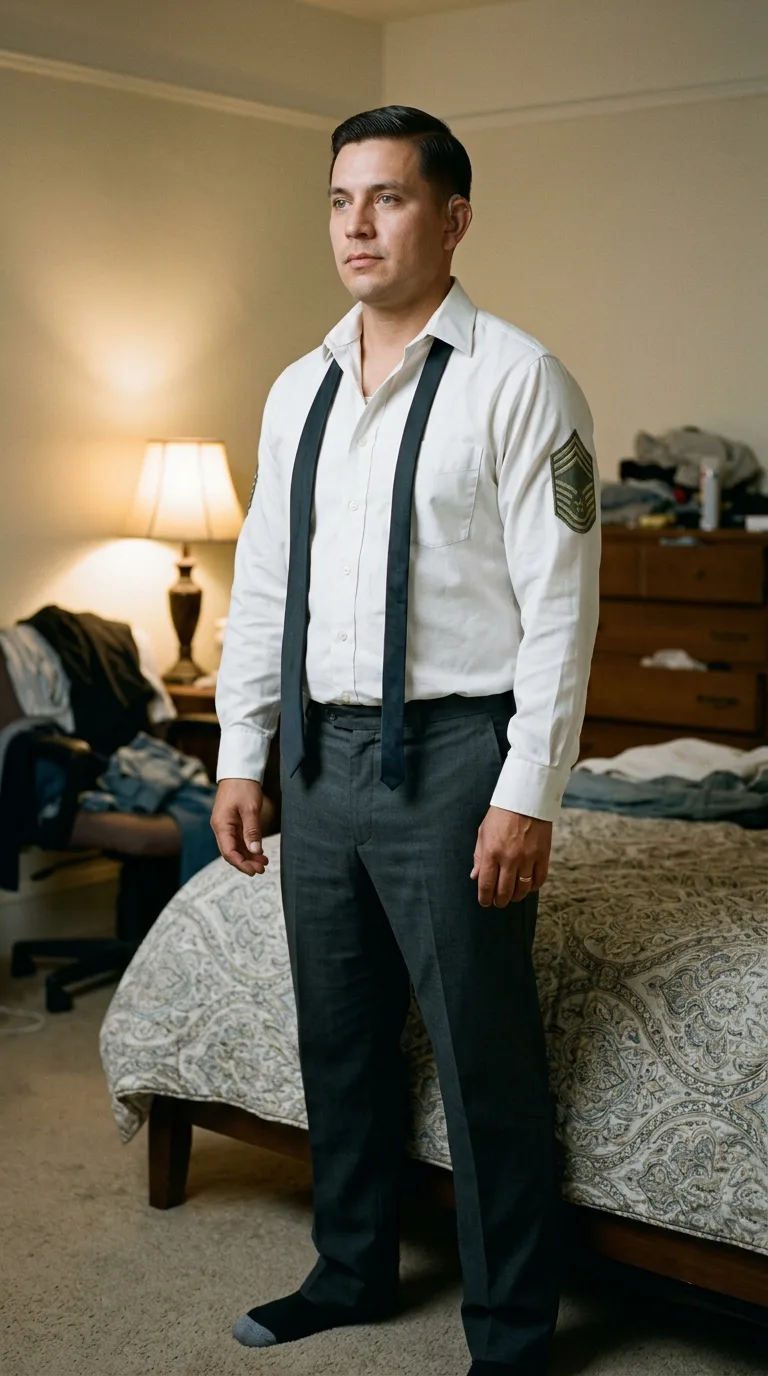
Rarest thing about him: Hearing loss, wears aids — epic, 1 in 165
Season 0seed 1989252399 · engine v10
Character card
lineage 2NZHHJ
His body-swap story
@colin.hasbrook, wearing Marcos Reyna, rolled the wheel on and woke up as Danilo Corrales, spent under a minute in him, then spun the wheel and woke up as Colby Rhoades
Marcos Reyna's hands smell like the moving truck's vinyl seats, and that smell is the last thing you notice as him. Two hours and fourteen minutes in this body — thick through the shoulders, a callus map across the palms from dollies and straps — and it had been enough. The apartment was quiet, the shift over, and there was nothing left to do in it but sit on the edge of a bed that wasn't yours and feel the ache settle into a back that wasn't yours either. That's the itch, every time: not hating him, just having already read him cover to cover. You open the laptop. The wheel is still on the screen from before, spinning lazy and slow like it's been waiting. You didn't come back for Marcos. You came back because he was already used up, and the site never asks you to justify wanting more than one life at a time.
You pay. You spin. The color drains out of the room the way it always does in the half-second before—
—and you are standing at the foot of a bed with paisley sheets, half-dressed, San Francisco light coming flat and gray through a bay window that sits low, almost at the sidewalk's ankle height. Your hand is flat on your own chest. You can feel ribs that are not Marcos's ribs — narrower, a little more give between them — and a shirt buttoned wrong, one hole low, the collar sitting crooked. A tie hangs loose and unknotted around your neck, cheap black poly-blend, worn soft at the knot line from a thousand other mornings. Your fingers, without you telling them to, go to the misbuttoned placket and start over. Off. Correct. Up. The tie follows, tied in a four-in-hand with a dimple so practiced it isn't a choice, it's a reflex living lower than thought.
The first thing that comes through is the shirt itself — the give of the collar against a throat, and with it, an afternoon: standing in front of a mirror at nineteen, in a barracks, someone older barking at him to fix the knot, do it again, do it right, and the hot flush of shame that never quite left, just got folded into competence. Danilo Corrales learned to dress like a man being inspected and never stopped. The insignia patch on the sleeve of this shirt — not this shirt, the other one, the uniform one, but the ghost of it is stitched into the muscle memory anyway — brings a name that isn't spoken so much as felt: a unit, a rank, six years of a life that ended honorably and quietly and left him with tinnitus in one ear and a hard, small hearing aid he almost never mentions. Your fingers find it without meaning to, right ear, a small definite shape, and there's a flash of a VA waiting room, fluorescent, the audiologist's kind bored voice, the shame of that too, filed next to the shame of the tie.
The tattoo comes next — sleeve rides up an inch reaching for the second button, and against the skin of the upper arm there's a coolness, a patch not covered, and it opens onto men's faces you don't have names for anymore, laughing at something in a country that was hot in a way San Francisco fog never is. Danilo doesn't think about them often. He thinks about them exactly this much: a flash, gone, replaced by the weight of the ring on his left hand, which is heavier than a ring should be, the way wedding bands get after enough years that you forget you're wearing one.
The ring gives you her. Not a name at first — just the shape of a kitchen, early, her back to him at the stove, the particular quality of not talking that isn't a fight, is just a Monday. Then the name arrives riding on it: Renata. Nine years married. A daughter, six, who has his stubborn chin and her mother's patience, currently at school across town while he sleeps through half the day because the graveyard shift at the lobby desk downtown eats mornings whole — that's the wrongness under all of this, the reason the light through the bay window feels aimed wrong at a body that should be horizontal right now. He works nights. This getting-dressed is getting-dressed for the overnight, hours before it starts, because Renata asked him to take their daughter to a doctor's appointment first, and so his whole clock is inverted, standing here half in a tie in the gray part of the afternoon like a man doing his own life left-handed.
There's an ex in here too, touched more lightly, the way a bruise you don't press on doesn't hurt — a woman named Claudia from before Renata, a version of himself at twenty-six that still surfaces sometimes at three a.m. behind the lobby desk when nobody's come through the doors in an hour, wondering without any real weight to it whether a different door would have led somewhere he liked better. It doesn't cost him anything to think about her. That's exactly why it's there.
Underneath all of it, the body: thirty-six, and it tells you in specifics — a low ache across the lower back from a mattress that's a little too soft, a jaw that is, right now, clenched tight enough that you can feel the muscle bunched hard at the hinge, an old habit that has nothing to do with anger and everything to do with just holding still under fluorescent light for eight hours at a stretch. Catholic in the unthinking way — a chain that isn't there but the ghost of a childhood medal is, a rosary in a drawer he touches more than he prays with. No drink in the memory of any bar, ever, not even a sip, some old promise to his mother outliving every reason for it. Steady hands. A flashlight and a radio clipped to a belt that isn't on yet. He is, in every particular, an unremarkable man, and that unremarkableness comes through the shirt like its own kind of memory — thirty-six years of nothing going particularly wrong, which is its own quiet inheritance, worth more than people who never had it understand.
You look down. The tie is finished, correct, a knot this closet — Danilo's closet, Danilo's mirror — has apparently never once produced on its own. Your hands turn over in front of you, his hands, a thin white scar along one knuckle you didn't put there and don't know the story of yet.
You look up into the mirror across the room, into his own eyes.
"Okay," you say, to no one, to him, to the tie. "Let's go to work."