Daniel Okamura
Fictional. Generated by AI — not a real person, and no likeness of one is intended.
33, carpenter in Small-town Ohio · rolled by @frank.dombrowski · card — no film
History
who has worn him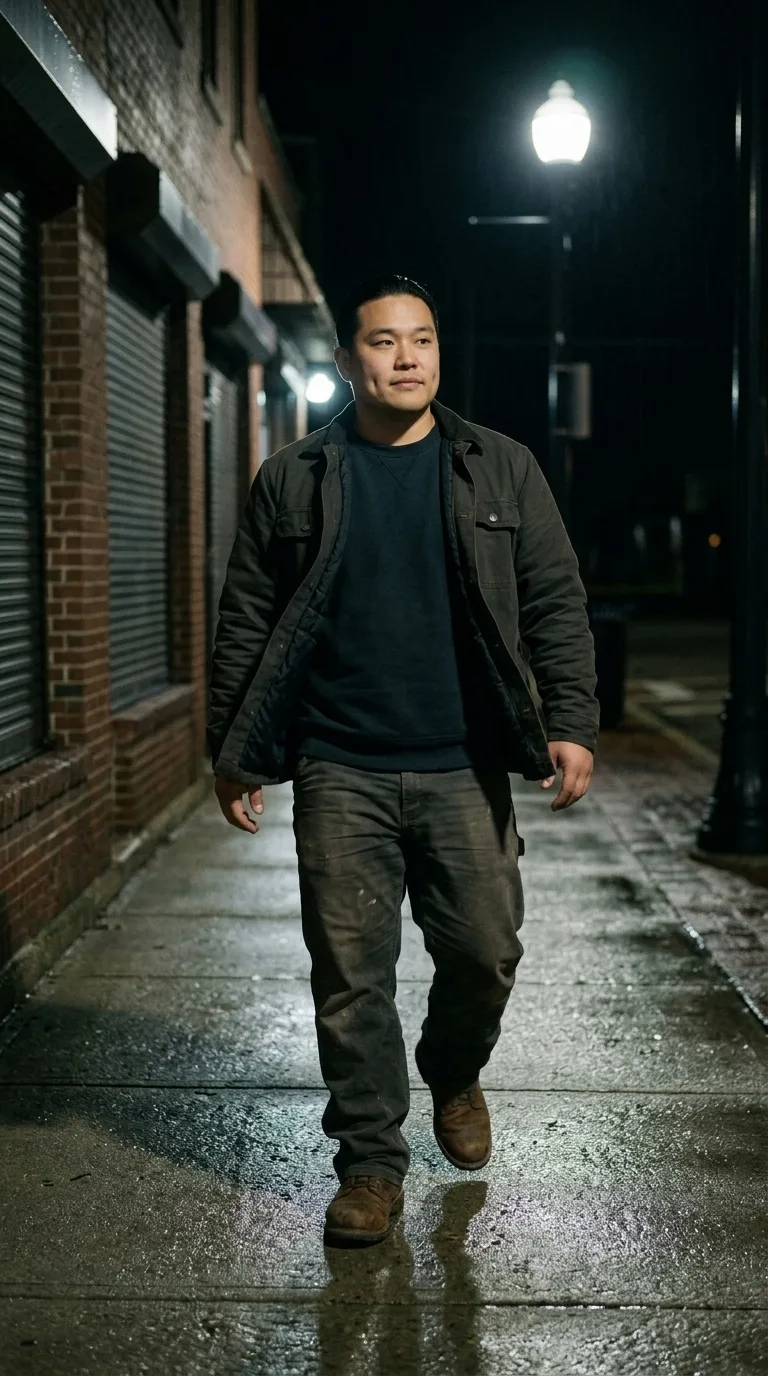
Rarest thing about him: Drunk, walking home the long way — common, 1 in 64
Season 1seed 852989387 · engine v11
Character card
lineage Q2CSHL
His body-swap story
@frank.dombrowski, wearing Ramón Escobedo, rolled the wheel on and woke up as Daniel Okamura, spent 6 minutes in him, then spun the wheel and woke up as Mateo Garza Whitlow
You are standing at a sink in Anchorage with Ramón Escobedo's hands under the tap, and the water has gone lukewarm and you let it. The hotel is quiet on the fourth floor. There are forty-one rooms and tonight you stripped thirty of them, and your knees, his knees, have a long opinion about it. In the mirror his blue eyes look back, his gray goatee wet at the tip. You have been him for five minutes. It was long enough to learn he can't reach the top shelf of the cart without a stool, and that his lower back tightens when he bends over a bed. You know what it is to be wanted by nobody on this floor. It isn't a tragedy. It is that the body works, and you find you don't want a body that merely works. The phone is on the edge of the sink with the page already open, the wheel sitting there, patient and bright. You dry his hands on his own apron. You press.
Wet cold on the face. Your weight comes down on a kerb that isn't there, and the world tips, and your palm slaps the cold flank of a parked car. Metal, rain beaded on it, a mirror knocking your hip. You're upright. The street is black and shining. A streetlight hums a block away. Shutters, brick, no one.
Your leg is bouncing. Even standing, the right one keeps going, a small tapping against nothing, and you let it.
The jacket first. Your fingers close on the canvas front and the lining is flannel, soft, worn thin at the pocket, and it comes up from nowhere: a Thursday, dark in the kitchen, him pulling this jacket off a hook by the back door because the other hook is empty. Nobody has hung anything there in two years. He doesn't think about why. He puts his arm through the sleeve the way you put an arm into habit, and the memory has no words in it, only a flat, familiar quiet.
Your hand drops to the car's cold roof and then to your own thigh, the denim stiff with old dust. Drywall mud. Under it, the long muscle, heavy and thick, a body that has carried sheets of plywood up a ladder since he was nineteen. The dimples are there, you can feel them, pulled into the cheeks even though nothing is funny. Then the slab: a morning, gray concrete fresh and still faintly damp, the nail gun hose coiled by his boot like a sleeping animal. He frames the wall plate by plate. He is good. The pleasure of a stud going in true is a clean small click behind his sternum, and no one has ever told him it was good, and he has never needed it said.
The shirt under the jacket is a sweatshirt, soft, the crew neck pressing at his collar. He bought it at the Dollar General on a lunch break. He stood in the aisle and held it up and thought, this is fine, and that was the whole purchase.
Your tongue finds the taste of beer, sour and warm. Four of them, then a fifth that Pete poured over his protests, at a bar with a neon sign the color of a bruise. The memory laughs, and his laugh is easy, hips-loose, a man who goes out twice a month and means it. Walking home the long way because the short way passes the diner. It has been closed since March. He used to eat eggs there at six every morning, and the woman who ran it called him *hon* though he was thirty-three. The dark window gives him something that isn't grief. It's more like a missing step in the dark.
The boots now, wet leather, his toes bunched against the cap. One scuffs where the sole has worn, every third step. You test it. Left, right, and you set them down even. No scuff. The sound of your own walking comes back quiet and level. It's strange to be so steady in someone so drunk; the drink is there, a warm swaying behind the eyes, but your wanting holds the rest of him like a rail.
You look at your hands. They're broad, the nails cut square, a flat white ridge of callus across each palm. You turn them over. They know a hammer's weight and a pencil's and the exact pressure of a level on a plumb wall. They don't know you.
At the corner, the street splits. Home is right. You can feel the pull of it, the habit in his calves. You look up the left-hand road, the empty one, and say aloud, to the wet dark, in a voice that sits lower than you expected, "Okay. Let's see you."
The leg bounces. The streetlight hums. You don't know how long he'll hold, whether it's the morning or the year, or whether, once the wanting turns over again, you'll still be standing in him.