Daniel Kessling
Fictional. Generated by AI — not a real person, and no likeness of one is intended.
30, fast food worker in El Paso · rolled by @connor.waskiewicz · card — no film
History
who has worn him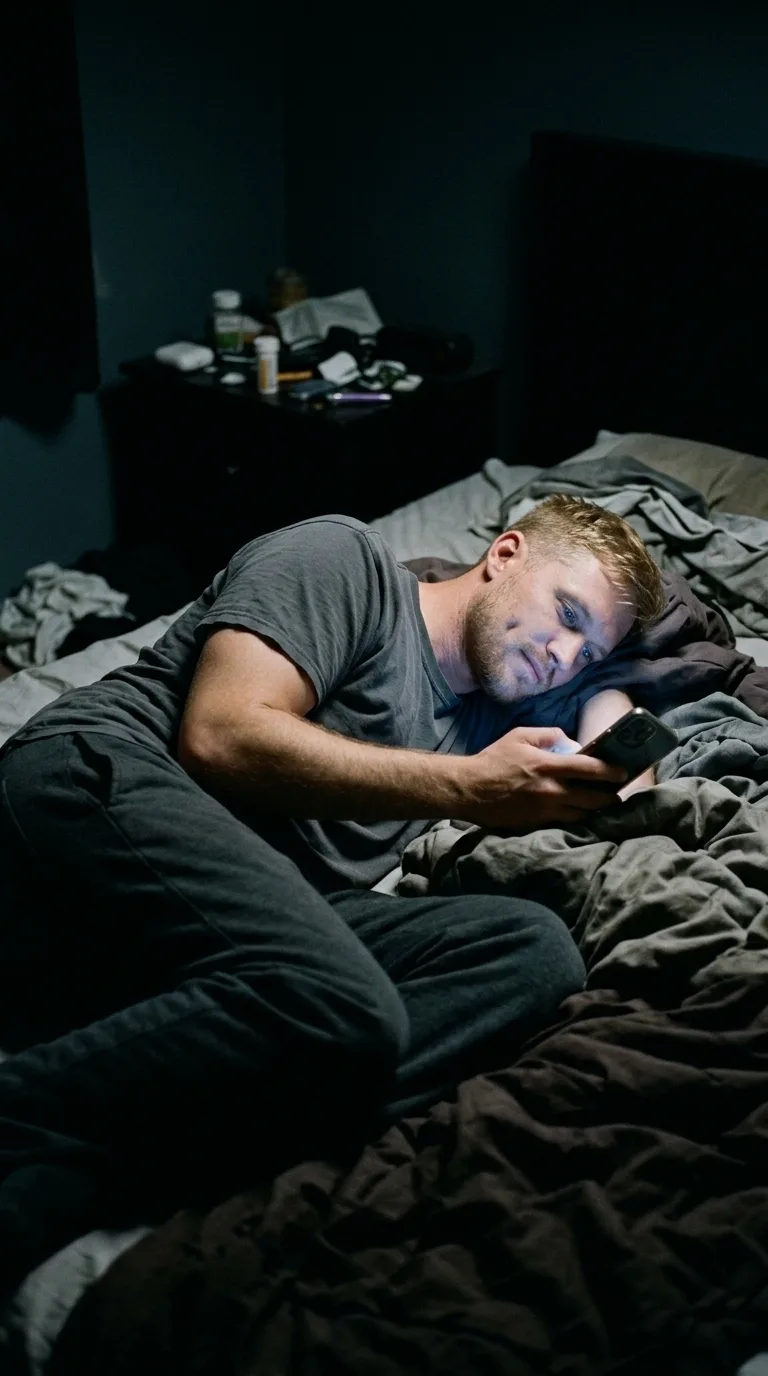
Rarest thing about him: 6'5" — rare, 1 in 229
Season 1seed 1268016629 · engine v11
Character card
lineage 2NZHHJ
His body-swap story
@connor.waskiewicz, wearing Hector Olivares, rolled the wheel on and woke up as Daniel Kessling, spent under a minute in him, then spun the wheel and woke up as Russell Hendricks
You are standing at Hector Olivares's bathroom sink in Atlanta, and the house is asleep. The tap is running over his wrists. His nose, the once-broken one, ticks faintly when he breathes in. You have been him for less than a minute and you already know why you're leaving. It is the quiet. He has a wife's side of the bed turned down, a child's night-light down the hall, and a whole sleeping house that expects him. Nobody here is asking anything of you, and it is unbearable. You dry your hands on his towel. You do not look at the mirror again.
The page is open on his phone. The wheel turns.
Dark. Blue light on one cheek. The phone is six inches from your face and your thumb is stopped mid-scroll, and the mattress has taken the whole weight of you on your left side. There is no travel and no warning. One second there is a towel, and the next there is a pillow gone warm under your ear.
Your thumb starts again. It is faster than his was.
The shirt comes first, a soft gray T-shirt worn thin at the collar. Under it is a morning with a maroon polo, ironed badly, and his hands doing the buttons at the neck, two of them, the second one always hanging by a thread. Dread comes with it, the ordinary kind, for the fry station. You get the baskets rising out of the oil and the hiss. You get the headset pinching above his ear and the visor, and the way he says "Welcome to" nine hundred times a week and means it a little less each hour.
The sheet is under your forearm, cheap and pilled. Through it comes the house. It is turquoise, flat-roofed, and the chain-link rattles in the wind. White light lies on the dust, and the swamp cooler drones. He bought none of it. He rents it from a man who calls him mijo, though he is not one. Mass is Sunday and he goes alone. He stands at the back and he does not take communion, because there is something he has not said to a priest. You do not get what it is. You get only the weight of it, low under the ribs, like a swallowed stone.
His thumb goes to his mouth. You taste the nail and the raw edge. His teeth already know the ring finger, and you stop them. The nightstand holds a tin of nicotine pouches, and your lip aches for one in a way you didn't choose. There are orange pill bottles and a drawer of unpaid envelopes. A year ago a bottle of something clear sat in that drawer, and he poured it out in the yard and stood there shaking while the dust drank it. That is the best thing he has ever done. Nobody saw it.
He is six-five, and his feet hang near the end of the mattress. His hip is sore from standing, and his calves are knotted from ten hours on the tile. His back remembers every flat shift. His arms are strong in a plain way, from lifting boxes of frozen fries and hauling oil. The dimples are there. You feel them in your cheeks when you breathe out, even though there is nothing to smile at.
You hold your hand up in the blue light and turn it over. The nails are bitten to the quick, the calluses are yellow, and the knuckles are scarred with small burns, so many that you can't count them. They are not yours, and you flex them anyway.
You look up and say, to the dark, in his voice, which is lower than you expected, "Okay. Hi."
Nothing answers. You wonder how long this one lasts, whether the wanting stays quiet, and whether tomorrow you'll still be tired in his bones.