Dale Brandt Hutchins
Fictional. Generated by AI — not a real person, and no likeness of one is intended.
25, waiter in Small-town Ohio · rolled by @owen.prescott · card — no film
History
who has worn him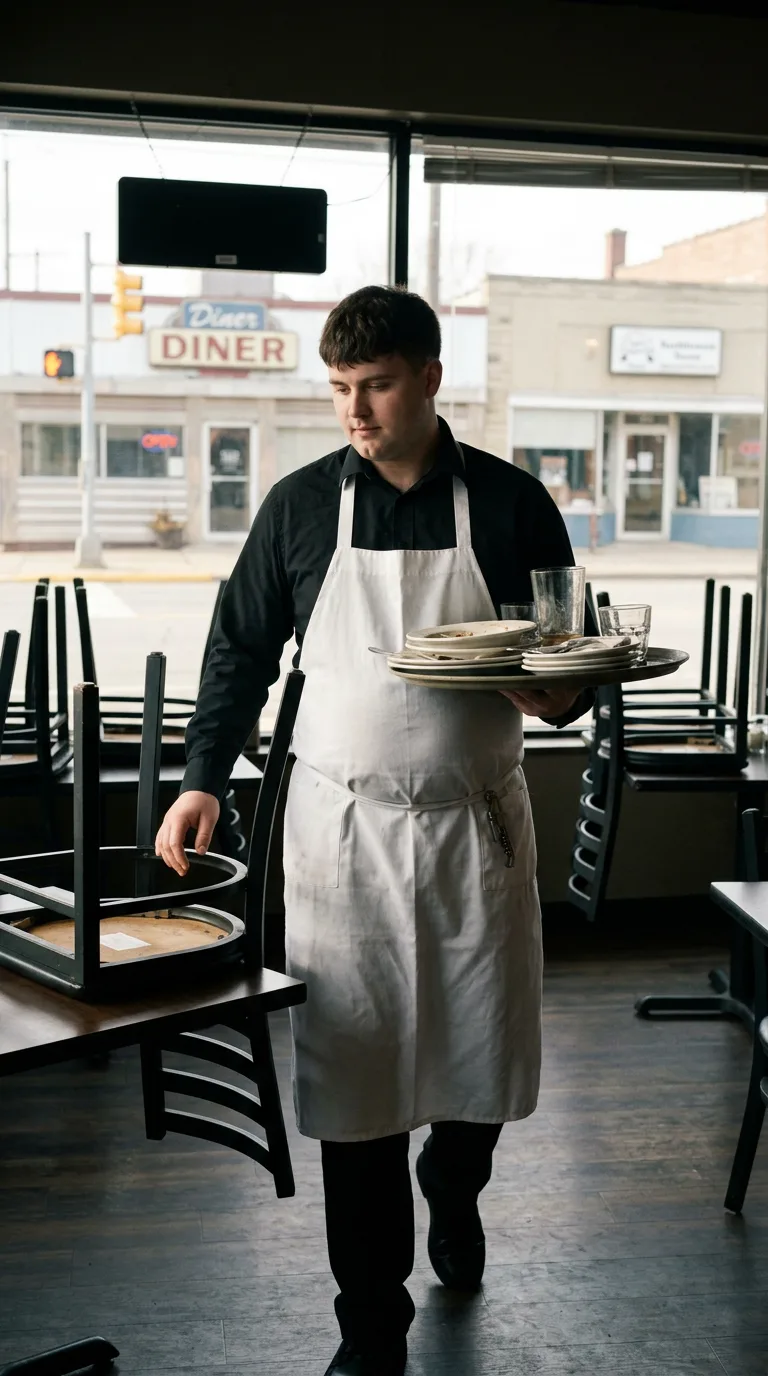
Rarest thing about him: Nicotine pouches — common, 1 in 31
Season 1seed 791285681 · engine v11
Character card
lineage 5OR92V
His body-swap story
@owen.prescott, wearing an unnamed body, rolled the wheel on and woke up as Dale Brandt Hutchins, spent under a minute in him, then spun the wheel and woke up as Liam Patrick Doyle
Start with the beard, because I am still wearing it. Silver, coarse, a little damp from the shower, and my thumb is on it now in the dark of the van's cab, a Tuesday before anything is open. The cable man's knees ache in the cold. His left shoulder has a click in it that I have learned to lift around. Fifty-five. He is good at his job and he has been good to me, and in less than a minute of having him I knew exactly what I would do next, because I had a reason, and the reason is not his fault.
Yesterday, in the body before him, I was handed a thing I could not finish. I will not say what. Only that it sat in his chest all night like a swallowed stone, and this man's strong back and his decent gray patience did nothing for it. A body that works is not the same as a body that answers. So I open the page. The wheel is already turning. I pay, and the cab goes out like a lamp.
Then there is a tray in my left hand and it is heavy in the right way, plates stacked and glasses hooked in the crook of the fingers, and I am walking. My right hand is on the back of an upended chair. There is a floor under me, dark boards, and the light through the front glass is flat and white. My first step is wrong, a half-beat of someone else's stride, and the glasses chime. I set it right. Slowly. Again. Then ten more steps, each one checked, as if the floor might have moved.
The apron strings are tied in a bow against his belly, and that is where it starts. Dad bod, soft in the middle and wide in the shoulder, a body that carries things for a living. The cotton is stiff with washing. The bow gives me a morning: his thumbs pulling it tight in a dark bathroom, the mirror fogged, the black shirt buttoned from the bottom up because the collar button always fights him. He does the cuffs last. He is tired. Not sleepy, just tired, in the bones of a twenty-five-year-old who is carrying more than he can say.
The chair back is cool under my fingertips and gives me the closing routine, hundreds of nights of it: chairs up, legs to the ceiling, the scrape of the rubber feet. Then a counter, a phone, a screen with a number on it that makes his stomach drop every time. The debts are not one debt. They are a truck, a loan, a card, a hospital, a woman's name on some of it. He does the math on napkins. It never comes out. Somewhere in him is a flat acceptance that it will not.
The corkscrew on his hip bumps my leg, and the metal is warm. That is a Christmas. Three small kids on a living room carpet, loud, and him on his knees in the paper, laughing at something one of them said. His laugh is real. It shocks me how much of the weight is love. Then the same kids at a door, in a car seat, going the other way, and an ache so exact I nearly drop the tray. Their mother is the ex who still matters. He thinks of her whenever the bell over the door rings and it isn't her.
Under my tongue there is the faint burn of a nicotine pouch he put in an hour ago. Mint. It steadies him, and now it steadies me. A big night, once or twice a month: the memory of a bar, the floor tilting, a friend's arm around his neck, and the hungover quiet afterward, the one kind of rest he allows himself.
His chin. I feel it when I swallow, the cleft pulling, a thing people remark on and he has stopped hearing. Across the street through the glass, the diner has been closed since spring. One stoplight, red, holding over nobody. He knew the cook there. He thinks, sometimes, that he is next.
I lower the tray onto the bus cart. My hands are his, broad, nicked at the knuckles, the pads rough from hot plates. I turn them over. Palms up, palms down. They do not shake. They know every motion without me.
I lift my eyes to the window and my reflection, a boy with a cleft chin and tired eyes, and I say, "All right. Let's see what you were carrying."
Behind the words, the other question, as quiet as the room: how long before the wanting comes back, and whether I am still him tomorrow.