Connor Waskiewicz
Fictional. Generated by AI — not a real person, and no likeness of one is intended.
19, gravedigger in Chicago · rolled by @colin.hasbrook · card — no film
History
who has worn him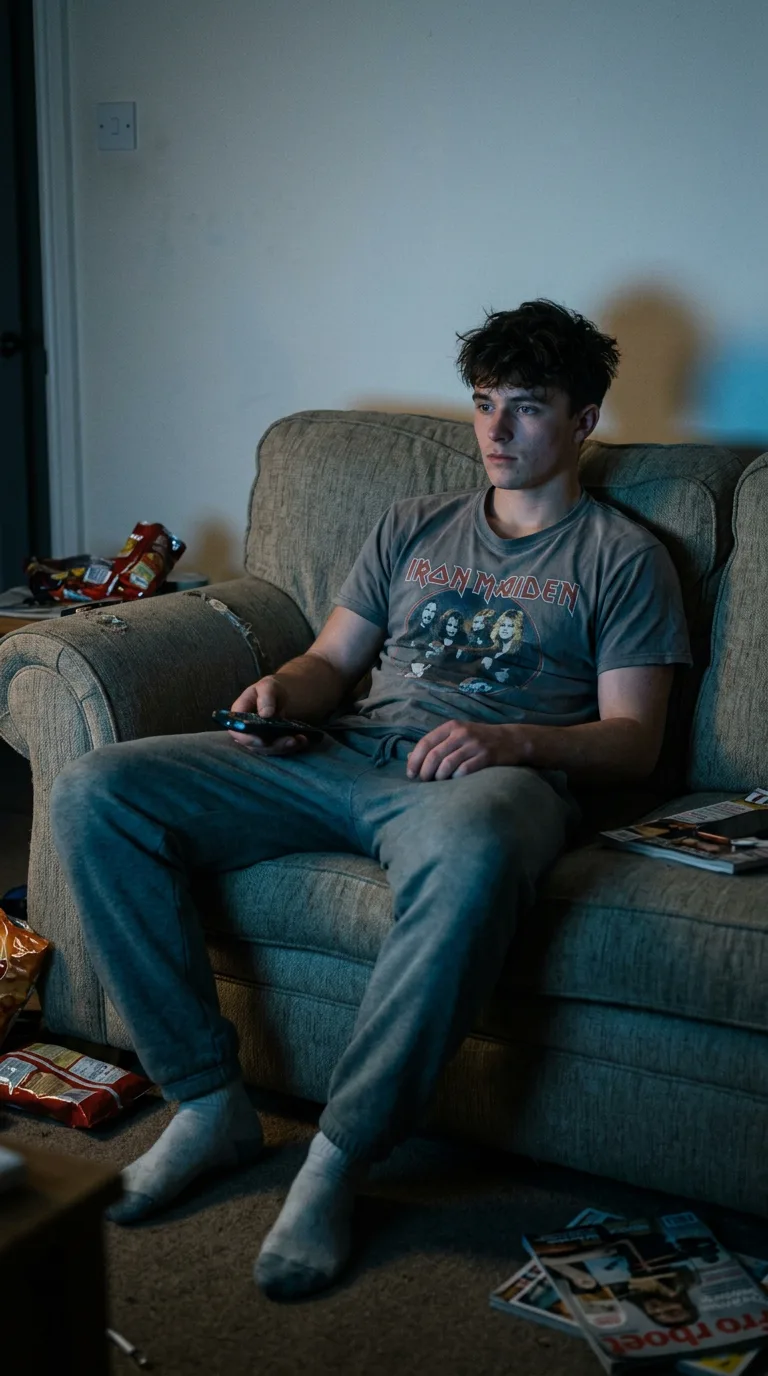
Rarest thing about him: Asexual — legendary, 1 in 125
Season 0seed 108890092 · engine v10
Character card
lineage 2NZHHJ
His body-swap story
@colin.hasbrook, wearing Gerald Pankowski, rolled the wheel on and woke up as Connor Waskiewicz
The oven's not on yet, but you can smell tomorrow's bread anyway, ghost of yesterday's flour still caught in the seams of Gerald's knuckles. Fifty-eight years in this body and the last minute of them belongs to you. It's not that Gerald was bad to be. It's that he's *finished* — you already know the shape of every hour he has left: rise at four, proof the dough, complain about his knees, watch something on his phone in the walk-in cooler where nobody bothers him. You have been him less than sixty seconds and already you can see the whole rest of the loaf. That's the thing nobody warns you about the good ones. They get boring exactly because they're good. So standing in his dark kitchen, everyone in the building asleep, you find the site again on his cracked phone screen, the wheel already spinning before you've decided anything, because deciding is not really what this is.
The television doesn't change. The room does.
You're sitting instead of standing, weight dropped low into a couch that gives more than Gerald's mattress ever did, and there's a remote loose against your palm, and the light on your face is blue and moving and not your kitchen's light at all. Your breath comes out through a chest that's narrower, tighter, younger — nineteen years of wear where there used to be fifty-eight, and the difference lands in your knees, your spine, the fact that nothing aches. On the screen, something you were about to laugh at plays out and you don't laugh. You just watch it happen to somebody else's memory of funny.
The shirt is doing it first. Thin, soft-worn cotton with a screen-print you can feel more than see — four faces, ridged and cracked from washing — and it comes with a flash: pulling this exact shirt over his head some morning eleven months ago, in a room with a blacked-out window and a space heater ticking, the fabric still smelling like the box it came in from his mother's closet cleanout, a gift she didn't know was a eulogy for a shirt she used to wear herself in 1988. He liked that it had been hers first. He liked a lot of things quietly, is the thing you're learning — you're learning him in pieces, sleeve by sleeve, the way the facts said you would.
The sweatpants next, worn soft at the knee, and under them: a body that has swung a shovel six days a week since he was seventeen, shoulders wider than they look in a slouch, forearms that ache low and dull the way work aches rather than the way age does. Calluses across the base of every finger, a permanent crescent of dirt under two nails no amount of scrubbing gets out anymore, a lower back that twinges when he stands too fast because the ground never gives the way people think it does, you have to make it. His hands know a rhythm they don't ask permission for — dig, throw, square the edge, tamp — and right now, doing nothing at all, his fingers still twitch against the remote in a four-count, an old habit with no shovel to spend it on.
The couch gives you the rest. This apartment under the tracks, the rattle that comes through the floor every eleven minutes that he's stopped hearing as a sound and started feeling as a kind of pulse. A daughter, two years old, asleep down the hall at her mother's tonight, not his tonight, and the specific ache of a Saturday with no shift and no kid in it, which is why he's up at an hour that isn't really morning or night, alone with chips he didn't finish and a magazine he didn't read, watching a show he's already seen because it doesn't ask anything of him. Somewhere in there, quieter, a man's name that still catches — not the mother, someone before her, someone who left clean and kind and completely, and whom Connor still sometimes almost calls when he can't sleep, and doesn't. The vape on the arm of the couch, used maybe twice tonight out of habit rather than want. A rosary he doesn't pray with, kept in a drawer for reasons he couldn't explain to you or to himself. The graveside this morning — was it this morning? — green cloth pulled taut over piled earth, and under it, his own steadiness, the thing about him that isn't sadness so much as room for it.
You look down. His hand, calloused, dirt-lined, nineteen years old and moving before you tell it to — four taps against the couch arm, the drum going on without him, without you, some rhythm older than either of you renting this. You turn it over once like it might not be yours, and it is, entirely, for however long that turns out to mean.
"Okay," you say, to the empty room, to no one, to him. "Okay."
The television keeps playing to whoever's left to watch it.