Colton Braswell
Fictional. Generated by AI — not a real person, and no likeness of one is intended.
40, fisherman in El Paso · rolled by @marlon.etienne · card — no film
History
who has worn him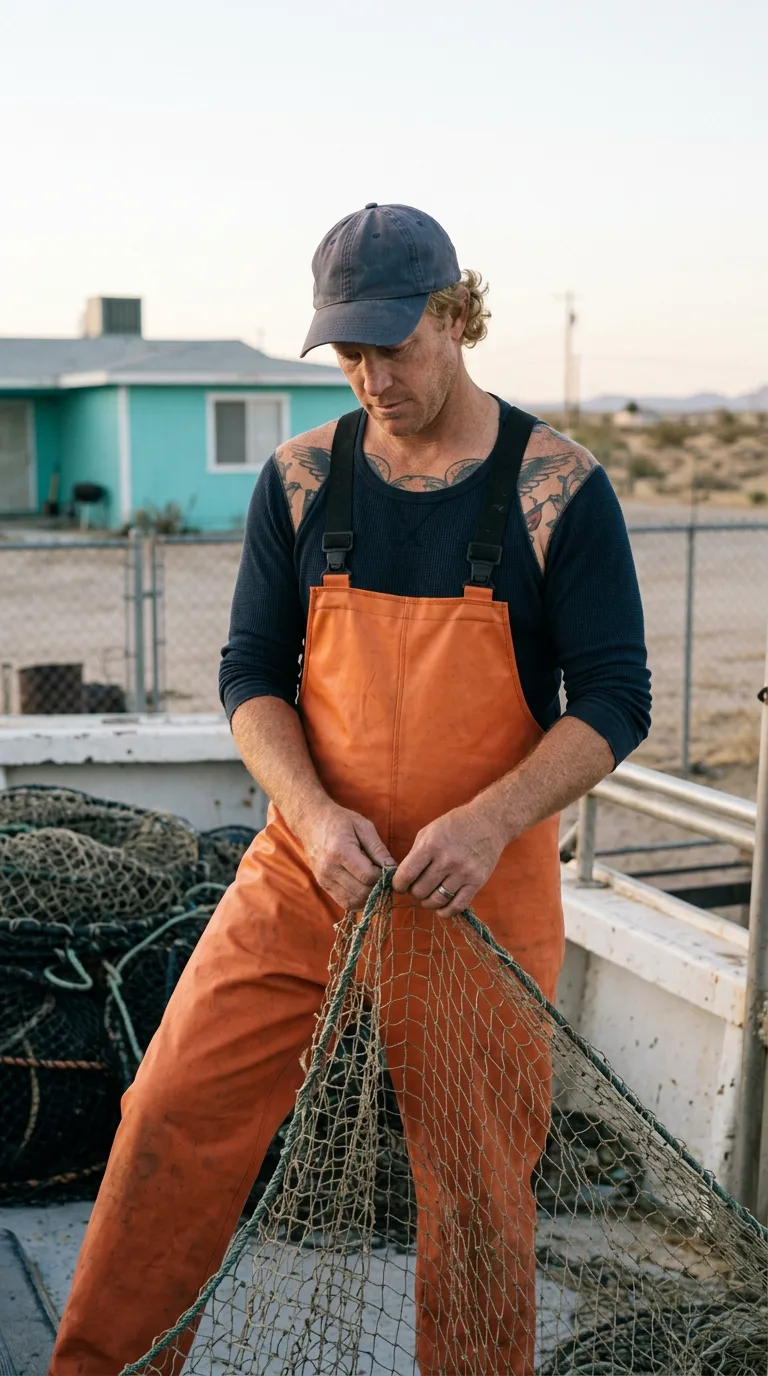
Rarest thing about him: Back piece — epic, 1 in 64
Season 0seed 150416347 · engine v10
Character card
lineage 6PRR5R
His body-swap story
@marlon.etienne, wearing Kaito Sugimoto, rolled the wheel on and woke up as Colton Braswell, spent 3 minutes in him, then spun the wheel and woke up as Riley Kastner
The waiter's tray is too light. That's the thought that sits wrong the whole two minutes you've had this one — Kaito's arms, thin, eighteen years of them, not enough weight in the wrist to remember carrying anything. You're standing behind a counter that smells like soy and someone else's cigarette break, and the body under you keeps glancing at its own reflection in the fryer hood like it's checking a costume fits. It doesn't. You knew that walking in. Nine bodies deep and this is the first one that felt like a downgrade the second you landed in it — a kid's frame, a kid's shift starting in ten minutes, nothing in these hands that knows how to do anything you'd want to watch it do. Boredom is too small a word. It's more like hunger that already ate and is still hungry. You go back to the site with his phone, his thumbs, his blue eyes in the dark glass of it. The wheel is already loading before you've decided anything, which is its own kind of honesty.
It lands you mid-motion, which is the only way it ever lands you. Net rope, wet, salt-stiff, running between two hands that are suddenly not a teenager's hands — thick through the palm, freckled to the knuckle, a plain gold band catching the low early light. The rhythm you're dropped into breaks for half a second: a loop pulled the wrong way, a knot that should have set and didn't. Then it corrects itself, slow and deliberate, and the ten pulls after that come out checked, one at a time, on a task the body clearly hasn't had to think about in a decade. Somewhere behind the sternum a boat deck creaks. Gulls, maybe, or just the wind finding the chain-link past the hull. It's early. Too early for a man to be standing here already sweating through a thermal shirt, except this is a body that starts before the sun does and has for twenty years, and some muscle deeper than memory knows that even while the rest of it is you now, uncertain, borrowed, new.
The net gives you the first flash — not words, just a feeling, callus recognizing callus, and behind it a name that isn't yours to keep: Colton. The netting between his fingers unspools an afternoon three years back, this same knot failing in a storm swell off a coast that isn't this one, water coming over the rail sideways, him laughing about it after, soaked through, because nobody died and the catch held. Fear that turned to pride the second it was over — that's how he keeps most of his bad days, you realize, flipped over like a caught fish, shown its better side.
The overalls next — rubber gone soft with wear, straps worn into the same two grooves on his shoulders every morning for years. Putting them on this morning: hooking the left strap first, always the left, because once the right one snapped at four a.m. in the cold and he's been superstitious about it since. Under the thermal, the ink at his collarbones stirs something bigger — his twenties, a shop in another state, a friend who's dead now holding the stencil steady while Colton gritted through the shading on his shoulder blade. The wife wasn't there yet. She came after, found the tattoos already old and faded and loved them anyway, ran a thumbnail along the wing at his collar once in bed and told him it looked like it had always been there, which he took, wrongly, as the nicest thing anyone had said to him that year.
There's a woman before her too, closer to now than the ink is — not his wife, someone whose name comes up through the rope with a different weight, guilty and warm at once, a voice on the phone late at night that he shouldn't have answered and did. That's still sitting in him somewhere, unresolved, a low coal he hasn't had to look at directly in weeks because the boat doesn't let him look at much of anything except water and rope and the next line to check.
His hands, you notice, already know they should be moving. Forty years old and it shows in the low back, a dull permanent complaint he's stopped mentioning to anyone, and in the thickness at the waist that no longer answers to anything he does about it. High cholesterol, a doctor's voice once, flat and unbothered, filed away and ignored the way men his age file most warnings. What's strong is everything from the elbow down — the forearms, the grip, forty years of rope and net and the specific violence of hauling something heavier than it should be up out of moving water. Under the cap, hair he never bothers to cut except at the sides, curling loose on top the way it's curled since he was young enough not to care.
A lighter, cold, sits in the bib pocket though he hasn't smoked in years — his hand drifts there anyway between pulls, an old tell his fingers never got the memo to retire, flip, catch, flip, done before he notices he did it.
Your hands stop moving. You look down at them — his hands, sun-spotted, ringed, rope-marked, not the thin quick fingers you walked in on tonight in a Tokyo kitchen, not any hand you've worn before this one — and turn one over slowly like it might explain itself from the back.
You lift your eyes to the empty deck, to the desert light coming up flat and white past the chain-link, and say, to no one, in a voice that isn't the one you left behind:
"Didn't know I still had it in me."