Colt Rasmussen
Fictional. Generated by AI — not a real person, and no likeness of one is intended.
19, soldier in Honolulu · rolled by @malik.overton · card — no film
History
who has worn him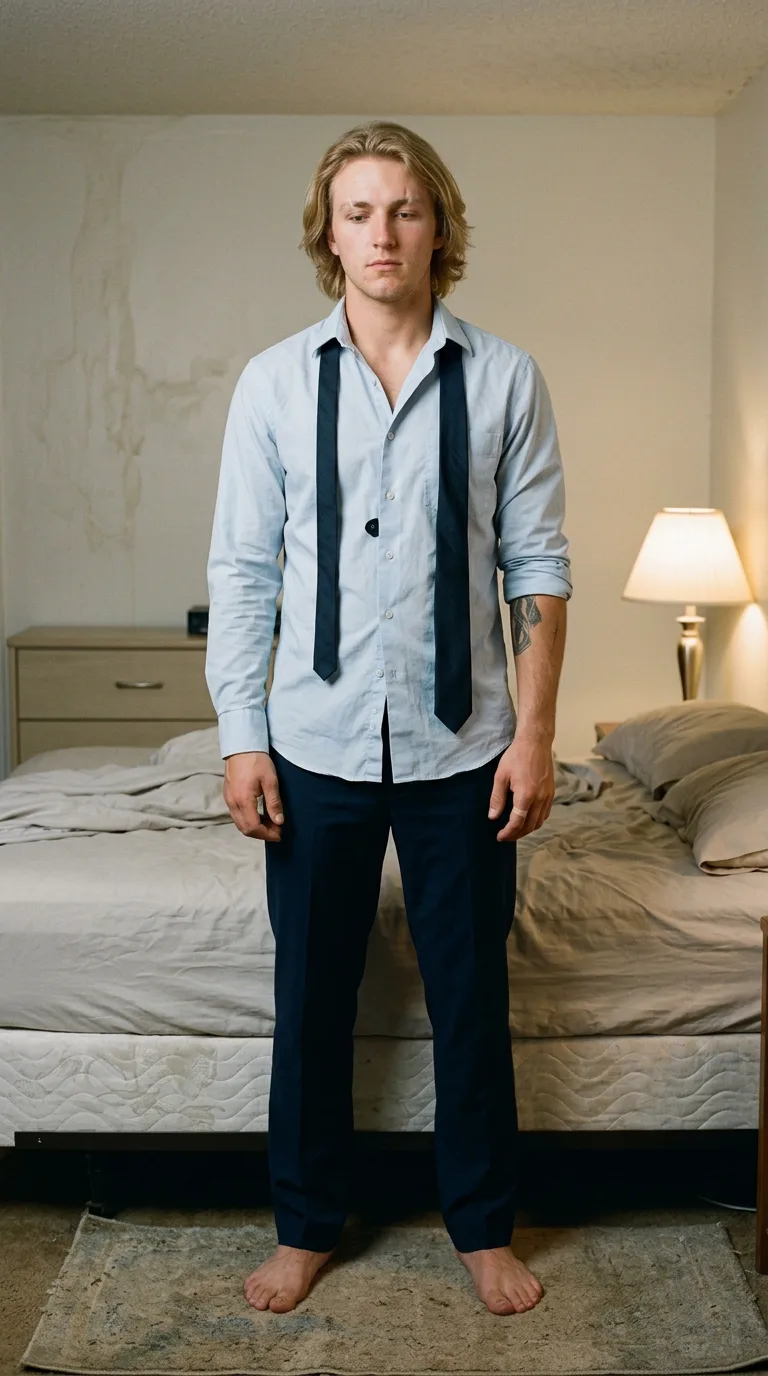
Rarest thing about him: Divorced — legendary, 1 in 501
Season 0seed 412563069 · engine v10
Character card
lineage WV6PBZ
His body-swap story
@malik.overton, wearing Greg Osterhout, rolled the wheel on and woke up as Colt Rasmussen, spent 43 hours in him, then spun the wheel and woke up as Sione Faleolo
The burn scar on this Ohio hand has been aching all week, a tight shine of skin along the forearm that never stopped complaining since the panel blew back in March. You are 48 in this one, tall enough to stoop through doorframes, thin in the way men get when the job eats them from inside, and you are standing in a kitchen that is not yours in any way that matters, holding a beer you are not going to drink because sober is the deal you made twenty-four bodies ago and somehow it stuck even through the changing. The house smells like drywall dust. Somewhere a television is saying something about weather. This body's knees hurt on the stairs. You have had six days of it and you are finished; not because anything happened to you, but because nothing did, and that absence has its own particular weight by Thursday evening, a hum under the sternum that only one website has ever answered.
You open the site on a cracked phone screen with this man's cracked thumb. The wheel loads slow on his data plan. You spin it the way you always do, without ceremony, the way another man might reach for a cigarette he swore off.
The bedroom that arrives around you is not evening. It is glare — white through gauze curtains, the kind of light that has no mercy in it, and you are bent forward with a button between two fingers, chest bare above navy trousers, a tie already hung loose and stupid around a collar that isn't buttoned yet. Your hand — his hand — is flat on his own sternum for a second, feeling ribs that are younger than any ribs you've worn in eleven spins. Then the fingers move on their own correction, undoing three buttons and setting them right, and the tie comes up and ties itself into a four-in-hand this room, this mirror, this life has never once produced. Nobody taught you that knot. It arrives anyway, muscle before memory.
The shirt is what opens him.
It's a dress shirt, pale blue, slightly stiff with a starch he did himself because the laundromat two blocks from the barracks charges too much and he's saving — for what, the memory doesn't say yet, just the saving, a habit worn smooth as a coin. The cotton against your back brings the barracks room first: a locker, a name taped to it, a photograph tucked into the frame of the mirror that used to be of a woman and now is just a woman-shaped absence where the tape marks are still sticky. Nao. That was — is — her name. Naomi. Married at twenty, done by twenty-two, and the ring is gone from the finger but the tan line isn't, and when your thumb finds that pale stripe out of nowhere, out of nothing, it starts turning an invisible band that isn't there anymore, around and around, an old tell his hands do without him.
The tie against your throat gives you the morning she left — not a fight, worse than a fight, a calm conversation at this same kind of table, her voice even and kind and absolutely finished, and him standing in the driveway afterward with a duffel bag that wasn't even his, just something to hold. That was Fort Campbell. Before Hawaii. Before the transfer he asked for because he needed an ocean between himself and every room they'd stood in together.
The tattoo on the arm — half under the rolled sleeve, unit insignia inked at nineteen in a strip mall shop three guys from his platoon went to on the same drunk Tuesday — gives you formation. Early light, red dirt yard outside the barracks, the smell of diesel and cut grass and somebody's aftershave too strong for 0500. Standing at attention with a scar through one eyebrow that came from a training exercise nobody talks about anymore, a rope and a wall and bad luck, healed pale and permanent, the first thing anyone notices about his face and the last thing he thinks about.
The floor under his bare feet gives you Honolulu itself — tin roof ticking as it heats, geckos on the porch rail, the particular white glare of two in the afternoon on a day off that isn't a day off because the shift starts at four, because nights are what they gave the newly divorced guys, like a mercy or a punishment, hard to tell which. He chews instead of smokes because smoking gave his old man cancer and chewing felt like a smaller kind of stupid. He believes in something, not church, just a sense that the ocean out past the barracks fence is paying attention. He has $61,000 in a account he doesn't check often, growing quiet as a held breath, and he has told no one about the money and no one about the thing he carries that he would not bring up even to himself, some contour of guilt from Campbell that only surfaces at 3 a.m. on shift, staring at gate cameras that never move.
He is nineteen. He is strong the way people are before they've had to think about it — shoulders built by ruck marches, hands calloused in a pattern this Ohio body's hands have never known, a body that can run further than it wants to and doesn't complain until later. Nothing hurts yet. That, too, is its own kind of information.
You look down. The fingers are already mid-turn on a ring that isn't there, an old orbit around a bare stripe of skin, and you stop them, and you look up into the light coming through the gauze curtain, and you say, to no one, in a voice that still has to learn what it's doing:
"Okay."
You do not know how long this one is for. You never do.