Colt Massingale
Fictional. Generated by AI — not a real person, and no likeness of one is intended.
26, sales rep in Eastern Kentucky · rolled by @colin.hasbrook · card — no film
History
who has worn him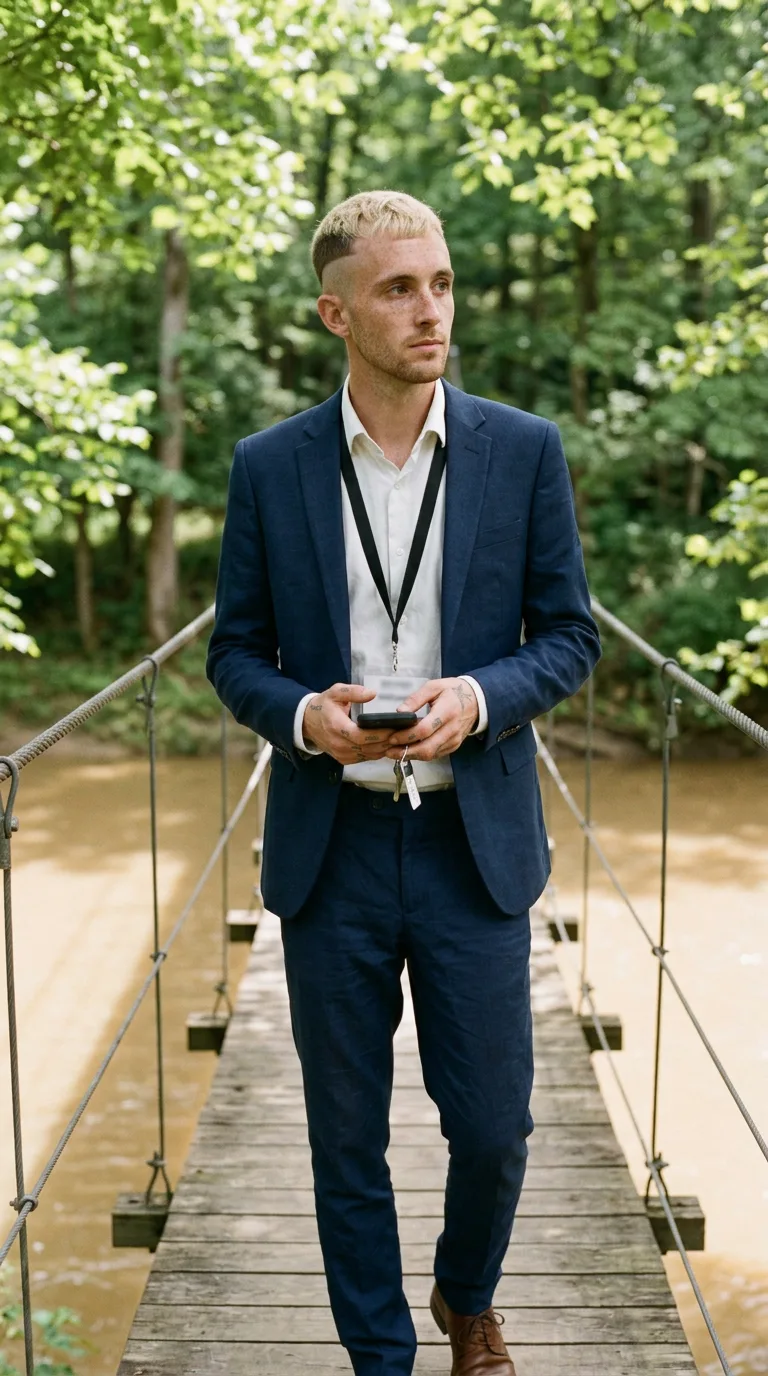
Rarest thing about him: A high and tight — uncommon, 1 in 64
Season 0seed 2030929770 · engine v10
Character card
lineage 2NZHHJ
His body-swap story
@colin.hasbrook, wearing Warren Sedillo, rolled the wheel on and woke up as Colt Massingale, spent 14 minutes in him, then spun the wheel and woke up as Ramón Iwata
The florist's hands smell like carnation stems and cheap green tape, and that's exactly the problem.
You've had them since yesterday, sitting in the walk-in cooler of a shop on Airline Drive, forty pounds heavier than you'd like and slow at the wrists from something arthritic that isn't yours to fix. Nice enough man. Widower, you gathered, from the framed photo on the register nobody dusts. But the ribbon spool jammed twice this morning and you had to use his reading glasses to see the thorns you were stripping, and somewhere in that small humiliation the wanting came back, quiet and total, the way it always does. You didn't decide it so much as notice you'd already decided it, the way you notice you're hungry. You wipe the sap off his knuckles in the back sink, take out the phone, thumb to the site you know better than your own front door by now. Six hundred and sixty times you've told yourself this is the last stupid one. The wheel doesn't care what you tell yourself. You spin.
It lands mid-afternoon in Houston, which means nothing here, because here is a wooden footbridge over a creek the color of steeped tea, cable rails cold under two hands that are suddenly not old and not yours — young hands, thin-wristed, a little chapped, a phone in one and a set of keys in the other, and the light coming down green and broken through sycamore leaves onto a face that isn't the florist's and isn't yours either, not yet.
The first thing is the smell — laundry sheet and cedar and, underneath, creek mud — and then the weight, which is nothing, which is a body built like a fence post, and your foot catches on a bridge plank because his stride is longer than the stride you just left and the arrival makes you check it, once, twice, deliberately, the way one checks a hundred small motions when the rhythm has skipped a beat it was never supposed to skip.
Then his shirt against your back gives you the morning.
Pressed, a little too warm off the iron, his girlfriend's iron actually, she does the collars because he burns them — and there it is, her name arriving sideways, not spoken, just known: Dana, doing the collars in a kitchen with a window unit rattling, him standing there in his boxers with coffee saying I can do my own damn shirts and her saying then do them, and neither of them meaning it. The lanyard around your neck swings and gives you the hotel lobby, the exact one, three hours from now that never comes, chairs in a row, a man named Delbert Combs he's supposed to charm into a distributor contract by Thursday. The tie he didn't wear today because it's a plant visit, not the pitch — he learned that the hard way, eighteen months in, showing up in a full suit to a mine-country supply house and a foreman looking at him like he'd wandered off a wedding cake.
The keys in your hand are heavier memory than the shirt: his truck, an F-150 with 140,000 miles and a check-engine light he's ignored since spring, and under the ring, smaller, the shop key nobody else has, a storage unit outside Prestonsburg where he keeps nothing anyone would guess — not drugs, not a mistress, just paperwork, statements, the actual number, seven figures with a comma in it that he has never once told Dana the real size of because some ungovernable part of him is afraid of what her face would do. Commission on volume nobody expects out of a kid with a farm-boy haircut and freckles, five years of being underestimated by buyers who then signed anyway. He likes being underestimated. It's the only leverage he was born with.
Your own — his own — knuckles ache faintly with a habit: he cracks them without knowing, a rolling snap down the row, did it in church as a boy until his grandmother swatted his hand, does it now in silences on sales calls, does it lying next to Dana at night until she elbows him. You feel the ghost of the motion sitting in the tendons even before you do it.
The bridge itself comes up through his feet — bare in summer as a kid, boots now — this exact crossing a hundred times, late for the bus, later for a girl who wasn't Dana, latest of all this morning, ten minutes ago in his time, checking the phone for the meeting address while the creek ran brown and unbothered below like it has his whole life and will after him too.
He never drank at his own signing bonus dinner, water with lime, watched the sales director get loud and thought some clearer thought about his father, who did drink, who is why he doesn't. That arrives with the phone's cold glass — a flash of a kitchen far smaller than this, a man's raised voice, a boy deciding something at eleven that he has never had to decide again.
None of it is yours. All of it is warm going through you anyway, borrowed weather in a stranger's chest.
You look down. Freckled hands, thin-wristed, a phone lit up with a calendar reminder, keys still swinging on one finger, knuckles wanting to crack and you let them, one two three four, down the row, an old man's tell in a twenty-six-year-old's hand.
You lift your eyes to the trees, to the light coming apart on the water below the bridge, and you say, out loud, to no one standing there, "Foreman ain't gonna wait on me."
Then you start walking, and you do not know for how long this will be true.