Colm Rafferty
Fictional. Generated by AI — not a real person, and no likeness of one is intended.
20, waiter in San Francisco · rolled by @paul.gervasi · card — no film
History
who has worn him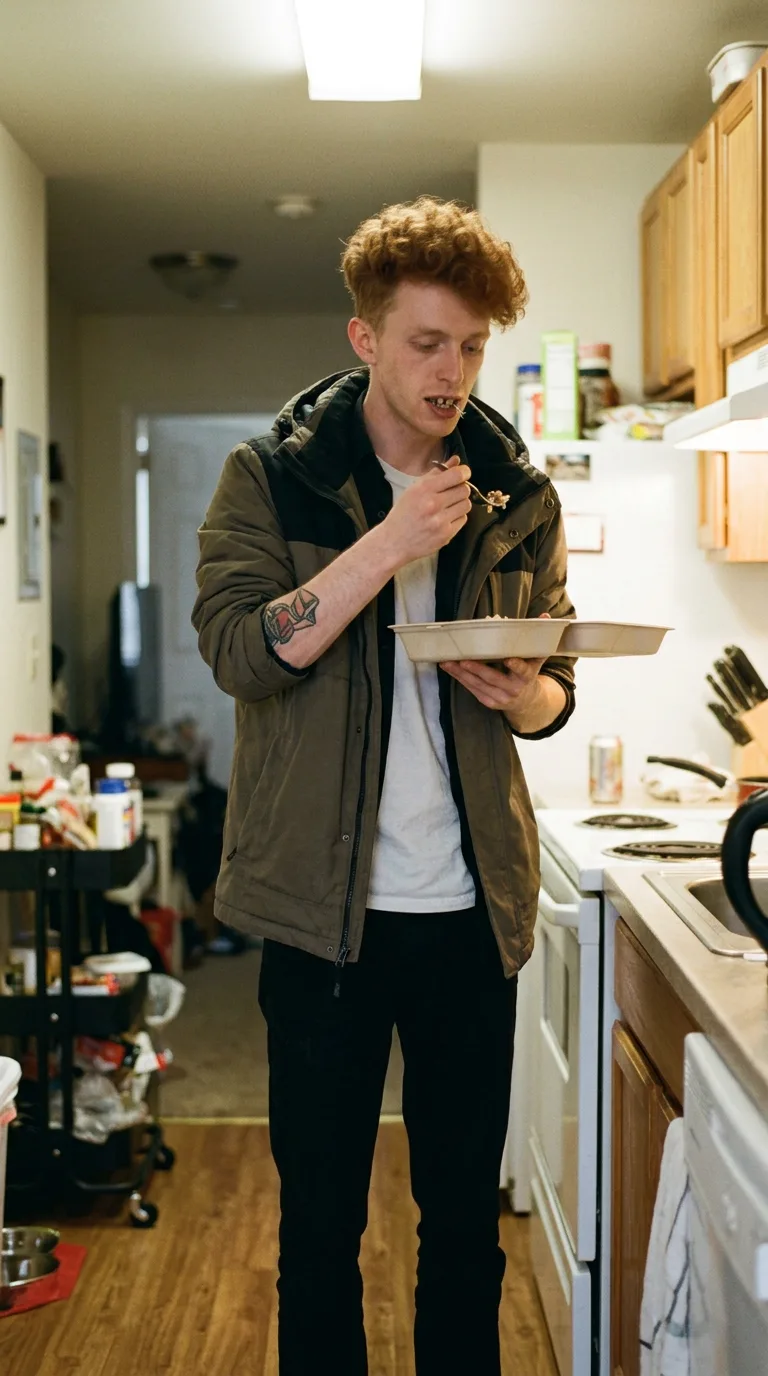
Rarest thing about him: A gap between the front teeth — rare, 1 in 33
Season 0seed 1759906806 · engine v10
Character card
lineage 8ZQHYV
His body-swap story
@paul.gervasi, wearing Marcus Adebayo, rolled the wheel on and woke up as Colm Rafferty, spent 5 minutes in him, then spun the wheel and woke up as Paul Gervasi
Sunday, afternoon, Chicago. You are standing in a screened-in porch that smells like smoke and clover, and the hands you are wearing are not yours, though by now they answer when you ask them to. Marcus Adebayo's hands. Broad, calloused at the base of each finger, a thin white scar splitting one eyebrow like a hyphen. Five minutes you've had him — five minutes of a beekeeper's Sunday, a suit hung on a hook by the door, a jar of last year's honey gone thick and cloudy on the sill. You liked the hives. You liked, for about ninety seconds, the idea of a slow life, of bees, of a scar that had a story attached to it that wasn't yours to tell but was yours to wear.
Then the itch again. Not boredom exactly — worse, a kind of hunger with no shape, the thing that has followed you through four men now like a dog that won't be fed enough to leave. You don't examine it too hard. You never do. You take out the phone that is his and not his and yours and not yours, and you open the page with the wheel on it, and Marcus Adebayo's thumb — thick, sure, a beekeeper's thumb — taps to pay, and the porch and the smoke smell and the half-formed idea of who Marcus might have become to you all fall away at once, mid-afternoon, mid-decision, the way a chair falls away when you stand up from it.
—
The fork stops on its way to your mouth.
It sets itself down on the rim of the container with a small, tinned sound, and your hand — thin now, longer-fingered, a stranger's hand, though it does not feel strange from the inside, it feels like the only hand you have ever had — comes to rest on the counter's edge. You shrug a coat off shoulders that are narrower than the shoulders you had a second and a world ago. Somewhere behind you a kitchen light is buzzing very faintly, the fluorescent kind, an ugly white that makes everything underneath it look like evidence. You sit. You eat what's left of the container in slow, even mouthfuls, and the window in front of you shows nothing but your own face doubled back at you in the dark, and you do not yet know whose face that is.
—
It comes in through the coat first, which is on the floor now where he dropped it, sleeves still holding the shape of the arms that wore it. Cold — that's the first thing, an afternoon fog that never burned off, the kind of San Francisco cold that has nothing to do with the calendar. You feel a whole winter of walking home in that coat, head down, hood up, the zipper that snags a third of the way if you don't hold the fabric taut with your other hand, a habit so old the body does it without you.
The fork is next. Cheap steel, a bent tine, and it brings back a version of you — him — standing in this same spot after a double, too tired to plate anything, eating cold pasta out of a to-go box because cooking for one felt like a joke nobody was going to laugh at. That's most nights. The job comes back all at once then, riding in on the memory of the fork: the dining room with its chairs upside down on the tables at close, legs in the air like something overturned in a flood, the particular ache across the shoulder blades from carrying a tray too long on one side, the manager who says *table eight needs you, table eight needed you five minutes ago*. You feel the apron strap's memory of sitting on your neck, though the apron itself is hung on a hook by the door thirty feet away — the body remembers the weight even absent the weight.
The countertop under your palm gives you the apartment itself, this garage under someone else's bay window, the driveway outside cut so steep that the landlord's Honda scrapes its bumper every single time, a joke you — he — used to make to whoever would listen, which by the end was no one, because the roommate moved out in June and never got replaced, because $2,400 alone is a special kind of quiet you learn to live inside.
The gap in your teeth — you feel it now with your tongue before you feel it any other way, the specific absence of it, and with that comes a girl in high school who told you it was the first thing she noticed and meant it as an insult, and a different girl years later, in a bar in the Mission, who told you it was the first thing she noticed and meant something else entirely, and nothing came of either, really, nothing comes of much, you are twenty and single and it doesn't sting the way it would have at sixteen.
The sleeve against your arm — rolled, day-old, the shirt he's had on since morning — brings the tattoo up into feeling before you even glance down: the American traditional piece high on the arm, bold black lines gone a little soft with a few years on them, a rose the color of a stop sign faded to brick. You remember the shop, the buzz of it, a friend from the restaurant who came along and held your other hand and laughed at you for flinching, and how proud you were of it for a month afterward in a way you'd be embarrassed to say out loud now, and how it doesn't feel like pride anymore, just feels like yours, the one unchosen fact on your skin that you did choose.
Under all of it, the body itself keeps talking: skinny, hungry after a twelve-hour shift plus the walk home, a knee under the table already going, that leg bouncing on its own the way it's bounced through every job interview and every awkward silence and every meal eaten alone standing at a counter because sitting down alone felt like admitting something. No drink in the fridge worth mentioning. No cigarettes, though the hand still sometimes reaches for a pocket that hasn't held a pack in two years. Nothing in the wallet in the coat pocket worth calling money. A church he doesn't go to and a God he isn't sure of and a feeling, some nights, walking back from the restaurant under the fog-softened streetlights, that something is listening anyway.
You finish the last bite. The container is empty. The window shows you a face with a gap in its teeth and hair like a lit match, and for a second you just watch it not-quite-belong to you.
—
You look down at the hand still holding the plastic fork, turn it over slow, like it might be wearing gloves.
"Huh," you say, to the dark glass, to no one. "Guess I'm not done spinning."