Colin Brashears
Fictional. Generated by AI — not a real person, and no likeness of one is intended.
43, trucker in Los Angeles · rolled by @colby.marsh · card — no film
History
who has worn him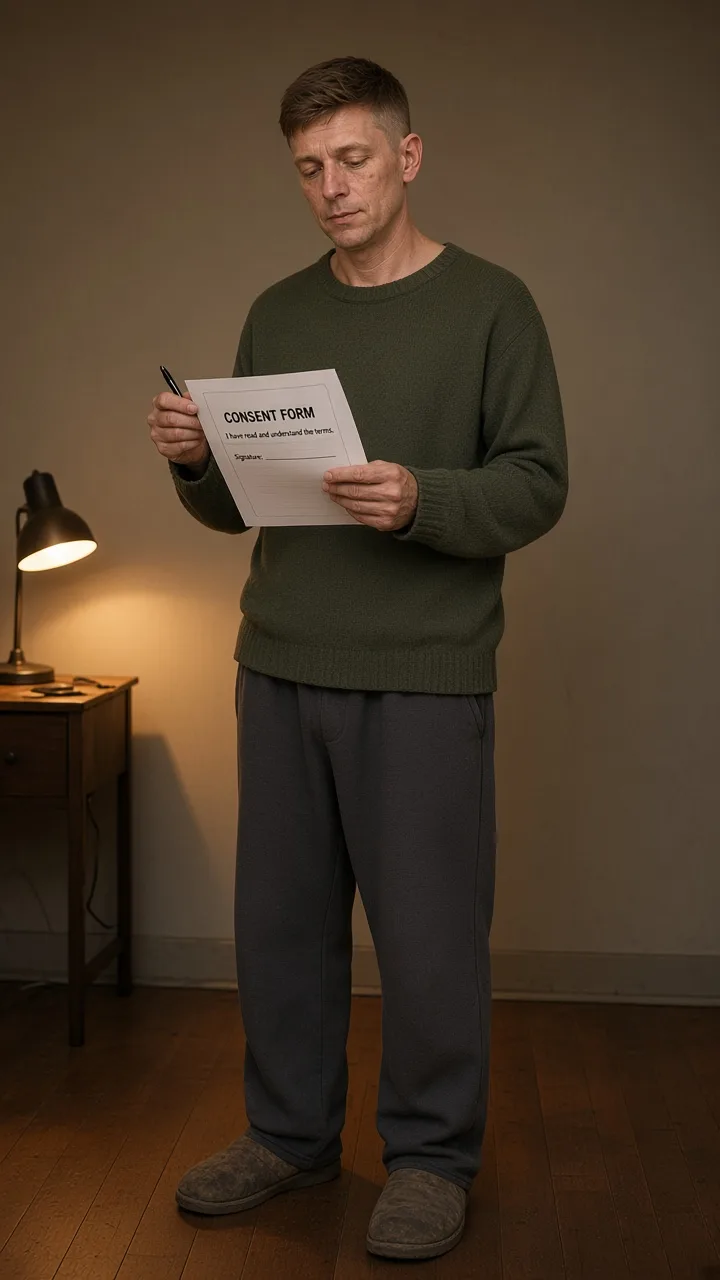
Rarest thing about him: Cracks his knuckles — uncommon, 1 in 15
Legacyseed 1672426024 · engine v8
Character card
His body-swap story
---
You have never seen him before in your life.
That is the strange part, and you keep turning it over the way he will soon turn over his own hand. Whoever arranged this — and something arranged it, some clerk in some system you don't have a name for — matched you to a man you have no claim on. No blood. No debt. No old hurt to settle. He is a stranger and you are a stranger and in about ninety seconds you will be the only one of you left.
You watch him read.
He is doing it properly. That's what gets you. Most of them skim — you know this the way you know a lot of things you were never taught, the way water knows downhill — most of them find the signature line and go straight to it because they have already decided and the paper is only a formality standing between them and the decision. He isn't doing that. He is holding the pages up near the lamp because the light in that room is bad, one desk lamp on a scarred wooden table, the bulb throwing a warm cone up the wall and leaving the rest of him in dim, and he is reading each clause with his lips just barely moving. Forty-three years old. Skinny through the shoulders and soft at the middle, the build of a man who sits eleven hours a day and eats what the truck stop has. Green sweater, sweatpants, house slippers. He got comfortable for this. He dressed the way you dress for a long night at home.
Freckles. That's the thing you'd notice, the thing anyone would notice — a spray of them across the nose and up over the cheekbones, boy's freckles on a man's weathered face, so that from a distance he looks younger than he is and up close he looks like a kid who got left out in the sun for thirty years. His hair is faded tight at the sides, light brown, left full on top and pushed back with his fingers rather than a comb. Under the sleeves his forearms are ropey and dry. There's a callus ridge across both palms from the wheel.
He turns a page. He cracks his knuckles — one hand, then the other, absent, a sound like small twigs — and he doesn't hear himself do it. You will hear yourself do it. You already know that. You'll be the one flinching at it for the first month, until the hands teach you it's just what they've always done.
You want to know why. You will never know why, not really — you get the body and nothing else, no memory, no ledger, none of the reasons — and so you take what the room gives you. There's a phone on the desk, face down. There's a set of keys with a fob shaped like a shield. Under the lamp there's a ring, unworn, small enough to be a woman's, sitting where a man puts a thing he looks at and doesn't wear. Nothing he would bring up. He hasn't brought it up. He has three kids somewhere — more than three, maybe; you don't get told the exact count, you get *three or more*, which is the way the world talks about children when it's tired — and a girlfriend who does not know he is standing in this room, and a comfortable life in a stucco courtyard in Los Angeles with dry palms rattling out front and the late sun going up the wall like a tide. He quit drinking. He quit smoking. He has been quitting things in order, one at a time, for years, and you understand suddenly, watching him hold the last page to the lamp, that this is only the next one on the list.
*Spiritual, but not religious.* That's the box he'd tick. It means he thinks something is out there and has never once expected it to be kind. It means he was ready to believe you when you came.
He gets to the bottom of the last page. The part that says *for good*. The part that says there is no term, no review, no undoing, no one to appeal to. He reads it twice — you see his eyes go back up and come down again — and his mouth does something you will think about for a long time afterward. Not fear. Not quite relief. Something in the family of *fine*. The face of a man who has finally been offered a deal where nobody lied to him about the length of it.
He initials the corner. He sets the pen down on the desk and squares it with the edge, parallel, tidy, the way he'd chock a wheel.
And he looks up.
You are already there. You come in the way weight comes into a chair. There is no tearing. The head goes back — that's the body's doing, not yours, the machine startling as the driver changes — and there is a second of light, and then there isn't, and then the room is very quiet and very warm and very small and it smells like dust on a lamp bulb, and the sweater is itchy at the back of the neck, and the left knee is worse than the right, and there is a sourness at the back of the throat that has been there so long he stopped calling it anything.
You are standing up. You have not stood up in a long time. You had forgotten the arithmetic of it, the constant tiny corrections, the ankles working.
You bring the hand up.
Big. Dry. Freckled on the back, right up over the knuckles, and the nails cut short and square and the ridge of callus you saw from outside now something you can *feel* against your own thumb, which is the same thumb. You turn it over. Palm, lines, a faint yellow shine where the wheel sat. You flex the fingers and they answer immediately, obedient, unsurprised — and then the joints crack, all four of them, without you asking, because these hands do that when nobody is thinking about them and nobody is thinking about them.
You laugh. It comes out of his chest, low, unfamiliar, and it stops fast.
He gave you this. A stranger. He read every word and he signed and he set the pen down straight, and now there are children somewhere who will get a father back on Sunday who is you, and a woman who will say *you seem lighter* and mean it as a good thing, and a rig in a lot in Fontana that will start at four in the morning under a sky going grey, and a ring under a lamp that you will never know the story of and will keep anyway, because it was here when you got here.
You lift your eyes off the hand.
You look for something to look at — there's no mirror, only the dark wall and the lamp's cone and past it, somewhere, the sense of being watched, which is the only thing you brought with you and the only thing that was ever yours.
"He read it," you say. "All the way through."