Colin Aspinwall
Fictional. Generated by AI — not a real person, and no likeness of one is intended.
38, restaurant manager in Los Angeles · rolled by @colin.hasbrook · card — no film
History
who has worn him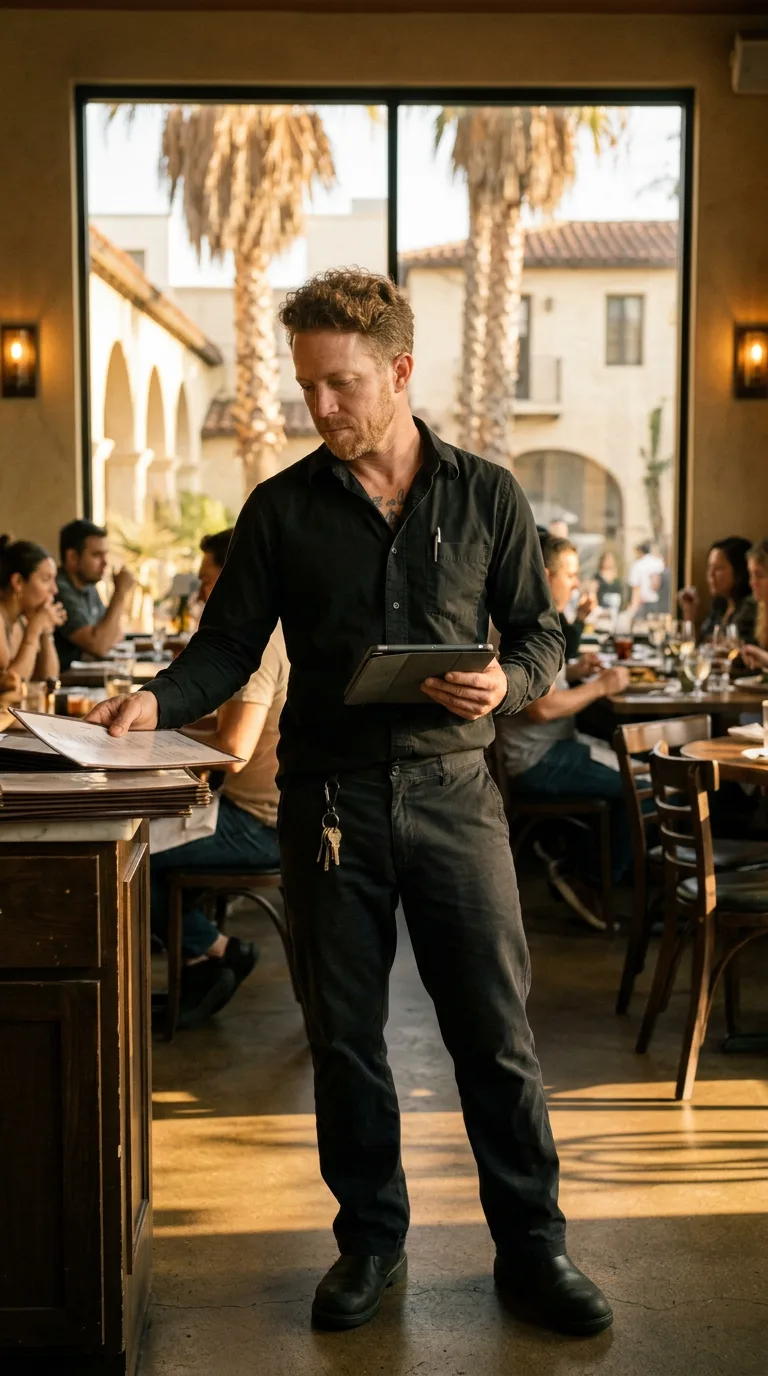
Rarest thing about him: One, chest — common, 1 in 32
Season 1seed 404571461 · engine v11
Character card
lineage 2NZHHJ
His body-swap story
@colin.hasbrook, wearing Álvaro Nieves, rolled the wheel on and woke up as Colin Aspinwall, spent under a minute in him, then spun the wheel and woke up as Malcolm Dessalines
---
Álvaro's office chair is good leather, the kind that exhales when you sit in it, and you have been sitting in it for less than a minute, and already you hate it. Not the chair. The being in it. You made a man rich enough to own a chair like this and now, at sixty-five, in his skin, in his home office in Atlanta with the evening light doing something gold and unearned across a wall of photographs of people who are not your children but who look up at Álvaro like he is somebody's father, you feel the specific, familiar hunger arrive again — not thirty seconds after arriving here, but for real, like it's been waiting under the leather for you. You did not spin six hundred and six times because you wanted to stop at Álvaro. You spun because there is always a next one, and this body, this good chair, this view — it is comfortable, and comfortable is the thing you have never once let yourself sit inside. Your hand, his hand, liver-spotted at the knuckle, is already opening the laptop. The wheel loads the way it always loads: patient, colorless, waiting to be spun by someone who has never once needed a good reason.
You spin. It does not ask why. It never has.
---
The strip goes wrong and then right and the tray in your hands rattles a half-beat off-time — one motion, badly done, silverware clattering against itself — and then you set the fork down again, correctly, watching your own fingers do it like they belong to a stranger performing your job for an audience of one. You are 5'3" in shoes with a heel worn soft on the left one. You are standing at a expo line in a restaurant lit gold by a window full of palm tree and late sun, and there is a printed ticket in your other hand, and behind you a room is loud with a hundred conversations you are, for one second, not part of.
---
The shirt is what opens first — black cotton, warm from your own back-sweat, a pen clipped crooked into the breast pocket — and through it comes a whole morning: standing in front of the closet in the apartment, palm trees clacking dry outside the window, picking this shirt because the other black one has a coffee stain at the cuff that never came out no matter what he tried. Colin. His name arrives with the shirt, plain as a tag. Colin Aspinwall, thirty-eight, doing the buttons up one-handed the way he's done it four thousand mornings running, top button skipped because it chokes him, and the tattoo at his collarbone — small, blurred at the edges, a swallow that a twenty-two-year-old version of him thought meant something and a thirty-eight-year-old version of him covers with his top button skipped for entirely different reasons.
The keys on his belt loop are next — a scatter of feeling, brass-warm, the particular weight of them against his hip when he walks the floor fast between the host stand and table six, twelve years of walking this exact floor in three different locations before this one, promoted up from server to shift lead to this, manager, a title that mostly means he is the one who apologizes when the kitchen is slow. He is good at his job in the unglamorous way of someone who has simply done it enough times that his hands stopped needing his eyes years ago — folding napkins, resetting a four-top, running a card, all of it automatic, all of it, until thirty seconds ago, perfect.
The tablet under his arm gives him Friday — every Friday, the good chaos of it, the particular pleasure of a packed room he built the reservations for himself, block by block, like Tetris, like a proof he's solving. He loves this part and would never say so out loud to anyone who asked, because it sounds small. It isn't small to him.
His body: compact, wiry-strong in the forearms from years of carrying too much on a tray at once, a low back that aches by nine every night and has since he was maybe thirty-one, curly hair he has stopped fighting and just cuts short at the sides so it behaves. Blue eyes that a woman named Priya told him, four months into dating him, were the first thing she noticed, and he still doesn't fully believe her, the way he doesn't fully believe most nice things said about him. She's picking him up after close tonight. There's a version of tonight, the one that was supposed to happen, where he takes his apron off at eleven-forty and she's outside in her car with the windows down and something dumb on the radio, and neither of them yet knows that particular tonight is no longer a thing that is going to happen to him.
There's an ex-wife in here too, brief, three years married in his twenties, ended without drama, without a villain, just two people who wanted different Tuesdays. There's a mother in Sacramento who prays a rosary for him every night whether he asks her to or not, and a version of Catholic in him that shows up mostly at Christmas and quietly, privately, at moments like tonight when the room is full and warm and he thinks, briefly, unbidden, thank you, to no one, for no reason, out of pure animal gladness at being alive and useful and slightly tired in a room full of people eating well.
None of it is dramatic. That's what's strange, holding it — there's no wound in here big enough to explain anything, no secret shame bigger than the tattoo he covers with a button. Just a decent, ordinary, unremarkable life, worn in like the boots on his feet, and worth, on paper, more than most men make and less than he sometimes wishes, and entirely, completely his, until eleven seconds ago.
---
You look down at the hand holding the fork. Small hand, tan at the wrist, a thin white scar across one knuckle from a broken glass he doesn't remember breaking. You turn it over once, slow, watching it not obey the memory of Álvaro's hand, watching it be its own thing entirely.
You look up, past the tablet, into the gold light coming through the window, and somebody near the host stand is saying his name — "Colin?" — waiting on him to notice the room again.
"Yeah," you say, in his voice, quiet, mostly to yourself. "One sec."
Behind your eyes, six hundred and seven men deep, the wheel is already loading again, patient, colorless, in no hurry at all.