Colby James Reinhart
Fictional. Generated by AI — not a real person, and no likeness of one is intended.
22, freight handler in Philadelphia · rolled by @noah.samuel.brenner · card — no film
History
who has worn him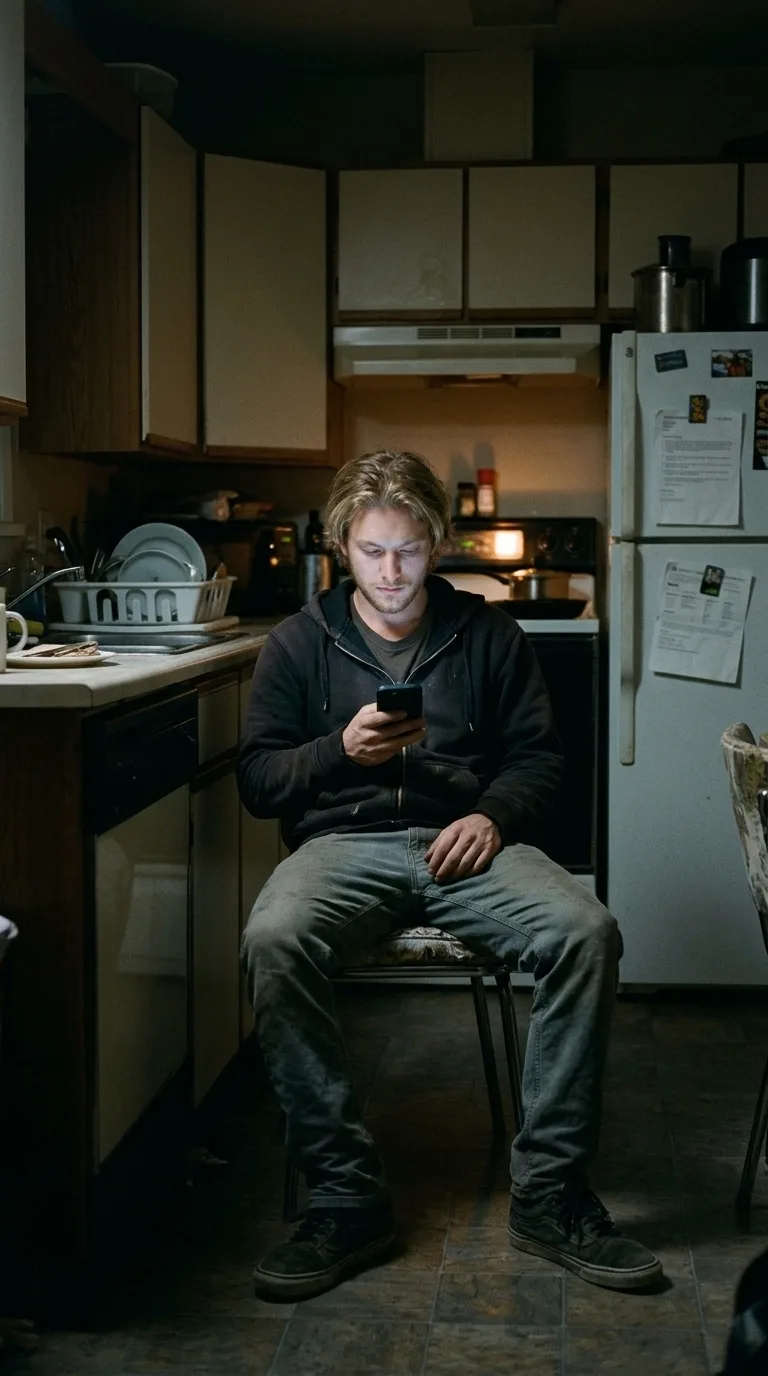
Rarest thing about him: Scrolling a shop he cannot afford — common, 1 in 54
Face-off rating 1500 · not ranked yet
Season 1seed 1418506114 · engine v11
Character card
lineage GPCVRD
His body-swap story
@noah.samuel.brenner, wearing Frank Edward Kowalczyk, rolled the wheel on and woke up as Colby James Reinhart, spent 2 hours in him, then spun the wheel and woke up as Noah Samuel Brenner
You are sixty-four, and your nose aches where it was broken. You are sitting at a desk in Chicago under a lamp. Frank's reading glasses are pushed up on his forehead, and his wife's last voicemail is still on his phone, which you have not deleted, though it was never yours to keep. Three minutes in him, and you already know it is wrong. His knees are too careful. His breath is too measured. He has spent forty years learning to be quiet, and quiet is all he has. You want a body that wants things. The page with the wheel on it is open, and your thumb, his thumb, is already coming down.
Then the kitchen. The scroll stops on a price, and your thumb comes up off the glass and stays up. The phone goes face-down on the counter. The hand that set it there does not pick it back up.
You are sitting on a vinyl chair in the dark. Your right leg is bouncing, and it does not stop when you notice it. Heat from the stove light, and a dish rack dripping. The body is small and tight, quick at the shoulders, and it hums like a wire.
The hoodie cuff against your wrist gives you the morning first. A dark street, first sun on the white marble steps worn hollow by a hundred years of feet. His hands pull the zipper up in the cold. He did it without thinking, the way he does everything. The jeans are stiff at the knee, and you feel a trailer floor, boxes to the roof, the count in his head, forty, forty-one. The shoes remember a loading door, and the sting of the wind between the dock and the truck. His back is sore in a clean, earned way. Under the table the leg bounces on, and it comes with a feeling, not a memory: the bouncing is prayer he never says aloud. Sunday, a folding chair, a church hall that smells of coffee and floor wax. Someone put a hand on his shoulder and he wanted, badly, to be good. He has never had a drink and has never wanted one. The rent is a number he carries in his chest like a stone. The watches were never to buy. He looked at them the way you look at a window from the street, to feel the glass.
Nobody is coming for him. There is nothing left of him to mourn it.
You lift your hands into the light. They are scarred with work, with calluses along the palms, and the fingers are quick. You turn them over. Then you look up at the dark window over the sink, at the face in it, young and tired, with stubble and too much hair.
"Okay," you say, in a voice that is not Frank's. "Okay. Let's see you."
And underneath it, already, quietly: how long. Tomorrow, or four minutes. You can't tell yet whether the wanting will come back.