Cody Fessenden
Fictional. Generated by AI — not a real person, and no likeness of one is intended.
19, grocery stocker in Small-town Ohio · rolled by @connor.waskiewicz · card — no film
History
who has worn him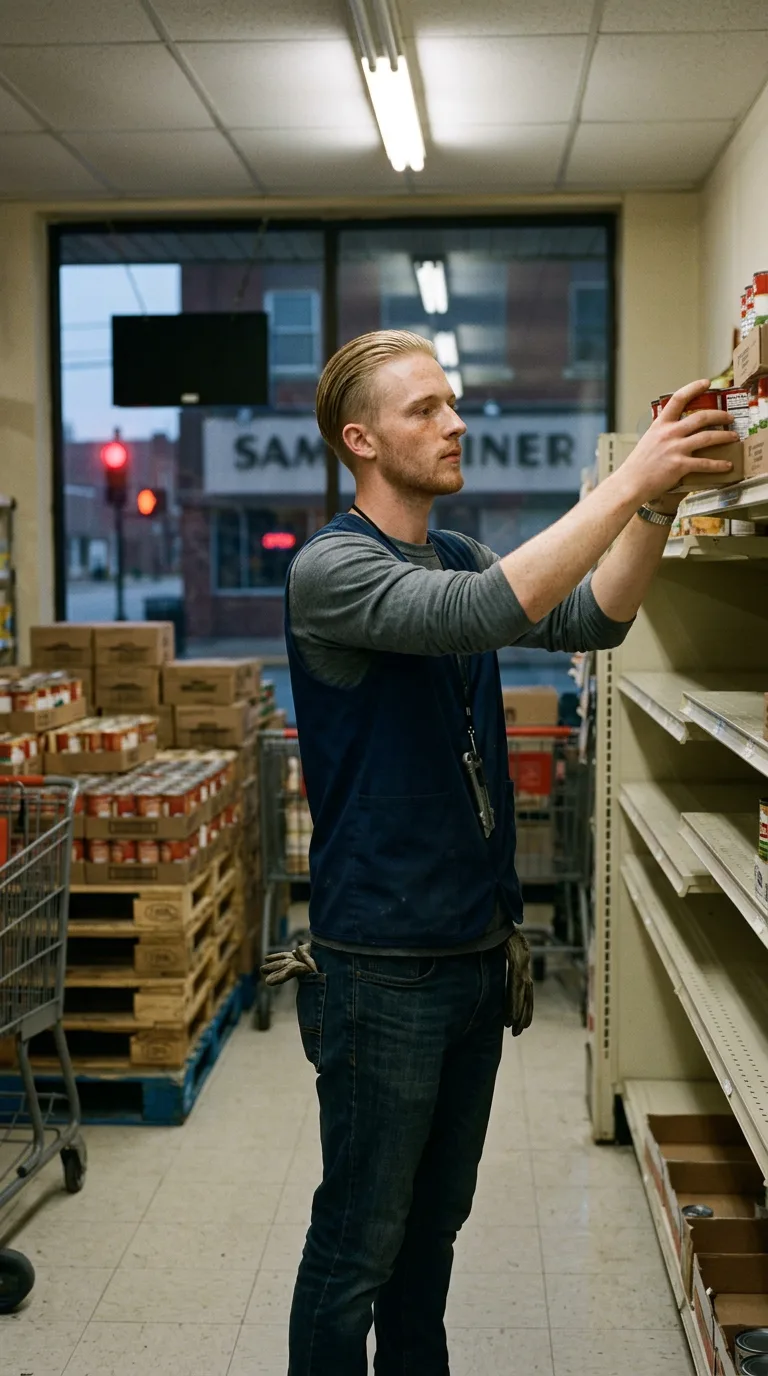
Rarest thing about him: Sober by decision — common, 1 in 27
Season 1seed 1491054172 · engine v11
Character card
lineage 2NZHHJ
His body-swap story
@connor.waskiewicz, wearing Dennis Whickerham, rolled the wheel on and woke up as Cody Fessenden, spent 4 minutes in him, then spun the wheel and woke up as Paul Dunleavy
The picker's body has good hands. That's the thing you keep coming back to, standing in Dennis Whickerham's skinny frame in a Denver warehouse aisle, the unibrow throwing a shadow you can feel more than see, this being the last minute of a shift that started an hour before it will start again tomorrow. Good hands, bad everything else — the shaved head that's always cold, the beard that itches, the back that has started, at thirty-three, to announce itself on the tenth hour. You have had him less than a minute and already you know the whole shape of wanting to leave: not disgust, nothing so clean as disgust, just the small itch of a body that works fine and promises nothing else. Nine hundred and four men behind you and you have learned the itch doesn't need a reason. It just needs a phone, propped on a shelf bracket, open to a wheel.
You spin it on your break, thumb still smelling like cardboard.
—
The box in your hands is a can of stewed tomatoes and it is going onto a shelf that is not this shelf, in a light that is not this light — fluorescent tube humming white instead of warehouse orange — and your arm, mid-reach, does the motion wrong. You correct it slow, deliberate, like a man relearning where his own elbow bends. The can goes up. The next one goes up checked. So does the one after. Somewhere behind your sternum a heart that isn't the one you had a second ago is beating at a different, younger rate, and your feet, standing in boots that have already broken themselves in around somebody else's stride, adjust their weight without asking you.
Outside the window a single stoplight cycles red to nobody. SAM'S DINER, dark, dead sign. It is almost midnight here. It was evening where you were.
—
The vest comes first — not the putting on of it, that's hours gone, but the memory of it sitting heavy over the shoulders, STORE ASSOCIATE stencilled in thread that's peeling at the O, and with it a flash: clocking in at 10:58, Reyes at the register already looking dead on his feet, the automatic doors letting in October cold. The lanyard against your collarbone gives you the clip on the end of it, box-cutter blade retracted, and under that a whole afternoon — Tuesday, maybe, some Tuesday — opening cases in the back with music on a phone propped against a fifty-pound bag of dog food, singing badly, alone, happy in a way that doesn't need witnesses.
The gloves, tucked into your waistband where you left them because your hands don't need them for cans, give you callus — a year of callus, a specific ache low in the right thumb from the same box-cutter grip ten thousand times. Your shoulders know this reach before you tell them to make it. Six feet of you, average through the middle, nineteen years in a body that has not finished deciding what it's going to look like at thirty, and everything in it already fluent: how far to lean into the top shelf, how to walk backward pulling a pallet jack, how to read a shelf tag upside down without slowing your hands.
The shirt sleeve, pushed up over the tattoo on your upper arm, gives you the most — because your fingers brush it reaching for the next case, and it opens like a door left open. Script lettering. A name — Thurston — and a date under it, 05.16, that isn't a birthday, is the day a dog you had for eleven years stopped getting up in the mornings. You remember the vet's fluorescent light, worse than this one, and a rawness in your throat at nineteen that surprised you with how much room it took up, and the tattoo shop three weeks later, a decision made mostly so the crying would have somewhere to go.
The phone in your back pocket, when your hip brushes the shelf edge and you feel its shape, gives you her — Brianne, a name that arrives with a specific laugh attached to it, a booth at the diner across the street back before it closed, her cold feet against your shins under a blanket that was always technically hers. Dating nine months now. There is warmth in it and also, underneath, unbidden, an older warmth — Kayleigh, the one before, whose number you still know by heart though you'd never dial it, whose ring you can still half-feel some nights for no reason you'd say out loud. You don't compare them. The body just holds both, the way a hand holds a scar and doesn't examine it every time it moves.
The floor under your boots gives you the store itself — nights of it, pallets at 3 a.m., the diner's dead neon the last human light on Main Street before you lock up, the drive home in a truck with a check-engine light you've stopped seeing. Your body is tired in the honest way, the muscle-worn way, not sick, not old — nineteen and strong and a little sore in the lower back from lifting wrong four hours ago and not stopping to fix it. It smells like cardboard dust and the coffee Reyes makes too strong. It is, you understand, standing here holding a can of stewed tomatoes that is not moving because your hand has stopped moving it, a good life being lived by somebody who never once had to decide whether he wanted it.
—
You look at your hand. Freckled, faintly, across the back where the light catches it, a callus riding the base of the thumb that isn't the callus you had an hour and two bodies ago. You turn it once, slow, like checking it for damage that isn't there.
"Huh," you say, to the empty aisle, to the dead stoplight through the glass, to nobody. "Okay."
You go back to the cans. Somewhere a wheel is still warm from the last spin, and you don't know, standing in this good tired body at midnight in a town with one working light, whether you'll want another one in four minutes or four years — only that you will, eventually, and that he will never be the one who finds out.