Chad Bellinger
Fictional. Generated by AI — not a real person, and no likeness of one is intended.
41, line cook in Houston · rolled by @colin.hasbrook · card — no film
History
who has worn him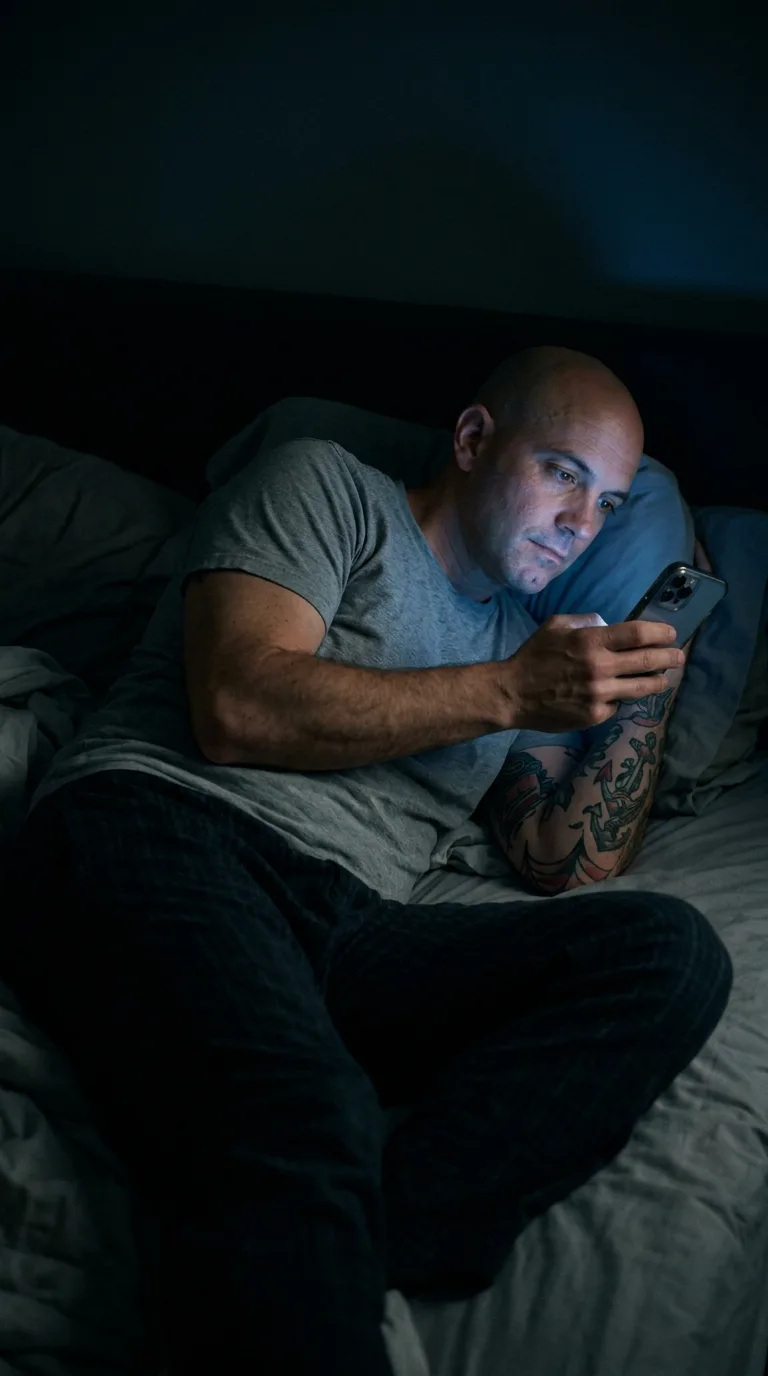
Rarest thing about him: It's a problem and it shows — rare, 1 in 49
Season 0seed 1141659763 · engine v10
Character card
lineage 2NZHHJ
His body-swap story
@colin.hasbrook, wearing Douglas Merchant, rolled the wheel on and woke up as Chad Bellinger, spent under a minute in him, then spun the wheel and woke up as Walter Prescott
You have been Douglas Merchant for forty seconds and already you hate the knees.
That's what does it, in the end — not some grand dissatisfaction, just the specific ache of a fifty-eight-year-old joint bending down to plug in a extension cord backstage, the crew chief already yelling about places, and you think: no. Not tonight. Not this one. You've had him less than a minute and you know already, the way you always know, fast now after two hundred and eighteen times — the freckles, the bald head catching the work lights, the small tired hands. He'll be here when you get back, or he won't, it doesn't matter, nothing you leave behind ever matters, that's the whole mercy of the thing. You take the phone out backstage, thumb already knowing the site by feel more than sight, and you spin before the second thought can find you.
The wheel doesn't care that it's evening in Atlanta and a Monday afternoon in Houston. It doesn't care about anything. It gives you weight — more of it, immediately, a bigger frame settling around you like a coat two sizes up — and a mattress underneath instead of a rigging catwalk, and a phone already in your hand instead of an extension cord, and blue light on your cheek instead of gel-colored stage light, and a thumb that was slowing down and now, under you, speeds back up.
You are lying on your side in the dark. Somewhere behind you a window is doing very little against a Houston afternoon, blinds shut, room dim as a confessional. Your knees don't hurt. Nothing hurts, yet, though you can already feel the specific unhappiness sitting low in a body that drinks more than it should — a kind of humidity behind the eyes, present even in dim light, even resting. You are enormous compared to what you just were. Six-foot-something of shoulder and forearm. Your thumb stops moving on the screen for one held second, the residual motion of a man mid-scroll meeting a driver who has never scrolled this particular phone before.
Then the shirt.
It's a plain gray tee, worn soft, and touching it — no, being it, wearing it from the inside — throws the first flash at you: a walk-in cooler, steam off a hotel pan of braised short rib, someone yelling *Bellinger, on me* and you — him — Chad — turning with two plates stacked up his forearm like it's nothing, like his body learned this a decade before his brain caught up. The half-sleeve on the right arm burns for a second with a memory that isn't pain — a shop in Pasadena, nineteen years old, a swallow going in first because his boy cousin told him swallows meant you'd always find your way home, and then years of adding to it badly, anchor, banner, a rose that a girlfriend before this one hated, all of it bold and faded now the way real ink fades, not the way movie ink fades.
The sweatpants against your legs, and under them, sleep apnea — a machine somewhere in this room, hissing quietly in a case, that he resents and needs and forgets half the nights. You feel it in his tiredness, a tiredness that predates today, service after service, a chronic debt his body carries the way it carries a low simmering thirst for something with a burn in it, chew tucked usually behind his lip even now — you can taste the ghost of it, faint mint-tobacco phantom on a tongue that hasn't had it in the two hours he's been trying to nap before evening prep.
The bed under your back gives you more — a bed shared, most nights, with a woman named Priya who is not here right now, who laughs at his jokes about the walk-in being colder than her family's opinion of him, who he loves in the uncomplicated overworked way of a man with three kids already from before her and a fourth thing he hasn't said out loud yet, which is that he wants to marry her before the year's out. The kids come in pieces — a girl's handwriting on a card taped to a locker, a boy's cleats by a door, a toddler's weight riding a hip that is this hip, muscle memory in the arm before the face of the kid even arrives. Line cook money is not restaurant-owner money, but it's steady, tips folded into an account with more zeroes than you'd guess from the stains on his chef coat, more than Douglas ever saw backstage in a decade.
The phone itself gives the last thing, cruelest and smallest: he was looking, this exact minute, at a text thread with his brother he hasn't answered in four days, a birthday he forgot, guilt sitting there dumb and small underneath everything else, the kind of unfinished business that will now simply never be finished by him, because he isn't the one holding the phone anymore.
You feel all of it land in a heap — the marriage he was about to propose, the brother he was about to call, the shift he is due at in a few hours smelling faintly already of char and garlic on his own skin even now, hours before the pan touches heat.
You look at your hands. Big, a little rough, a tan line from a wedding ring he doesn't wear yet, ink climbing one forearm in blues gone to gray. You turn the right one over slowly, the swallow tilting with it, and you lift your eyes off it, into the low blue light, like you're looking for a lens that isn't there.
"Guess I'm working tonight," you say, out loud, to no one, and you don't know yet if that's true, or for how long it'll be you saying it.