Cedric Okonkwo
Fictional. Generated by AI — not a real person, and no likeness of one is intended.
45, stagehand in Pittsburgh · rolled by @colin.hasbrook · card — no film
History
who has worn him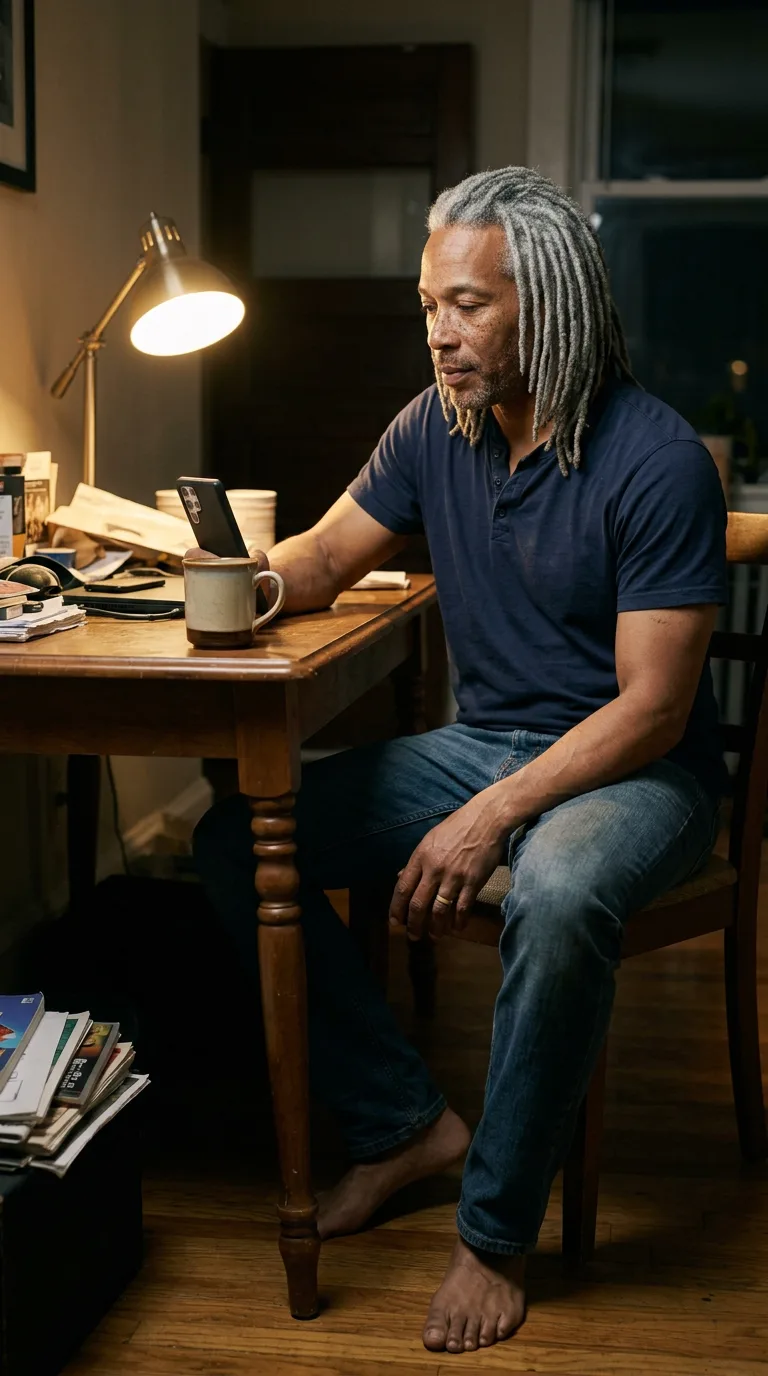
Rarest thing about him: Quitting right now — epic, 1 in 99
Season 0seed 521722572 · engine v10
Character card
lineage 2NZHHJ
His body-swap story
@colin.hasbrook, wearing Gordon Aldrich, rolled the wheel on and woke up as Cedric Okonkwo, spent under a minute in him, then spun the wheel and woke up as Reginald Paschal
The office chair in Honolulu has a crack in the armrest that catches the lawyer's forearm the same way every time he leans, and he leans now, at midday, the deposition transcript open and unread on the monitor. This body — number 378, gray-silver hair, blue eyes, a build like a coat hanger left too long on the rod — has been his for less than a minute and it is already unbearable. He knows this the way you know a hotel room isn't yours: the freckles wrong, the height wrong, some other man's ache behind the sternum where his ulcer flares on cue. He does not decide so much as remember deciding, already, before he sat down: the boredom arrives faster each time now, like a debt collecting interest. He opens the laptop. The wheel is already loaded, spinning lazily on its own axis on the screen, waiting for money he no longer thinks about spending. He clicks. He pays. He spins.
The mug is warm against the table and the phone is propped against it, screen bright, and the last thing the eyes were doing — his eyes, Cedric Okonkwo's eyes — was watching a filter melt fifteen years off a face that has earned every one of them. Then the filter cuts, the smoothing drops away like water off a coat, and there is a half-second where the bare face underneath simply holds still, the way a held note holds after the singer has already stopped feeling it. A hand — his hand, yours now — comes up unbidden and turns the jaw toward the lamp. One side. Then the other. Checking something that isn't there anymore. You are standing nowhere; you are sitting, weight settled low and solid in a body that knows how to be sat in, barefoot, one ankle hooked around a chair leg out of a habit that isn't yours yet but will be in a second.
The shirt is what gives him to you first — a navy henley, soft at the collar from wear, and touching it brings back a Tuesday, another Tuesday, dozens of them, the particular give of the fabric over a chest that has carried lighting bars and drop cleats for twenty years and still, still, wakes up sore in the same two places. You get the load-in at the Benedum before you get his name: the fly rail under its blue work light, rope in his palms with a callus exactly where the rope wants it, the stage manager's voice in a headset saying *go* and his body answering before his mind finishes hearing it. That's his hands. That's what they know without asking.
The jeans against your legs bring back getting dressed this morning — his morning, the actual one, hours behind you now in this borrowed noon — pulling them on standing at the foot of a bed too big for one person, the apartment quiet in the specific way apartments get quiet after a divorce finishes being news and starts being furniture. Belt through the loops one-handed, a motion so old it isn't a memory so much as a reflex wearing a memory's clothes. The tan line on his ring finger catches lamp light when he lifts the phone, and that is its own small flash: a wedding, eighteen years ago, her in ivory and him sweating through a rented jacket, and then, later, not that — an argument in a kitchen, a signature, boxes. Three kids who still call him on Sundays, mostly. A daughter who won't yet, not for reasons anyone says out loud.
The mug — stoneware, chipped at the handle — gives you coffee that should've been whiskey and wasn't, because it's Monday and he is three weeks into telling himself he's quitting the cigarettes too, and his chest still asks for one every time the phone lights up with nothing. The drink is a different matter; that one he doesn't fight so hard, and some nights — you feel this arrive whole, unwanted, ashamed of itself — he doesn't remember getting into bed. He goes to church anyway. Sits in the third pew. Believes it, mostly, the way you believe a hand that's caught you before.
His breath machine sits somewhere in a drawer in the bedroom, unplugged since the divorce because there's no one left to complain about the noise it isn't making. His shoulders are still good — better than good, stagehand-good, the kind of strength that doesn't announce itself until a drop needs flying in on a four-count and his body just does it. Forty-five and his knees know it on the stairs backstage, on the cement steps between the yards behind his place, wet with fallen leaves this time of year, but his arms don't know it yet. Won't for a while.
The filter is still glowing faint and stupid on the screen in front of you, some app his youngest sent him with a laughing emoji and *try this dad* underneath, and it had made him look, for three fake seconds, like a man who never worked a rail in his life. You feel that particular embarrassment — his, not yours — the vanity of it, wanting to look younger for a photo nobody asked for, and it curdles now into something that isn't quite his anymore.
You look down. The hand on the phone is dark-skinned, freckled clear across the back of it same as the face must be, knuckles thick, a thin white scar along one first finger from a rigging cable years back that isn't in any fact sheet, just in the wince that comes with touching it. You turn it over once, like checking it survived customs.
"Okay," you say out loud, to the empty kitchen, to the lamp, to no one. "Okay. Let's see what you're carrying."