Casey Doerfler
Fictional. Generated by AI — not a real person, and no likeness of one is intended.
25, film projectionist in Dallas · rolled by @ismael.aguirre · card — no film
History
who has worn him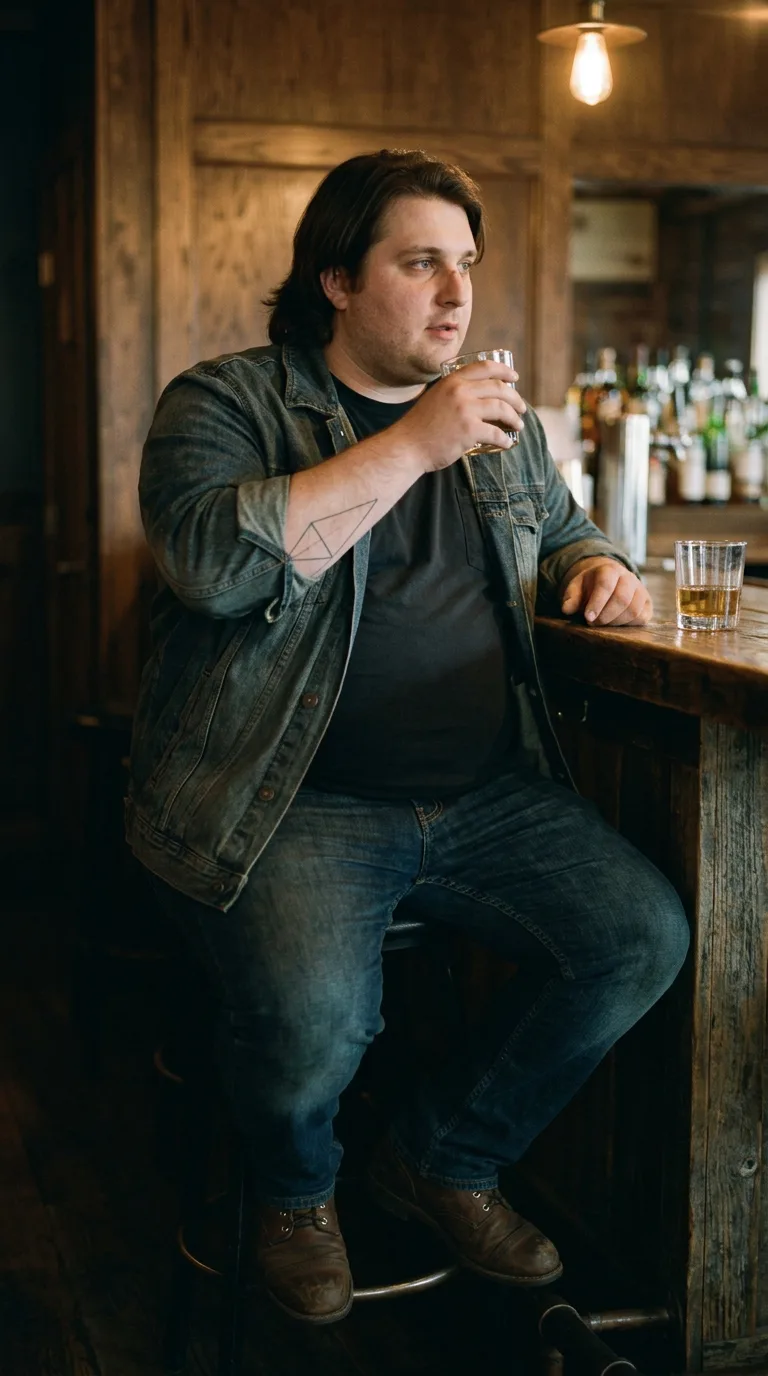
Rarest thing about him: It's a problem and it shows — rare, 1 in 33
Legacyseed 1016813142 · engine v8
Character card
His body-swap story
---
You have been sitting on the stool beside his for forty minutes and he has not once looked at you.
That is not rudeness. He looked once, when you sat, and did the arithmetic every drinker does — is this person going to talk to me — and decided no, and let you go. You were grateful. You have not had a face to be looked at in a long time, only the leftover shape of wanting one, and being examined would have been unbearable.
So you watched him instead.
Dark brown hair grown well past whatever cut it last had, shapeless over the ears, hanging down the back of his neck in a way that means nobody has told him about it and he has not asked. Twenty-five and already carrying weight the way men carry it when the weight is not from bread. Denim jacket over a black tee, the sleeve pushed up his right forearm, and there — where the arm turns — the fine-line geometric tattoo, a thin figure of intersecting angles, half of it hidden under the cuff so you never get the whole shape. Somebody drew that for him once. It is the only decorated thing on him.
The nose is the thing you keep coming back to. Broken once and set slightly crooked, so that the whole face is very slightly out of true, and it is the crookedness that makes him worth looking at. Without it he would be an ordinary heavy young man in a Dallas bar on a Tuesday. With it he is specific. He is somebody. Straight noses are a category; his is an address.
He cracks his knuckles. Not once — every four or five minutes, thumb to palm, a rolling series of small wet clicks, and each time you see him not know he is doing it. Then his hand goes back around the glass.
There are two glasses on the bar in front of him.
He ordered them together, both the same, and the bartender did not ask. That is the part that tells you the most. The bartender did not ask because the bartender knows him, and this is how it goes: two at a time so the second is already there when the first is gone, so there is no gap, no moment of raising a hand and being seen to want more. He is twenty-five and he has already engineered his own supply lines. On his phone, an alarm he silences at nine every night, the little orange bottle, the thing they gave him for the anxiety that he is careful about and takes properly, because he is a person who does one thing right. And then this. He does not think of it as a problem. He thinks of it as the weather.
You know why he sits at the bar and not at home. Home is a new-build in a subdivision north of here where every driveway is the same slab of unstained concrete and his pickup sits on his and the neighbours' pickups sit on theirs, and inside there is nothing. Nothing to his name. Under five thousand dollars in the world, including the truck, and the truck is most of it. He works nights in a booth up a metal stair with the machine running, the beam going out through the port in a long dusty wedge over two hundred heads, and he stands in the dark behind it and watches the back of the light instead of the front. It is a good job for a man who does not want to be looked at. Nobody has ever applauded a projectionist. Nobody has ever known his name in that building except the kid who sells the tickets.
He doesn't pray about it. He never has. There is no other side to any of this for him, no plan, nobody keeping score — and so the fact that he keeps getting up is not faith, it is just habit, which you have come to think is a harder and better thing.
There is an ex. You can see her in the way he checks the door at 8:40 and again at 8:55, not hopefully, the way you check a door out of muscle. She left two years ago. She was the one who took him to get the ink; hers is somewhere on her too, and she would say now that it was the drinking, and she would be about sixty percent right. He would say she was right. He tells people she was right. That is one of the things he does that makes you want him: he does not defend himself.
You want him. Understand that this is the whole of it. You are not here for revenge and you are not owed anything. He is a stranger. You picked him the way he picked the second glass — because he was there, because it was time, because you could not stand one more hour of standing next to a life without being inside one. If you'd wanted a beautiful life you'd have gone to the man at the far end with the watch. But you have been outside long enough to know the difference between a good life and a warm one, and this crooked-nosed, badly-barbered, over-served young man with less than five thousand dollars to his name is warm. He is warm the way a running engine is warm. He is still going.
The first glass comes up. Halfway to his mouth, held at the height where he can look past it at the doorway, and his lips are already parting, and you lean in over his forearm and put yours to the rim on the same side.
He drinks.
You go in with it. Not smoke, not a wind — just the fact of you, arriving down the throat with two ounces of well whiskey, and the warm is real, God, the warm is real, it is a furnace, it is the inside of a body: the tick in the left knee from the stool rail, the itch of hair on the neck, the ache under the ribs on the right that he has never once mentioned to a doctor, the small sweet blur of the four drinks before this one already at work in the blood. The taste. You had forgotten there is taste.
He sets the glass down.
You set the glass down. Both are true for about half a second and then only one is, and the hand that lets go of it is your hand, thick-fingered, ragged-nailed, warm.
He is gone. There was no scream, no argument, no bargaining. He was a man taking a drink and then the room went on without him, and you cannot tell whether the fact that it was easy means he was weak or means he was tired. You will think about that. You will think about it in the booth with the beam going and two hundred faces turned the other way, and you will think about it in that concrete driveway with the key in the truck door, and you will not arrive anywhere.
And now — the second glass.
It is sitting there eight inches from your hand, the amber in it flat and still under the pendant light, waiting for a man who no longer exists to want it. He put it there. He arranged for it. It is the last thing he did with the future.
You look at it from this side of the bar. From inside the arrangement. And the body wants it — that is the shock, that the wanting is not yours and comes anyway, rising up out of the meat like a dog getting to its feet at a sound. He built this. He built a whole man around getting to that glass.
Your hand comes up off the bar without instruction and cracks its knuckles, thumb to palm, small wet clicks, four of them, and you feel every one of them and you did not choose a single one.
You turn the hand over and look at it. Broad palm, a callus at the base of each finger from film cans and reel arms, the tattoo's thin black angles running up out of the cuff and stopping half-drawn.
It is yours. There is no term on it, no way back, nobody to give it to.
You will decide about the second glass in a minute.