Calvin Prioleau
Fictional. Generated by AI — not a real person, and no likeness of one is intended.
54, line cook in Miami · rolled by @justin.moy · card — no film
History
who has worn him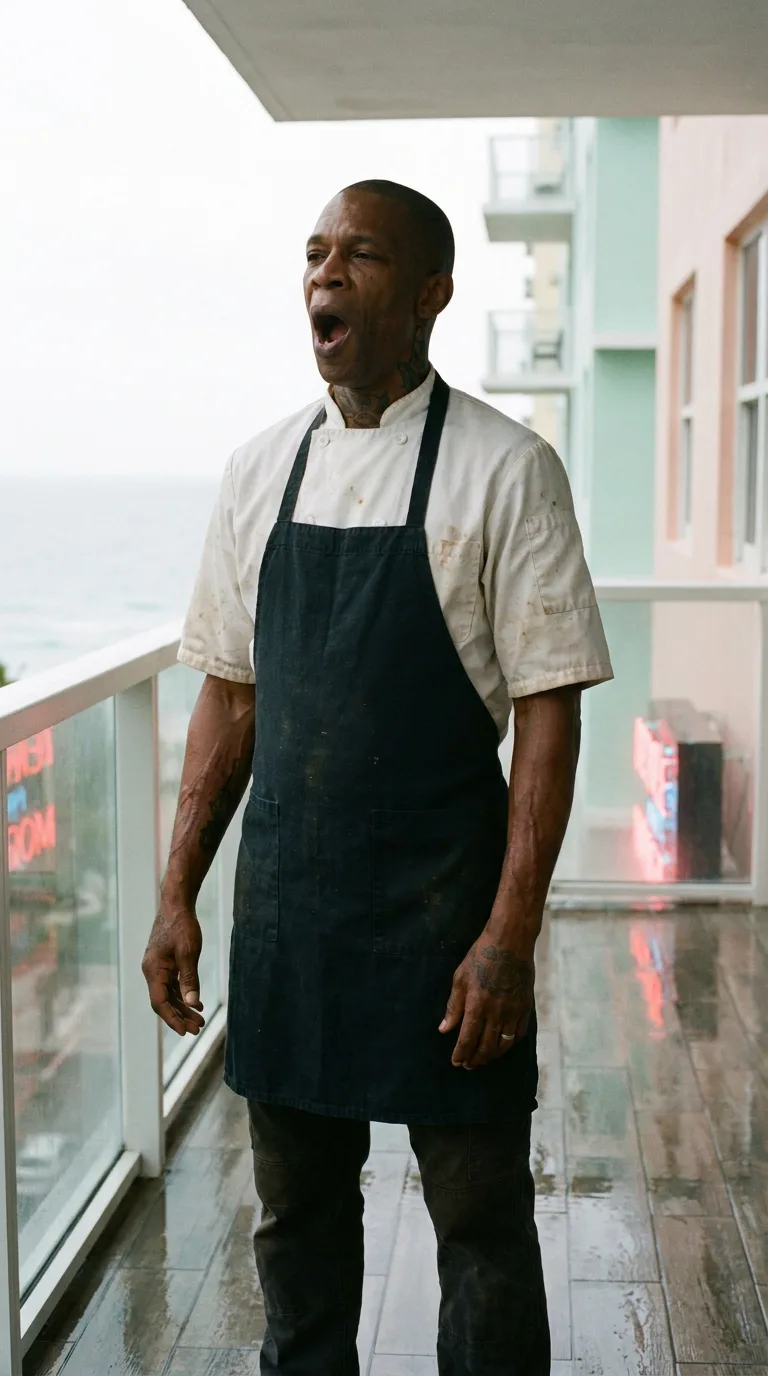
Rarest thing about him: Hand or neck (visible) — epic, 1 in 65
Legacyseed 1913771879 · engine v8
Character card
His body-swap story
---
You had the room off the kitchen for fourteen months. Nine hundred a month, no lease, and he never once asked you for it late.
That was the thing about Calvin. Everyone who ever lived with him says it the same way, like an apology: *he was easy.* Up before the sun, gone before you'd finished the coffee he'd already made too much of. He left the pot full because he assumed you'd want some. He never assumed anything else about you at all.
Fourteen months of sharing a bathroom, a fridge with a masking-tape line down the middle of the middle shelf, a wall thin enough that you could hear him on the phone at eleven at night saying *tell her I said pray about it, baby, and tell her I'll call Sunday.* Two kids grown and gone, a wife in the other bedroom who worked nights at a surgical center and slept the hours he was awake, so that the two of them passed each other in the hallway like shift change, and she'd put her hand flat on his chest for a second on the way by, and he'd cover it with his, and that was the whole conversation.
You never once put a hand on anybody's chest and had them cover it.
That is not why you did it. You want that clear, even to yourself. You did it because you could, because the way in was never anything you understood, only a pressure you learned to lean on, the way you learn a loose stair. Nobody knows how it works. Not the ones who do it. Certainly not the ones it's done to.
But you'd be lying if you said you picked at random.
You knew his hands before you knew his face. The tattoos on them — the old traditional stuff, a swallow gone green, bold black outlines that had spread a little the way ink does over thirty years — and up the neck the same, faded color under the collar of a whites jacket he never buttoned all the way. Sailor ink on a man who'd never been to sea; he told you once his uncle did them in a Liberty City living room in 1989 and charged him in ribs. And the wedding band. Plain. Worn so thin at the bottom of the circle you could see where forty hours a week of pan handles had eaten it.
You knew his pen, too. Order pad in the apron pocket, and when he wasn't writing on it he was clicking it. *Click. Click.* At the table, on the balcony, through the wall while he watched the game. It drove you crazy for a month and then it was the sound of the apartment, and then you were listening for it, and then you were doing it yourself with your own bad hands.
Fifty-four years old, six feet, built like a man who has carried things every day since he was nineteen. Buzzed to the scalp because at some point he stopped negotiating with it. He didn't drink anymore — hadn't in years, not dramatically, just less and less until it was nothing, and he'd hold a Coke at a party the way other men hold a beer, no speech about it. He didn't smoke anymore either, though he'd stand out on that balcony at exactly the time he used to, hands empty, breathing the ocean like it was owed to him. There was an orange bottle in the cabinet with his name on it and the little sticker about not skipping doses, and he didn't skip them, and he wasn't ashamed of them, and once when you were bad he said *there's no medal for white-knuckling it, man,* and went back to chopping.
He had money. More than you'd have guessed from the apron. Twenty-nine years on a line will do it if you never do anything stupid, and he never did anything stupid. He had a broker and a folder and a plan and two kids through school with no debt on either of them, and he ate rice and beans on Tuesdays out of preference.
He had all of it. That's the sentence you kept getting stuck on, in the room off the kitchen, at three in the morning, with the wall between you: *he has all of it and he isn't even holding on tight.*
---
It's a Tuesday. The rain came through at four and quit and left the tile out there shining, and the neon from the place across the street is still going because nobody switches it off till seven, red bleeding out across the wet floor. He's got service at ten and he's up at six anyway, whites already on, apron already tied, because there is no version of him that gets dressed twice.
He goes out to look at the water. He does this every day. Ocean haze, pink building, mint building, the whole pastel sherbet of it, and Calvin Prioleau standing there with nothing in his hands and nothing behind him but the mirror in the hall, the one his wife hung crooked and he never straightened because she liked it that way.
And he yawns.
Big. Jaw all the way down, the way a man yawns when he thinks no one is looking and nobody is asking anything of him yet. You can see it in his neck, the ink stretching, the tendons. It's the most unguarded he ever is, that yawn, and you'd watched it happen a hundred mornings through a doorway with a coffee cup you didn't pay for.
You lean on the loose stair.
He finishes the yawn. Truly finishes it — the jaw comes up, the eyes water, and he brings his hand to one eye and rubs it with the heel of his palm, that green swallow going over his cheekbone, the thin band catching the neon.
And the hand stops there.
Raised, covering half his face, and behind it a full second where nothing in the world happens except the ocean. His shoulders don't move. His breath goes out and doesn't come back on schedule.
Then his head goes back like something struck it from underneath, and the mouth that was yawning is open again and it isn't a yawn anymore, and there is light coming out of him — out of the eyes, out of the open mouth, a hard white spill of it that throws his shadow up onto the pink stucco and lights the wet tile like a flashbulb held too long. A second. Maybe less. It goes out the way a filament goes out, all at once and then orange at the edges of nothing.
He sags. The whole athletic frame of him just — hangs, from the shoulders, the way meat hangs, and the raised hand comes down.
And I'm in.
---
First: weight. God, the *weight* of him. Nobody tells you. You come in expecting a room and you get a building — the mass of the chest, the long bones, the ache in the right knee that has clearly been there for a decade and that he has clearly decided not to mention to anyone. The hands are enormous. They're hot. There's a burn scar across two fingers so old it's just texture now, and a callus ridge where the knife lives.
Second: the hum. Something low and level under everything, chemical, a floor beneath the floor. That's the orange bottle doing its work at six in the morning in a body that has been taking it faithfully for years. It is the quietest inside of anyone I have ever been. I expected to find him screaming in here. Instead there's this — a man who built himself a room with the noise turned down and then went to work every day to pay for it.
Third: the pen. The right hand is already going for the apron pocket. I didn't send it. It's in there before I know it's moving, thumb finding the plunger, and it clicks once — *click* — and the sound is the sound through the wall at eleven at night, and something in me that has no body to put it in goes over sideways.
I turn around.
Nothing behind him but the mirror, the facts said, and the facts are right; there's the hall through the sliding door, and there she is, crooked, and there he is in her. Fifty-four. Buzzed to the scalp, brown eyes, the ink coming up the neck out of the collar like ivy. My face now. It doesn't look like anything happened. That's the part nobody warns you about either. You expect the glass to show you a stranger wearing a man; it shows you the man, exactly the man, standing there with his hand half up and his mouth a little open, and the only difference in all the world is one you cannot photograph.
The pen clicks again. I let it.
Down the hall the bedroom door is shut and behind it she's four hours into her sleep and will get up at two and put her hand flat on this chest on her way to the kitchen. She'll do it tomorrow too. She'll do it for years, and I will cover it with this hand, and she will never know, and that is the whole price and I already paid it.
There's a phone on the counter with a ten o'clock alarm and two kids in it whose names I know because I heard them through a wall. There's a folder in a drawer with a plan in it. There's a line at a restaurant on Alton Road with a lowboy that sticks and a saucier who'll say *morning, Cal* at 9:52 and I'll say it back and I'll know how to break down a case of chicken because these hands know it even if I don't, and that is the only mercy in any of this: he did the work, and the work stayed.
Fourteen months he left the pot full for me.
I go inside and pour a cup. There's nobody to leave the rest for.