Calvin Maurice Denton
Fictional. Generated by AI — not a real person, and no likeness of one is intended.
29, nurse in San Francisco · rolled by @gustavo.armendariz · card — no film
History
who has worn him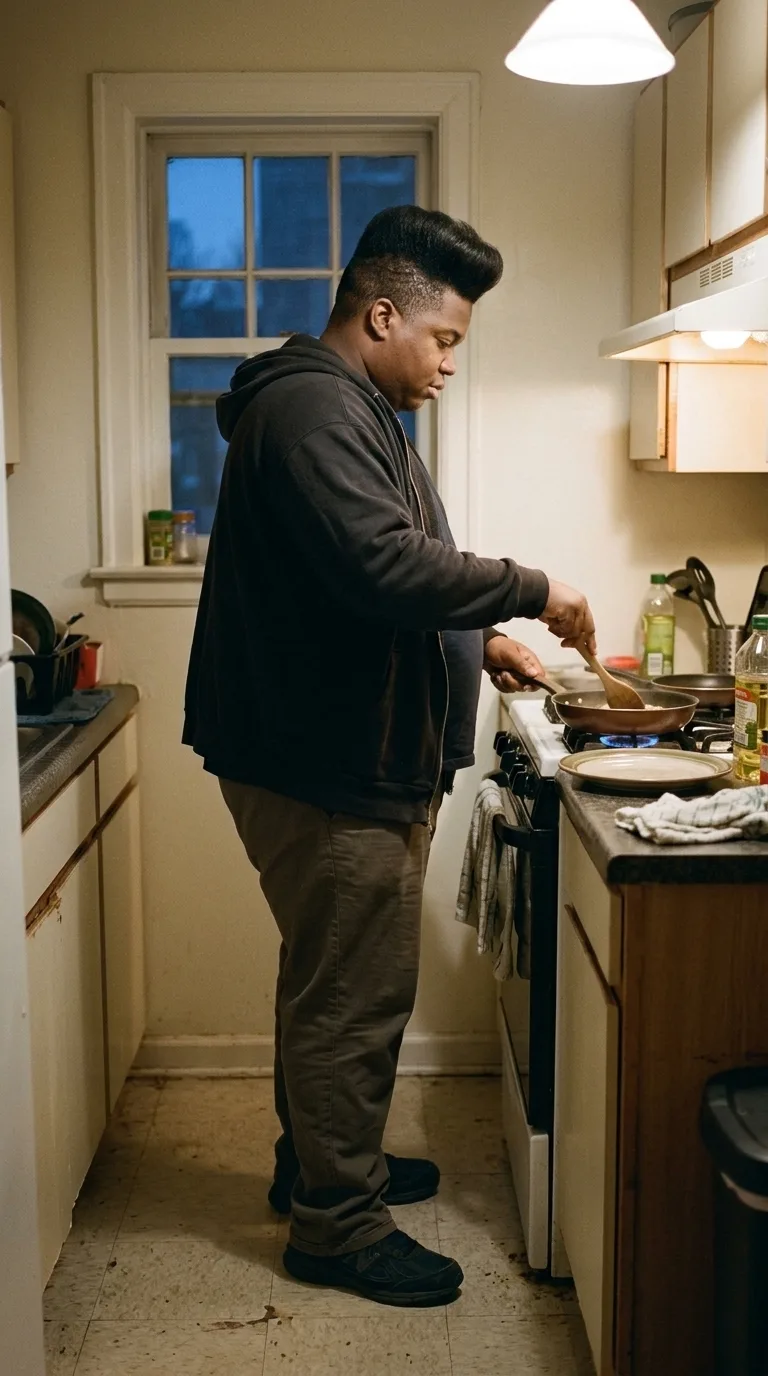
Rarest thing about him: It's a problem and it shows — common, 1 in 37
Face-off rating 1499 · not ranked yet
Season 1seed 127295124 · engine v11
Character card
lineage 4MPHJL
His body-swap story
@gustavo.armendariz, wearing Raymond Shu-Wen Liang, rolled the wheel on and woke up as Calvin Maurice Denton
You are standing in a bathroom in Queens with a dead man's deck of cards in your back pocket, except he isn't dead. He's Raymond Liang, forty-seven, five-five, and he has been yours for a day and seven hours. His knees click on the stairs. The beauty mark is his and the face around it is his, and when you pass the mirror the face does a small, tired trick: it looks like someone who expects applause.
You wake him at eleven-fifty with the phone in your hand and the site already open. The trouble is not Raymond. The trouble is the silent act. Tonight you stood in his practice room, he had a dove and a silk and a coin, and the hands knew everything. Your own wanting did not. Under the table the coin walked across his knuckles without you, and you watched it walk and felt nothing at all. Anything that works without you is a kind of furniture. So you pay, and the wheel turns, and the click of it sounds like a coin landing.
Then the stirring stops mid-circle.
A wooden spoon is in your right hand, and the pan under it is going gold at the edges. The burner ticks blue. You turn the spoon the other way because the first way felt wrong, and the body agrees with you. It is big and warm and sure of its weight, with a long back and a pompadour you can feel as height, as air above your forehead. Your feet are flat on cold vinyl tile. You reach for the salt and shake it in without tasting, and your hand does it as if it had a thousand times.
The hoodie comes first. The cuff is frayed soft against your wrist, and the cotton remembers a morning: a closet door that sticks, a hand pushing hangers, and then not this one, the scrubs. He'd come off a shift, the navy still creased at the hip, and he pulled the hoodie over it because the apartment is always cold. A feeling comes with it, thin and gray: a day that went wrong with a patient whose name is gone. The feeling wants a drink. It wants one specifically, with a little shame folded around it, and your mouth goes dry on his behalf.
The spoon handle is worn smooth on one side. It gives you his mother's kitchen, a church-basement Sunday, a spoon in a bigger pot, and a woman telling him to stir like he means it. He says "Yes, ma'am" in a voice you can feel in the chest. Nothing in it is yours.
Your shoes are heavy on the soles of your feet. The ache is in the left heel, twelve hours on tile, and in the lower back, a dull rope. The belly rests warm against the counter's edge. His breath is slow and deep. His hands are strong, the palms rough at the base of the fingers, and they know how to find a vein by feel. They find the second plate in the cabinet without you.
You take it down. You set it beside the first, and the click of china on laminate is loud in the little kitchen. Somewhere under the drink and the long days there is a habit of setting a place for someone, a hope or a practice or a grief. You can't tell which, and nothing of his touches that. You stand there with it.
You turn your right hand over under the light. The skin is dark and unmarked, the nails clipped short. You close it and open it, and the whole kitchen smells of onion and hot oil.
"Well," you say, and his voice is low and a little hoarse, "hello."
The pan hisses. You don't know how long he'll hold, or how long before the wanting comes back and the page with the wheel is open again under this thumb.