Calvin Marcell Ridley
Fictional. Generated by AI — not a real person, and no likeness of one is intended.
52, manager (mid-level) in Western Kansas · rolled by @jonathan.landry · card — no film
History
who has worn him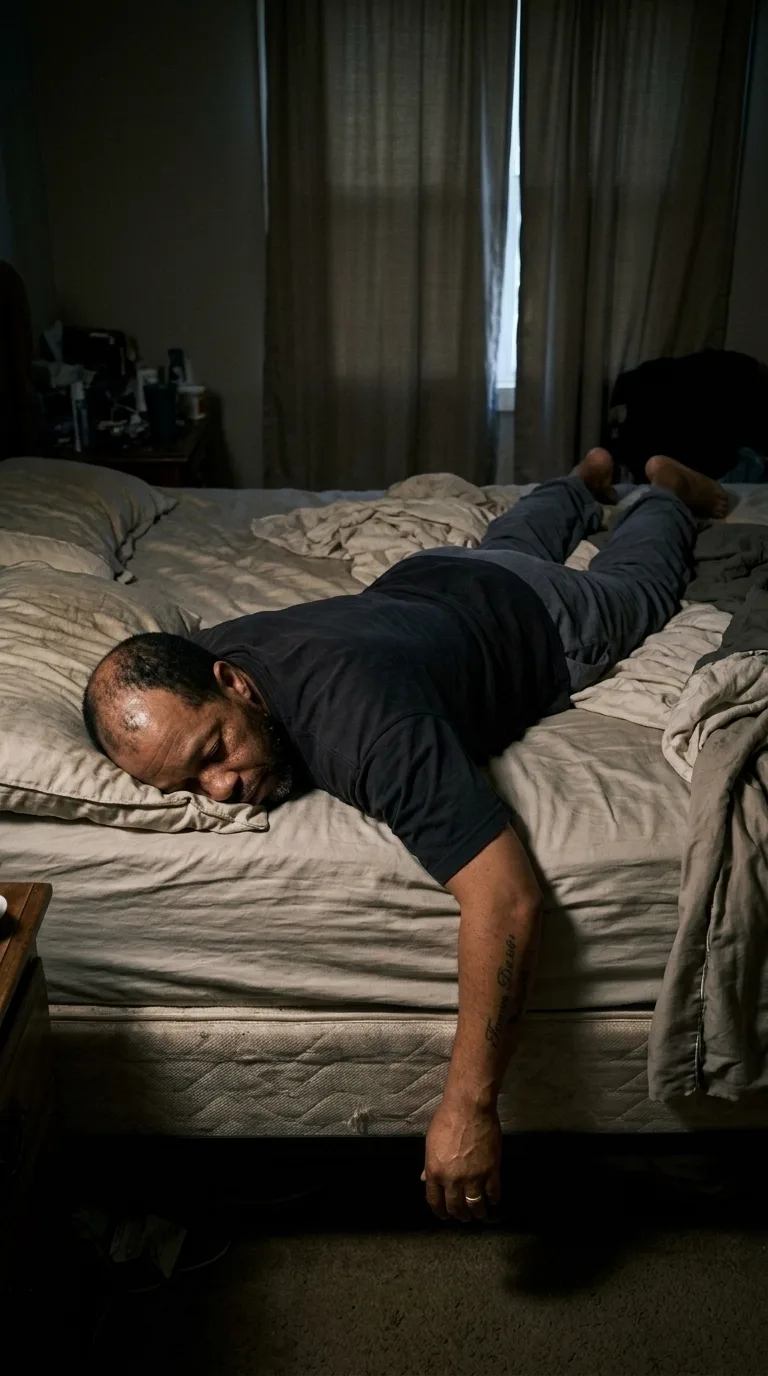
Rarest thing about him: Runs a hand over his scalp — common, 1 in 29
Season 1seed 1299647268 · engine v11
Character card
lineage K4WKNZ
His body-swap story
@jonathan.landry rolled the wheel on and woke up as Calvin Marcell Ridley — their first, spent 5 minutes in him, then spun the wheel and woke up as Darnell Octavius Greer
You have been at the screen since the dark came down, scrolling past things you will not remember. The room around you is nothing. The hour is nothing. What you have always had is the fascination: the films where a man wakes up wearing another man's face, the threads at two in the morning, the old private wish. You never believed the page. A wheel, a button, a price. You press it anyway, because nothing is on.
The wheel spins and slows. It stops on a stranger.
You are face-down. Sheets are bunched under your cheek, and your breath is ragged and wet in the cloth. One arm hangs off the mattress and the blood has gone out of it. Then the breath goes even, all at once, and the arm draws itself up. The body rolls onto its back and your hands fold at your chest. He has never slept like this. The body does not know it.
A thin streetlight comes through a gap in the curtains. It is the middle of the night and the whole town is asleep. He works days, with the door open, so the dark is his and ordinary.
Now the things touch you, and he comes back in pieces.
The shirt first, the soft black cotton on your ribs. It is a shirt he sleeps in, washed thin, and it gives you the morning he bought it: a store off the highway, a hand on the rack, a cheap pleasure at being fifty and still choosing. The sheet under your palms is rough. It is the sheet from the marriage, and it brings the sound of her putting the second pillow in the closet. He did not argue. He folded his own side of the bed and said nothing, and the nothing is still in your chest like a swallowed stone.
Your left thumb finds the ring finger by itself. The skin there is bare, and under it is a pale band that the sun never reached. The thumb rubs the place where the metal used to be. You learn what his hand does when he is not thinking: it goes up and runs over the scalp, over the short hair thinning at the crown, the skin warm and smooth. He does it in meetings. He does it when a number will not come out right.
The inside of the forearm is under your other hand. You feel the script without seeing it, raised a little from the skin. A name and a date. It is his daughter, the day she came. The memory is not an image. It is a weight, seven pounds in the crook of this arm, and his fear that he would drop her, and his certainty that he never would. Under that, further down, is another woman. An old girlfriend, years before any of it. He thinks of her on some nights and then prays about it, because he is a church man, and the praying is real even when the thinking comes back. The mattress under your back is hard with a spring gone. You know it has been gone a year, and that he keeps meaning to fix it.
Your feet are bare and cold at the ends. The body is short, compact and sturdy, and it is tired in a settled way. There is an ache low in the back from the desk chair, and a stiffness in the right knee. Your jaw is rough with the short beard, and your tongue finds the taste of whiskey from a drink or two last night, and under it, faint and old, a cigarette he quit and still wants. Freckles you cannot feel sit across the nose. They have been there all his life, and a child once counted them.
Then the office, all at once, through the smell of the room: glass walls, a door he leaves open, a badge on a reel at his hip. He is the one who stays late and covers the shift for the young ones. He has been passed over twice and has said nothing both times. In the end the nothing is what he is made of, and he does not know it. A little money is put away, and he checks the number sometimes the way other men touch a pocket. Outside this window, past the glass and the dark, the flat country goes on for miles, the stubble cut short, and the storms come in yellow and stack up black.
You lift your hands into the streetlight. They are broad across the knuckle, a little dry, and the wedding finger is bare. You turn them over. They are yours now and they are not. You wait for someone to come and say otherwise. No one comes.
"Hello, Calvin," you say. The voice is low and unhurried, and it is not yours either.
It holds. Under it the wanting is already stirring, small and patient, and you wonder how long this one lasts. You do not know whether you will be him by morning, or in four minutes, or whether the page is already open somewhere, waiting for you to press.