Caleb Thibodeaux
Fictional. Generated by AI — not a real person, and no likeness of one is intended.
18, furniture mover in New Orleans · rolled by @connor.waskiewicz · card — no film
History
who has worn him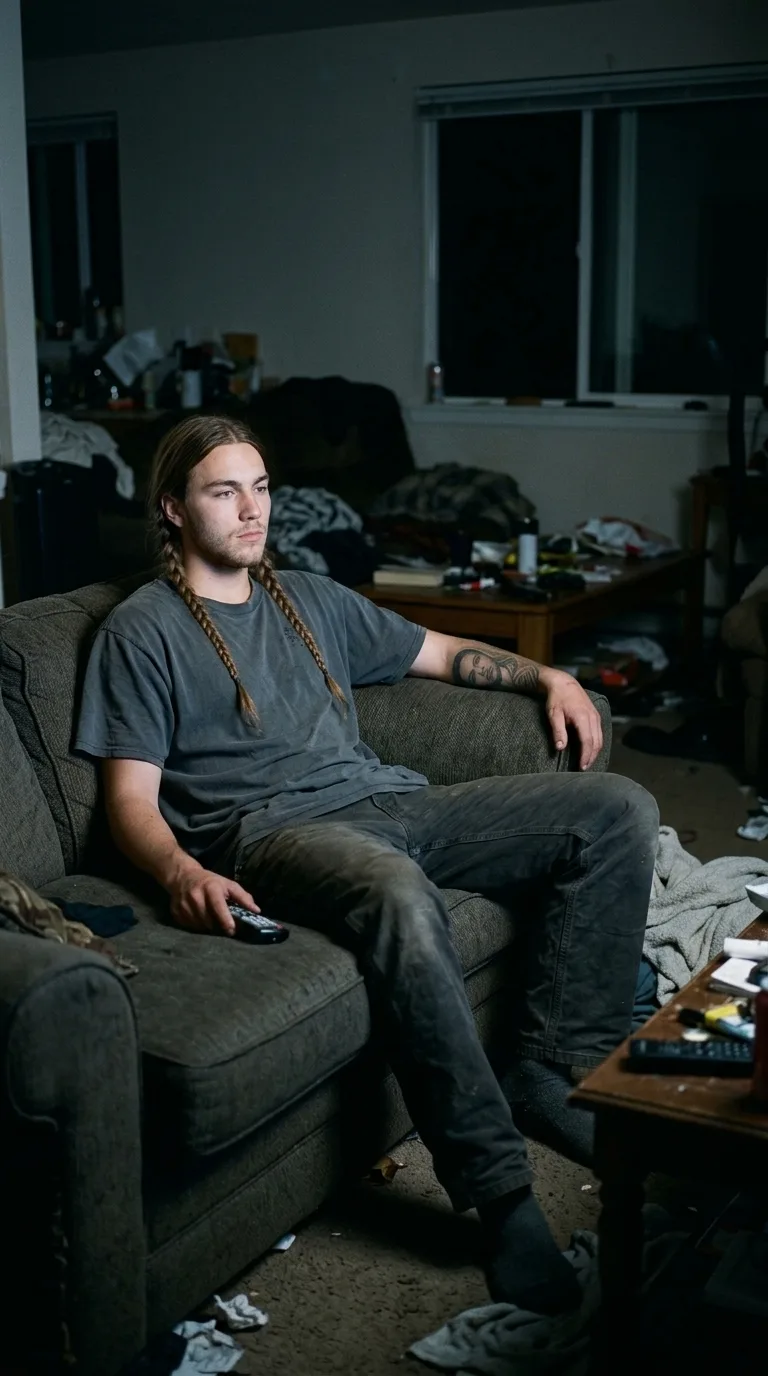
Rarest thing about him: Two long braids — epic, 1 in 709
Season 1seed 1031020669 · engine v11
Character card
lineage 2NZHHJ
His body-swap story
@connor.waskiewicz, wearing Ernesto Maldonado, rolled the wheel on and woke up as Caleb Thibodeaux, spent 1 minute in him, then spun the wheel and woke up as Dennis Hoang
You are standing in a kitchen in Small-town Ohio, at the sink, in the middle of the night. The refrigerator hums. Forty-three years old, the stubble on your scalp, the soft weight over your belt. You have been this man for less than a minute and already you know what's wrong with him. He is a body that is in the right place. It has a house and a job with a desk, and nothing in any of it makes you want to stay awake. Upstairs a woman you don't know is asleep in a bed you haven't seen. You find you cannot make yourself walk up the stairs to look at her. That is the whole reason, and you don't say it aloud. You dry his hands on his shirt and open the page. The wheel is already turning when you press.
The couch takes you before the room does. Cushions sag around your hips, and the television throws blue light that moves across your face. The remote lies loose in your right hand. The show cuts to a bright frame and you sit up straight. You set the remote on the arm of the couch. The room is dark, and dishes and laundry lie scattered across the coffee table and the carpet.
His body is long. Six foot four is a different country from five eleven; your knees are higher than they should be, and your feet in their socks find carpet farther away than you expect. His back is eighteen years old and has no complaints, though his shoulders ache in the deep, honest way of a man who carries things for money. A toothpick is between his teeth. You didn't put it there. Your tongue moves it to the corner of your mouth.
The shirt is soft gray cotton, washed thin, and it is against your back. Memory arrives through it. It is morning in a narrow house, the light coming sideways down a hall one room wide. He pulls the shirt off the floor, sniffs it, and decides it will do. Then the jeans, stiff with grime, one leg at a time, the belt through loops he never looks at. Then the boots by the door. He is whistling something low. A woman's voice calls from the bedroom, "Don't forget the lunch," and his chest goes warm in a way that is his and not yours.
Your left hand finds the braid over your shoulder and the hair is rough and tight. Another flash comes. His grandmother's kitchen, her fingers quick and certain, braiding it when he was small and wouldn't sit still. He sat still. He remembers the smell of cedar smoke and coffee, and that she hummed as she worked, and that he was proud.
Your right forearm lies along the couch arm, and there is something on it, a face in black and gray ink that goes from the elbow to the wrist. You press your thumb into it and the sensation rises: the buzz of a needle, a stranger's patient breath, a man's face he wanted to carry with him. You can't place who that man was, only the feeling that it mattered and he never told anyone why.
Under your feet the carpet gives off damp warmth, and with it comes a day on a truck. A couch stood on end at the curb, his shoulder under it, a partner on the other end counting down, three, two, and the lift. Steam rose off the wet street. Sweat ran into his eyes, and he felt the plain pleasure of a heavy thing being carried correctly. He has money put away. He doesn't spend it, and he is saving it for something he hasn't named.
On the screen, someone tells a joke, and you don't laugh where he would have.
You lift your hands into the blue light and turn them over. They are big and chapped, with the toothpick-chewing, strap-pulling habits already built into the fingers. They are not yours, and they are warm, and they close when you ask them to.
"Okay," you say, in a voice lower than any you've had. "Okay. You'll do."
Somewhere behind the words the question starts, quiet as a refrigerator in another house: how long.