Caleb Rourke
Fictional. Generated by AI — not a real person, and no likeness of one is intended.
24, carpenter in Denver · rolled by @owen.prescott · card — no film
History
who has worn him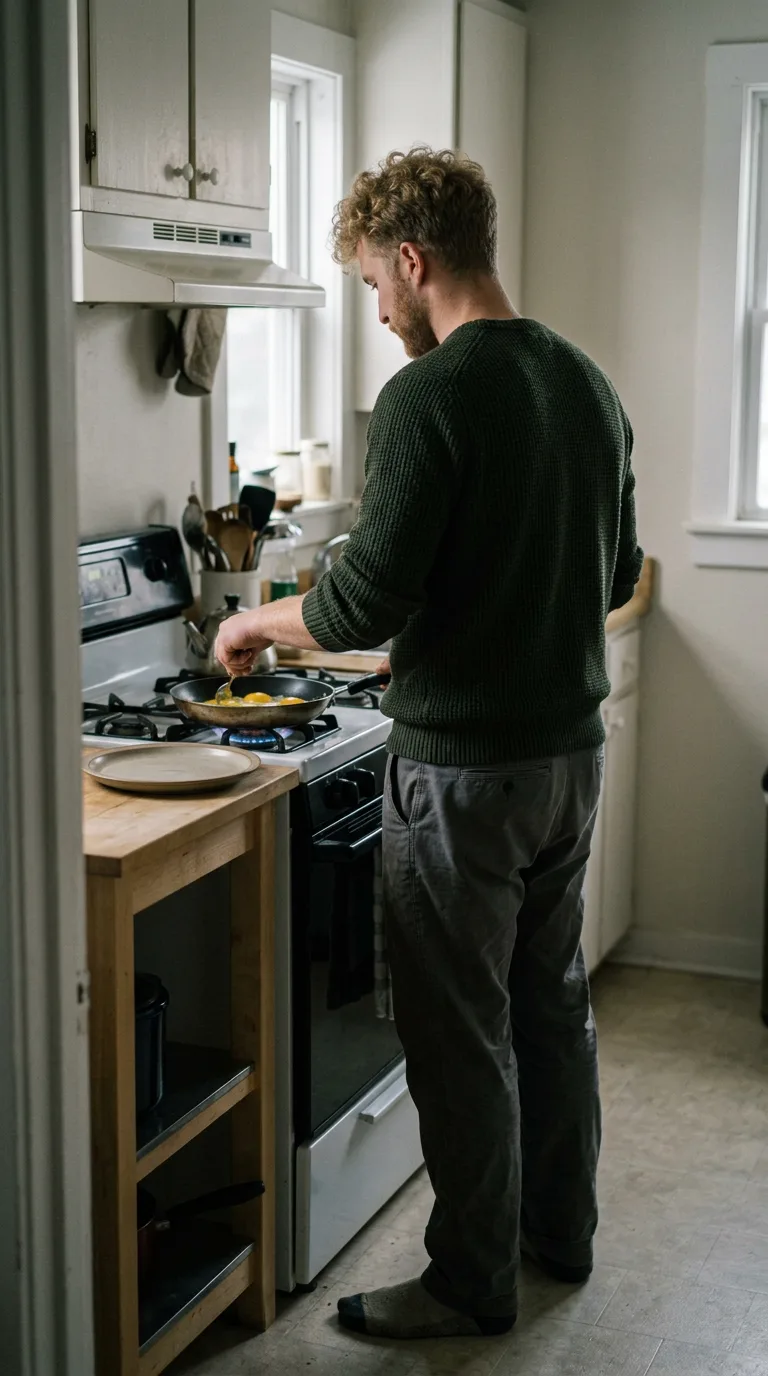
Rarest thing about him: Stutters under pressure — common, 1 in 79
Season 1seed 1050467586 · engine v11
Character card
lineage 5OR92V
His body-swap story
@owen.prescott, wearing Dennis Hollander, rolled the wheel on and woke up as Caleb Rourke, spent under a minute in him, then spun the wheel and woke up as Lonnie Prewitt
You are standing in Dennis Hollander's kitchen in Small-town Ohio, and his knees ache. That is the first thing, and it is the reason. Fifty-nine years of them. You have been him for less than a minute, and already the body is a list of complaints: the nose that whistles on the left, the shoulder that will not lift past an ear, the reading glasses folded in the shirt pocket like a verdict. It all works. Nothing about him is broken enough to excuse what you are about to do.
It is just that it is the middle of a Tuesday morning and the house is so quiet you can hear the refrigerator thinking. He is a man with a pension plan and a mortgage nearly done, and a whole decade of the same chair. You wanted to be inside something that had not already finished. You do not say that to yourself. You say: one more. You say it with his mouth.
The page is already open. The wheel turns, and there is no travel in it.
The spoon is moving in your hand. It is mid-circle, with a sweep of yellow behind it, and the pan is hot under your fingers' attention. You are standing in socks on cold linoleum, on legs that are shorter and lighter than the ones you just left and entirely without complaint. Your own breath comes up easy from low in a wide chest. Gas flame, blue, ticking. Butter, egg, steam on your face.
You reverse the stirring. The spoon does not want to; the wrist wants the old direction, and for a second the two of you disagree in the arm.
Salt. You take a pinch from the dish and let it fall, and some part of you that is not you says you ought to taste, and you do not.
Then the sweater. Green wool, waffle knit, heavy across the shoulders, scratching a little at the wrist where it has been pushed up. It gives you a morning: a dark room, a hand finding this sweater on the chair back because it is the warmest one and the heat in the bungalow is slow. A cold porch beyond the window with the mountains just beginning to separate from the sky. He pulled it on over his head and his hair came up out of the neck of it in curls, and he felt, ridiculously, fine. He felt alone in a way he had arranged, and it was fine.
The spoon handle, smooth with years, not his. It is his mother's, or his mother's kind: a Sunday and a pan of something Catholic and patient, grace said fast so the food would not cool, and a boy of nine or so kicking the table leg. Stirring, she told him, is not mixing. Stirring is paying attention. He has been paying attention to pans ever since, because nobody else in this house ever asked him to.
Your thumb finds a groove in the callus along the first finger and the hands remember a wall: two-by-four, the nail gun's hose coiled at his feet like something asleep, the hiss and the bang, a slab still pale from the pour. He is good at it. Under pressure, though, his hands go wrong, a stutter in the fingers, the nail set a hair off, a measure called twice. Last Thursday a foreman stood behind him and he put the tape down and picked it up again three times. The shame of it is in the palms still, warm and specific. You flex them, and they shake, just slightly, because you are asking.
The floor is cold through the socks. A Friday: beer after the site, a big night, the kind he allows himself once or twice a month, the whole crew loud, a cousin's wedding toast and a mouth that would not work until the third drink, and then it worked beautifully. He misses that fluency. You can feel him missing it in the chest, like a drawer that sticks.
The one plate is on the counter, light on the butcher-block. You take down another and set it beside the first. You have no reason. Your hands decided it, the way his would have, some old habit of making room that nobody ever filled.
You look at your hands. Broad, scuffed, the knuckles pink, a pale ridge of work across each palm. You turn them over. They are warm. Somewhere a pan is still ticking.
You lift your eyes and say, quietly, to the window and whoever is in it, "Well. Hello, Caleb."
Eggs set on the heat. You do not know whether you will taste them, or whether you will be here to.