Brian Kozlowski
Fictional. Generated by AI — not a real person, and no likeness of one is intended.
38, operations manager in Chicago · rolled by @danny.ruiz.combs · card — no film
History
who has worn him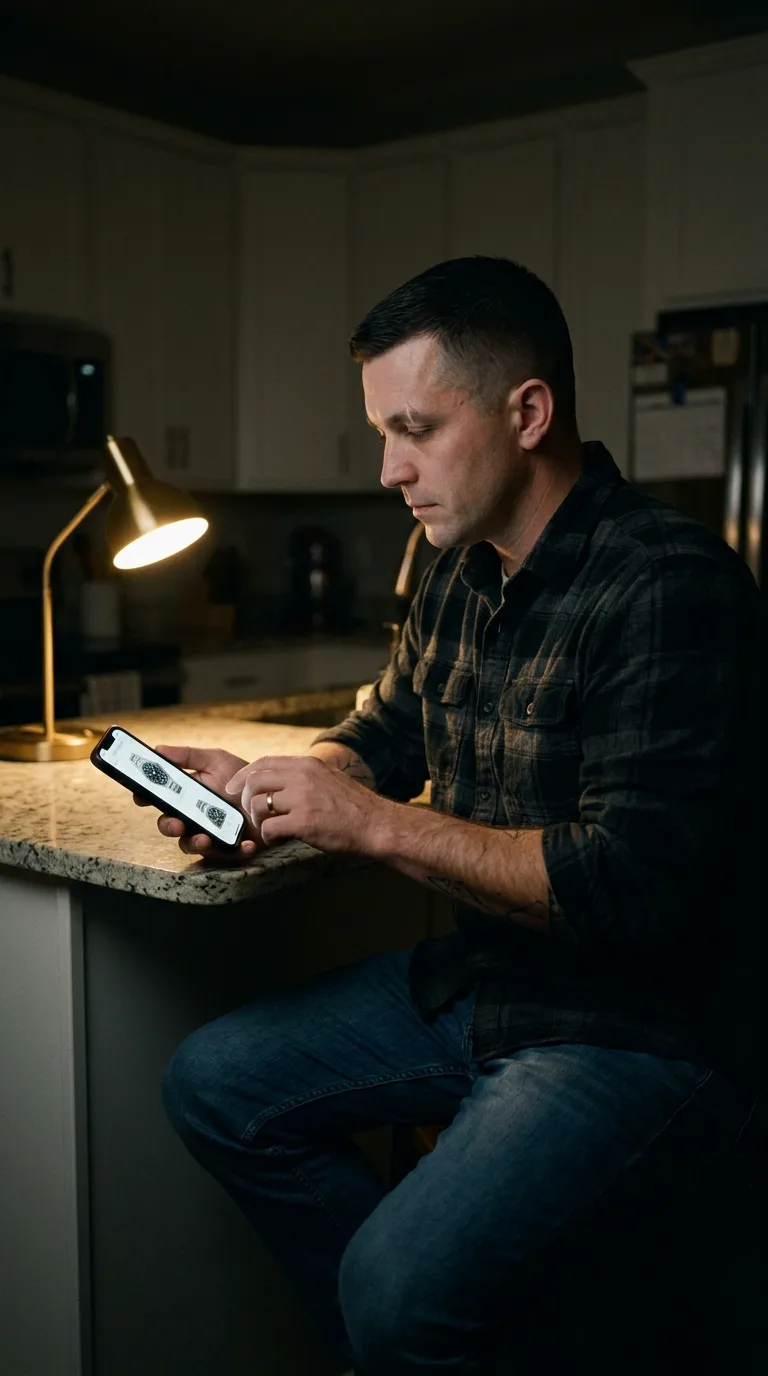
Rarest thing about him: Scrolling a shop he cannot afford — common, 1 in 54
Season 1seed 799024925 · engine v11
Character card
lineage UBMQCL
His body-swap story
@danny.ruiz.combs, wearing Mateo Villaseñor, rolled the wheel on and woke up as Brian Kozlowski, spent 4 minutes in him, then spun the wheel and woke up as Paul Guidry
You are standing in Mateo's kitchen in New Orleans with the window open and the night smelling of wet brick, and you have been him for six minutes. His camera sits on the table, the strap coiled like something asleep. You wanted to be small and quick and quiet in a city that lets you, and you were. The trouble is the lens. Every light you pass, some part of him reaches to frame it. His wanting keeps arriving in your hands, and you are tired of wearing a man who is still halfway himself. So you thumb the page open. The wheel is already turning under your finger, and you do not say goodbye to him.
Then you are sitting down. A granite edge presses your forearm, cold and gritty. A lamp is lit at your left and the kitchen is dark past it. Your thumb has just stopped on a price, and it lifts from the glass and hangs there. The number is more than his rent.
The phone goes face-down on the counter. You did not decide that. His hand did.
Now the things on him begin to talk. Flannel first, soft at the cuffs, rolled twice. Your wrist turns and it is a morning: a bedroom gone gray before the alarm, his wife's back warm and turned away, the shirt pulled off a chair because it was the clean one. He did the buttons in the dark, bottom to top, the way he does at the warehouse. Under the flannel is a worn undershirt, and with it comes a feeling of being unseen at work, of walking a mezzanine above forklifts and hearing numbers go wrong below him, and carrying everyone's mistakes home. His fingers find the ring and turn it. Her name comes up in him like a held breath. A small daughter is asleep down the hall, and the fear for her is plain and enormous: watches, and the rent, and a man who prays at the edge of the bed and does not feel heard. Jeans, heavy and faded, pull at the knee. A stool is under him. He quit cigarettes six years ago, and his mouth still wants one when it is quiet. His palm rises on its own to his scalp and rubs the crew cut flat, and it is the most him thing you have felt.
The scar through his eyebrow tugs when you frown. A swing set, a bleeding brow, his father laughing and carrying him in. And there is a girl from before his wife, some old summer, still a small ache he never mentions.
You turn your forearm up. Fine geometric lines run along the inside of it, thin as a drawn nerve. Under the lamp you turn the hand over and look at it, the ring, the knuckles, the callus from a clipboard edge. It is a good hand. It is not yours.
You lift your eyes to the dark window and find his face in it, and you say, quietly, "Hello, Brian."
The refrigerator hums. You wonder how long before the wanting comes back, and whether you will still be him tomorrow.