Brendan Kubala
Fictional. Generated by AI — not a real person, and no likeness of one is intended.
29, plumber in Pittsburgh · rolled by @colby.marsh · card — no film
History
who has worn him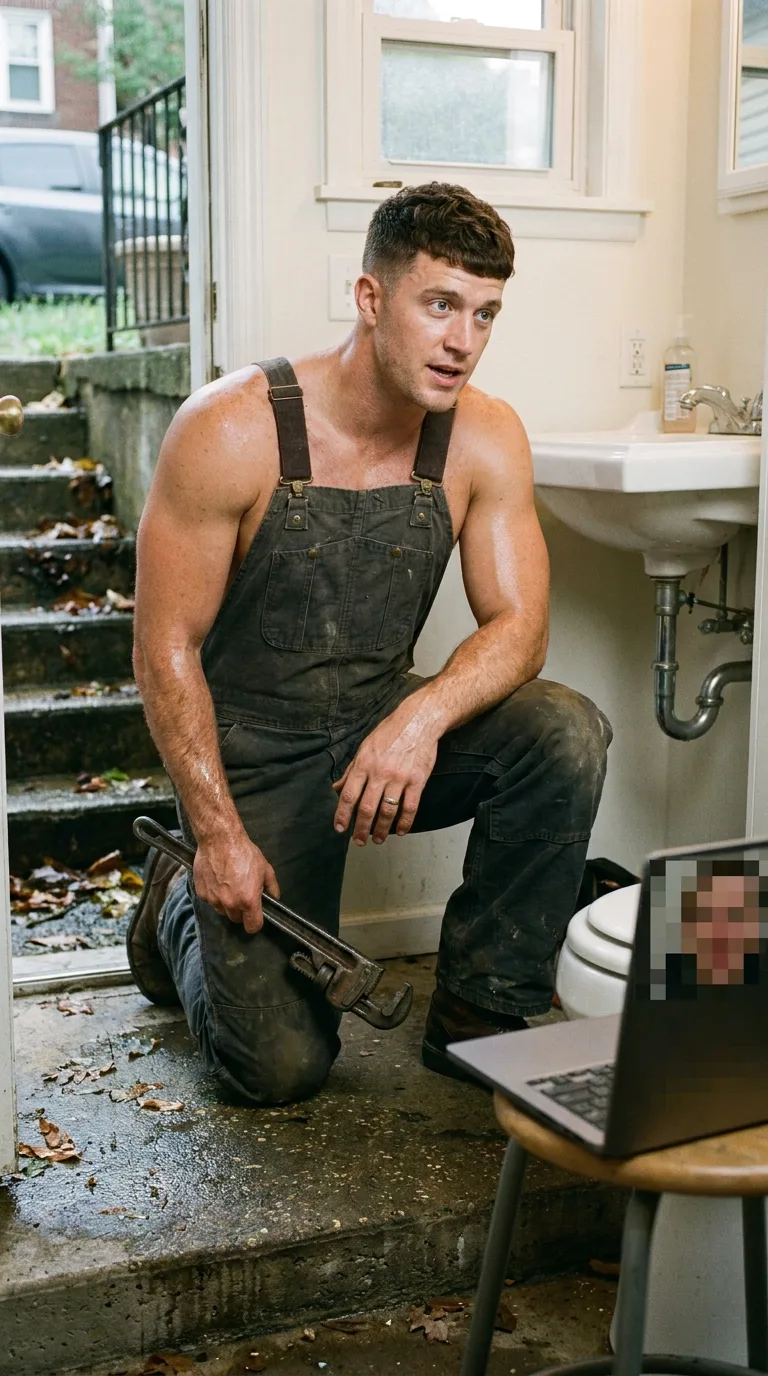
Rarest thing about him: High blood pressure — rare, 1 in 20
Legacyseed 15231800 · engine v6
Character card
His body-swap story
---
You have watched him for two years through glass, and glass has been very good to you.
It started as nothing. A cracked drain line in the building on Hazelwood, the landlord's number, a man in oil-dark overalls in the stairwell with his shoulders wider than the doorframe. He said *ma'am* the first time and never again, because you told him not to, and after that it was your first name in a voice that came up from somewhere under the ribs. He had a way of standing in the doorway with the light behind him. He had a leg that would not stop bouncing while he waited for the sealant to set, heel tapping the concrete, the whole big frame of him idling like a truck at a red light. He was twenty-seven then. He wore the ring even under gloves.
You are not going to pretend it was noble. You called him back for things you could have fixed with a wrench you owned. You learned the sound of his van. You learned that he drinks — not the funny kind, the steady kind, the six-pack-after-a-ten-hour-crawlspace kind, the kind his wife has started counting out loud. You learned he had high blood pressure at twenty-eight because he told you, laughing, in the way men laugh when they've been told to change everything and intend to change nothing. *Doc says I got the arteries of a fifty-year-old. I says, then I earned 'em.*
And you learned the shape of the thing you actually wanted, which was never his hand on your face. It was worse than that and simpler. You wanted to be looked out of instead of looked at. You wanted to know what it is to be six foot three and unafraid of a stranger's basement. To stand up out of a kneel without thinking about it. To be him — not with him.
You did not know that was possible until you found the way through the screen.
---
The last house is in Greenfield, up one of those streets that isn't a street so much as a set of public stairs between backyards, concrete treads slick with wet leaves, the late light coming sideways and orange over the rooftops. He props the bathroom door open with his boot heel because the room smells like old trap water and the outside smells like October. He is on one knee on the tile with the pipe wrench in his fist, the P-trap loosened and dripping into a bucket, the homeowner's laptop set up on a stool because the homeowner is in Cleveland and wants to see the work.
He is not seeing the homeowner. He is seeing you, in the corner of the frame, pixelated to a smear of skin tones — the little tile the software gives you when your connection is bad, when your camera is bad, when you are not entirely there. He squints at it.
"Hey — you still got me? You're all blocked up."
You do have him. You have had him for two years.
The call freezes. Not the whole picture, just the front of it: his breath stops mid-rise in his own chest, his mouth still open on the *up* of *blocked*, the leaves outside going on falling because the world isn't frozen, only him. On the screen the smear at the frame edge stretches and drains and does not resolve into your face — it resolves into *his*, low-res and blue-lit and mouth open, and then the resolution comes all the way up, and then the laptop screen goes black.
But the light on his face stays.
That is the part you did not plan and cannot explain. The glow that had been on his cheekbones from the screen holds there after the screen dies — one steady wash of cold blue on a face lit from nothing, three, four seconds, while everything that was Brendan Kubala goes out like a pilot light and everything you have been carrying pours in through the hole.
You come in behind his eyes at floor level, kneeling, and the first thing is *weight*. God, the weight of him. A hundred and some pounds more of it than you have ever moved through a room. The knee on the tile is bone-on-porcelain and it hurts and you love that it hurts. The blood is loud. It goes past your ears like traffic — that is the pressure, you realize, that is the thing he carries, and you feel his heart shoving it uphill with the enthusiasm of a man who has never once been kind to himself. There is a want in the throat that has nothing to do with you and everything to do with a bottle in the van's footwell, and it arrives fully formed, like a phone number you didn't know you'd memorized.
The wrench is still in your hand. Twenty-two inches of pitted steel, and it's *nothing*, it hangs off the end of this arm the way a pen hangs off yours.
You breathe. The chest goes out and out and out and you think: this is how much air he gets. This is how much air he always got.
You look down. The left hand is open on the thigh, dirt in the knuckle creases, and there is the band, plain, worn thin on the underside where the tools ride against it. Her name is Kayla. You know that the way you now know everything — not as memory, you were promised nothing but the body, but the body has habits and the habits have shapes. The ring is a habit. The thumb goes to it without asking you and turns it a quarter and stops.
You turn the hand over. Palm up. The calluses are yellow ridges. There is a nick on the pad below the thumb from a copper burr last Tuesday, and it is *yours* now, and it will heal on your watch, and there is no watch after this one. No term. No way back. Wherever he went, the road out closed behind you both, and the enormity of it sits in his chest next to the racing blood and does not slow you down at all.
Under the sink, the trap is still dripping into the bucket.
You reach up with a hand that knows the reach, and you set the wrench to the fitting, and you tighten it — not because you know how but because the shoulder knows how, because the wrist knows the quarter-turn past snug where the joint stops weeping. It's beautiful. It's the most beautiful thing you've ever done and you didn't do it.
You get up. You get up the way he gets up: no hand on the counter, no grunt, just the big machine of him unfolding to full height, and your head goes near the doorframe and you learn the ceiling as a thing that exists.
The laptop is black and silent. You leave it. Cleveland will call back and get nothing, and you will send an invoice tonight from his phone, because you know his rate, because you have paid it.
The leg starts bouncing while you stand there. Heel tapping the wet concrete of the top step. You didn't tell it to. You never do — it's his, it's the last stray current of a man who could not sit still, and it will go on doing that in doctors' waiting rooms and in his kitchen and in bed beside his wife for the rest of a life that is now yours to spend.
You let it bounce. You liked it. That was the whole point.
Out past the doorframe, the public stairs go down between the backyards in a wet orange stripe of leaves and low sun, and somewhere at the bottom is a van with his name on the door and a bottle under the seat, and you are going to have to decide, before the light goes, how much of him you're going to keep.