Bilal Haddou
Fictional. Generated by AI — not a real person, and no likeness of one is intended.
26, civil engineer in Rural Texas · rolled by @connor.waskiewicz · card — no film
History
who has worn him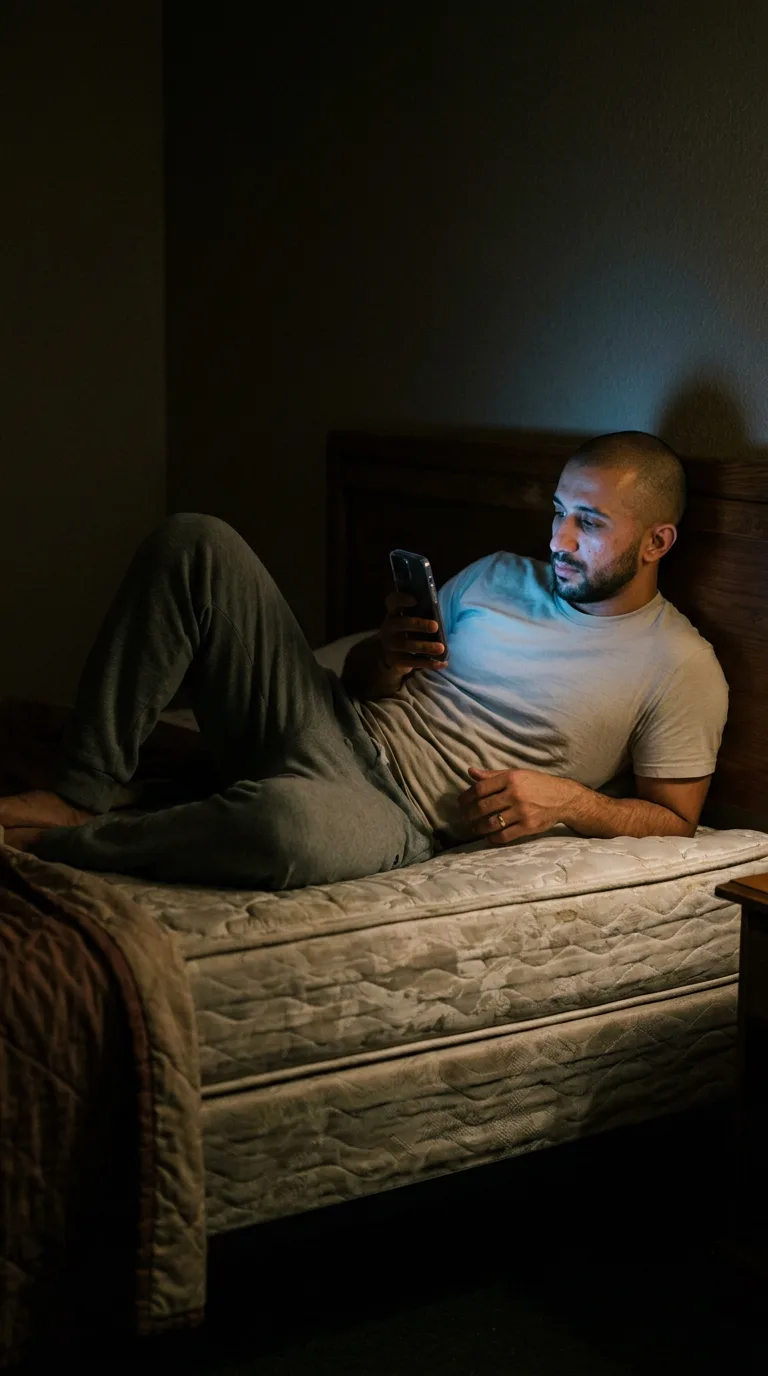
Rarest thing about him: An ancestral tradition — rare, 1 in 169
Season 1seed 1816816104 · engine v11
Character card
lineage 2NZHHJ
His body-swap story
@connor.waskiewicz, wearing Greg Vandermeer, rolled the wheel on and woke up as Bilal Haddou, spent under a minute in him, then spun the wheel and woke up as Wayne Teague
You are standing in a kitchen in Los Angeles, close to midnight, in a dead man's habit of standing: weight on the left heel, because Greg Vandermeer's right knee has opinions. The scar through his eyebrow itches when you frown. You have been him for less than a minute and already you have found everything he cannot do. He cannot sit still in a quiet room. He hums, low, a truck-route tune, and it is in your chest like a second pulse. His refrigerator holds mustard and one beer. His hands are enormous and slow, and they would be good at lifting things and bad at everything you want.
You came back because of the hum. Nobody should have to hear that much of a stranger, and no one else is in here to hear it. So you do not decide so much as notice that the phone is already in your palm, the page already open, the wheel already turning.
It stops, and you are lying on your side in the dark.
Blue light on your cheek. A phone six inches from your face, a thumb stopped mid-scroll, and the breath in your nose is slow and smoky, a pack-a-day breath, the lungs a little tight at the top. The mattress is thin and sags toward the middle. Somewhere in the house a refrigerator ticks. Everyone is asleep, and you can feel it the way you feel weather.
Your thumb starts again. It is faster than his was, and it flicks past everything he had stopped on.
Then the touching starts. The phone case is rubber and worn at one corner, and his thumb has worn it there: a thousand nights of this, scrolling because lying down means the numbers come. The numbers come. A figure, then a bigger one, a loan, a truck, a roof, a hospital bill with a stamp on it. You are deep in the hole, and it sits on his sternum every night, and the phone is how he keeps from looking at it. Not a thing he told anyone.
The T-shirt, soft and washed thin, lies against your back, and his hands know the morning he pulled it over his head, years ago, in a hurry, a small girl hanging on his leg, her fist in the hem. Three of them now. The oldest one's cough through the wall. The shirt is the one his wife says is finished, and he keeps it anyway.
The ring on your left hand is warm and a little loose. A flash: his wife's hands in his hair, her laugh at something he said badly in a language he does not use at work, and his mother's voice on a Friday, the prayers he mouths and half believes and would not give up for any sum. Under that, the bridge: the cold bite of rebar tie wire, a deck of steel mats in a pale Texas dawn, a water tower at the horizon, and the pride of being the man who checks it is right. The gravel under his boots. The cigarette at six, at ten, at lunch, the one he promised to quit, the lighter in his pocket with her initial scratched on it.
The body underneath is twenty-six and strong, short and dense, quick in the shoulders, with a cough waiting at the bottom of each breath. His scalp is cool where the buzzed hair meets the pillow. He is tired in a way sleep has not touched.
You lift your hand into the blue light and turn it over. Square fingers, a dark ring, a callus at the base of the thumb. They are yours now. You lift your eyes.
"Hello, Bilal," you say, softly, so the house stays asleep.
And under it the same small question as ever: how long, and when does the wanting start, and whether you are still him by morning.