Aslam Rehman
Fictional. Generated by AI — not a real person, and no likeness of one is intended.
59, janitor in Houston · rolled by @aslam.rehman · card — no film
History
who has worn him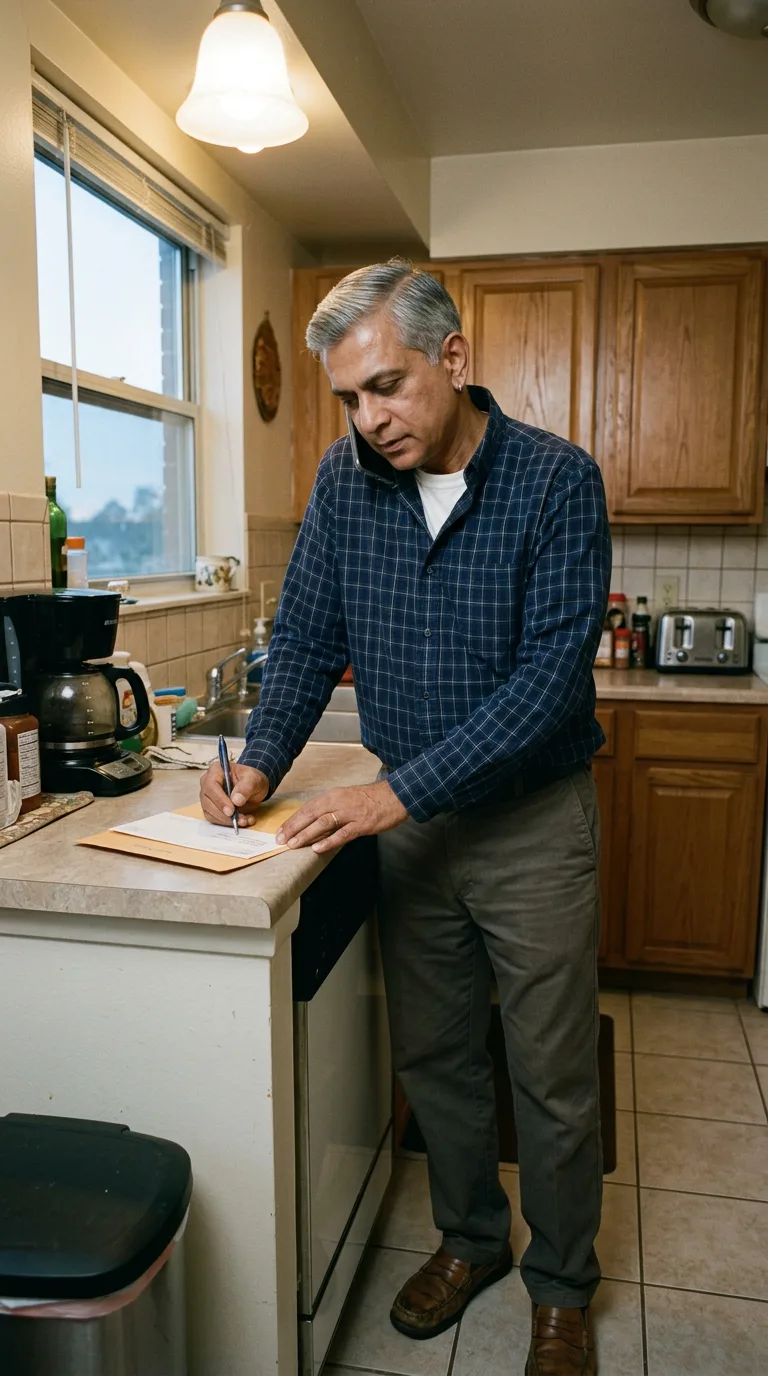
Rarest thing about him: On hold with someone — common, 1 in 70
Season 1seed 696813502 · engine v11
Character card
lineage TLVXT5
His body-swap story
@aslam.rehman rolled the wheel on and woke up as Aslam Rehman — their first
The screen has been open in another tab for an hour, behind whatever you were actually supposed to be doing. Wednesday, late, nothing on. You have wanted this since before you knew what to call it — every story where someone opens their eyes and the hands are wrong, every thread at two in the morning arguing about whether it would feel like anything at all. It was never for sale before. Now there is a wheel, and a button under it that says SPIN, and you have the card ready and the lights off and no one to tell.
You press it before you can talk yourself out of it.
There is no falling, no tunnel, nothing you were braced for. There is a kitchen. Fluorescent light over a stove, a window going gray-blue with a morning that hasn't started. A phone is wedged into the crook of a shoulder that is not a shape you know, and the hold music loops back to its first four notes, tinny and cheap, and a hand — his hand, and then, immediately, unmistakably, yours because there is no one else in it now — drops the phone out of the crook of the neck into the palm, mid-loop, like it was always going to happen exactly then. A pen stops on a two. It does not finish the digit.
You are standing at a kitchen counter you have never seen, and you are fifty-nine years old, and the weight of that settles into the balance of the knees before it settles into anything you'd call thought — a low ache behind both kneecaps, old and familiar to the body though not to you, the specific tiredness of a lot of standing done for a living. The shoulder the phone was on is stiff in a particular well-worn way, like it's been the phone shoulder for thirty years of calls exactly like whatever this one is. Breath comes shallow and a little fast, and underneath that, absurdly, calm — his calm, still leaking out of him into you the way heat leaves a stove after it's off.
The shirt is what opens first. Flannel, checked, sleeves already down to the wrist — and it comes back sleeve by sleeve, not as a memory but as an action, buttoning it this morning, no, not this morning, some morning that feels like every morning: standing in front of a mirror with the light still yellow and cheap overhead, working the buttons one-handed because the other hand is holding a mug, the fabric soft from a hundred washes, a little thin at the elbow. There's a smell in it, cedar and something like the inside of a closet, and with the smell comes the closet itself, the particular hangers, a wife's perfume two feet to the left on her side of it. Farah. The name arrives with no fanfare, just already there, the way your own name used to be.
The pen in the hand brings the envelope, and the envelope brings the reason for the call — an insurance company, a claim on the car that got hit in the school lot, the recorded voice that keeps saying *your call is important to us* like it means it. Irritation, mild and practiced, the specific fatigue of a man who has spent forty minutes today already being told to hold. It has been four days of this. He circles reference numbers the way other men chew gum.
The keys at what would be a belt loop are not there — he's not dressed for work yet, just this, the phone call before the shift, and that absence is its own small memory: the uniform hangs in the hall closet, gray, two shirts because one is always in the wash, and putting it on always comes after this kitchen, after coffee, after the call. Thirty-one years of nights and school corridors. He knows this kitchen with his feet before his eyes — tile gone cool a little where the fridge doesn't quite seal, the give of the floor near the sink where the subfloor's soft. He knows a mop handle the way another man knows a steering wheel: the exact place his palm has worn it smooth, the twist that wrings it out without thinking, the particular silence of a hallway at eleven at night when the kids are long gone and it's just him and the buffer and fluorescent tubes humming down a corridor that smells like pencil shavings and floor wax.
There's an earring — small silver hoop, cool against a fingertip that brushes it without meaning to — and that brings back a version of himself twenty years younger, a decision made in defiance of nobody in particular, a small thing that was his and stayed his. And the ring. Plain gold band, worn thin on the inside from decades, and touching it brings the whole marriage at once, not a scene but a weight: a woman's voice down a hallway, an argument about money that resolved the way it always resolves, a daughter's laugh from some kitchen years before this one. And underneath the marriage, quieter, a name that isn't Farah's — Denise — a long time ago, a summer that ended for reasons that don't matter anymore and still visits sometimes at odd hours, uninvited, like a smell.
He is tired in the specific way of a man who prays before the sun is fully up and then goes and stands under fluorescent light for eight hours and comes home and does it again. Cigar smoke in the memory of a garage, alone, an hour carved out of a week that's otherwise entirely someone else's. No drink in years — that particular hunger went quiet a long time ago and mostly stays quiet.
The hold music loops a third time. Somewhere in this body a small dry pride: he has never once let a corridor stay dirty overnight, not once, not in thirty-one years, and nobody has ever told him that mattered and he has never needed them to.
You look down at the hand holding the phone. Turn it over. The pen is still between two fingers, the ring catching the cheap kitchen light, a life's worth of small calluses along the side of the palm that have nothing to do with you and everything to do with him.
You lift your eyes off the hand, into the middle of the room, holding on nothing.
"Okay," you say, out loud, to no one, to the hold music, to the version of you that used to just read about this. "Okay. Yes. This is — okay."